
Culver City needs more housing. We also need housing that teachers, seniors, young families, service workers, and other working people can actually afford.
But we should be willing to ask a bigger question:
Does creating affordable housing always have to mean concentrating more density into large developments and a limited number of neighborhoods?
I don't believe it does.
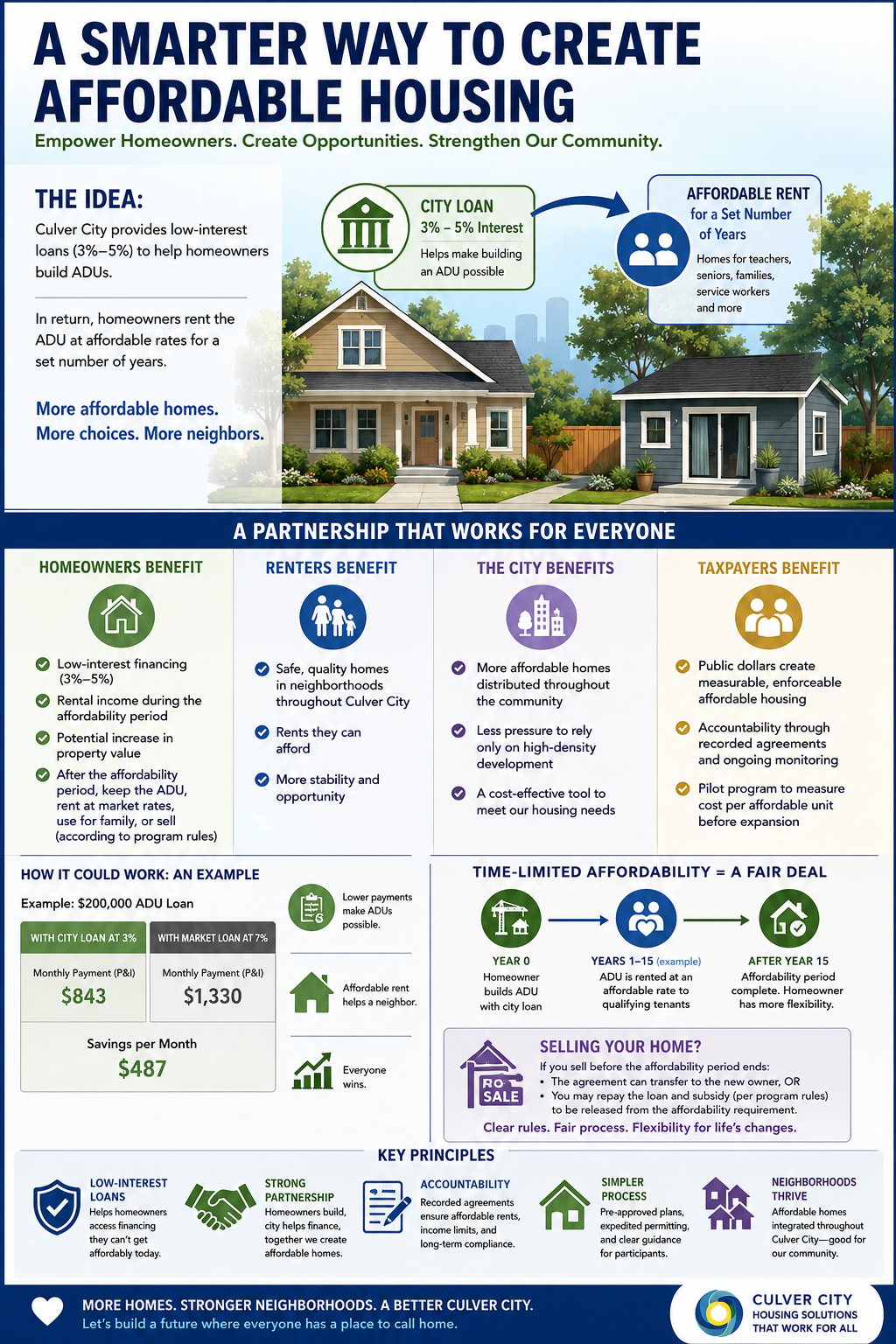
Culver City should explore another approach: help homeowners build accessory dwelling units (ADUs) by providing access to low-interest financing in exchange for renting those units at affordable rates for a defined period of time.
Instead of treating homeowners and affordable-housing advocates as opposing sides of the housing debate, let's give residents an opportunity to become part of the solution.
The ADU Problem Nobody Talks About Enough: Financing
California has made it significantly easier to build ADUs. These can be detached backyard homes, garage conversions, or other independent residential units located on an existing residential property.
But making ADUs legal doesn't necessarily make them affordable to build.
Construction can cost hundreds of thousands of dollars.
Many homeowners may have substantial equity in their properties but don't have $150,000, $200,000, or more sitting in a bank account to finance construction.
And obtaining conventional financing can be difficult.
Banks may not finance the entire project. Homeowners may have to use home-equity products or other forms of financing, and borrowing costs can make the numbers unattractive.
So we have an interesting situation:
Some Culver City homeowners have the land to create additional housing. They may even want to build it. But they cannot obtain financing that makes the project economically feasible.
Why shouldn't we try to solve that problem?
My Proposal: The Culver City Affordable ADU Loan Program
I propose that Culver City explore establishing an Affordable ADU Loan Program.
The basic concept is simple.
Qualifying Culver City homeowners would receive access to below-market financing—potentially targeting something like 3% to 5% interest, depending on what is financially and legally feasible—to help construct a permitted ADU.
In exchange for receiving this financial benefit, the homeowner would agree to rent the ADU at an affordable rate to qualifying tenants for a predetermined period of time.
For example, the affordability commitment might last 10, 15, or 20 years.
The precise interest rate, loan amount, income qualifications, maximum rents, affordability period, repayment requirements, and funding source would have to be established after financial and legal analysis.
But the underlying agreement would be easy to understand:
We help you finance the housing. You help Culver City keep that housing affordable.
Affordable Housing Throughout Culver City
One of the greatest advantages of an ADU strategy is that affordable housing can be distributed throughout the community.
Imagine 100 Culver City homeowners participating.
Instead of one building containing 100 affordable units, we could potentially have 100 smaller affordable homes integrated into neighborhoods throughout the city.
Imagine eventually having 200 or 300 participating homeowners.
Affordable housing becomes part of the fabric of the community rather than something that has to be concentrated primarily in particular developments or corridors.
That could also give Culver City another tool for increasing its housing supply while reducing some of the pressure to rely exclusively on increasingly dense developments.
This does not mean ADUs can replace apartments, multifamily housing, transit-oriented development, or the housing Culver City is required to plan for under California law.
They cannot.
But housing policy doesn't have to consist of a single solution.
Large developments can be one tool.
Traditional affordable housing can be another.
Market-rate housing is another.
Affordable ADUs should be another.
Give Affordable-Housing Supporters an Opportunity to Participate
There is also a philosophical reason I like this approach.
Many Culver City residents strongly support affordable housing.
Let's give them an opportunity to personally help create it.
If you own a home and have enough space for an ADU, the city could help make construction financially possible.
In exchange, you provide an affordable home to another member of the community.
Instead of affordable housing being something residents simply debate at council meetings, homeowners could actually participate in creating it.
If we believe affordable housing is a community responsibility, let's create a program that allows the community to participate.
Homeowners Need a Reason to Say Yes
Affordable housing policy works better when people have an incentive to participate.
A homeowner participating in this program would be accepting a significant responsibility.
They would undertake construction on their property. They would borrow money. They would become a landlord. And, most importantly, they would voluntarily accept restrictions on how much rent they could charge for a defined period.
There should be something meaningful in return.
There would be.
1. Low-Interest Financing
The first benefit would be access to financing that might otherwise be unavailable or prohibitively expensive.
If the city or a public-private financing program could provide an ADU loan at a substantially lower interest rate than conventional financing, the monthly cost of building the ADU could become considerably more manageable.
That could turn an impossible project into a possible one.
2. Rental Income
Affordable doesn't mean free.
The homeowner would still collect rent.
That rental income could help make the loan payments, offset property expenses, supplement retirement income, or provide another source of household income.
The objective should be to create a financial structure where the rent is affordable to the tenant while the project still makes economic sense for the homeowner.
3. A Potential Increase in Property Value
The homeowner would also be investing the borrowed money into their own property.
A permitted ADU adds another legal residential unit to a property and creates the potential for additional rental income. Depending on the property, construction cost, location, market conditions, and other factors, that additional housing unit may increase the property's market value.
We shouldn't promise homeowners that an ADU will increase their property value by a particular amount. Markets don't work that way.
But there is an important difference between simply receiving a government subsidy and using subsidized financing to construct a permanent improvement on your own property.
The homeowner is creating affordable housing for the community while simultaneously investing in their own asset.
4. The Affordable-Housing Restriction Would Have an End Date
I also believe the affordability obligation should have a clearly defined duration.
If a homeowner agrees to provide affordable housing for 10, 15, or 20 years, fulfills that commitment, and repays the loan according to its terms, the homeowner should eventually be released from the program's affordability restriction if that is how the program is structured.
At that point, the homeowner would retain the ADU.
They could potentially rent it at market rates, use it for family members, move into it themselves, or sell the property without the program's affordability restriction.
That creates an important bargain:
Culver City receives years of affordable housing. The homeowner receives a long-term asset.
What If the Homeowner Wants to Sell?
People's circumstances change.
Someone might participate in a 15-year program and need to sell their house after seven years.
The program should anticipate that possibility rather than trapping homeowners in their properties.
There are several ways it could potentially work.
The affordability agreement could transfer to the new owner, meaning the property could be sold but the ADU would remain affordable for the remainder of the original commitment.
Alternatively, the program could establish an early-exit provision allowing the homeowner to repay the outstanding loan and some or all of the financial subsidy received in exchange for releasing the affordability restriction.
The exact mechanism would need legal and financial analysis.
But homeowners should know the rules before entering the program, and those rules should provide a reasonable path for selling a property when life circumstances change.
This Could Be Particularly Valuable for Seniors
Consider a longtime Culver City homeowner who purchased a house decades ago.
The property may now be worth considerably more than what the homeowner originally paid, but that doesn't necessarily mean the person has a high monthly income.
A retired homeowner may be living primarily on Social Security, a pension, retirement savings, or some combination of them.
That homeowner may have enough backyard space for an ADU but no desire to take out an expensive loan at today's market rates.
A low-interest ADU program could change the equation.
The homeowner could build an ADU, provide an affordable home to someone else, and receive monthly rental income.
There are other possibilities as well.
Eventually, the homeowner could move into the smaller ADU and rent the primary residence.
The ADU could later house an adult child, grandchild, caregiver, or other family member.
Housing policy should recognize that people's housing needs change throughout their lives.
But Who Pays for the 3% Loan?
This is an important question—and one government should answer honestly.
If market financing costs significantly more than 3%, the difference doesn't disappear simply because the city wants homeowners to receive cheaper loans.
Someone has to pay for the subsidy.
That could potentially involve existing housing funds, state or federal programs, partnerships with banks or credit unions, revolving loan funds, philanthropic capital, or some combination of funding sources.
Culver City should investigate those possibilities before committing taxpayers to a large program.
And that is why I would start with a pilot program.
Let's find out what this actually costs.
Measure the Cost Per Affordable Home
Suppose Culver City helps finance 20 affordable ADUs as a pilot program.
Then we measure everything.
How much did each ADU cost to build?
How much public subsidy was required?
How long did construction take?
What rents are being charged?
What income levels are being served?
How many homeowners applied?
How many projects actually reached completion?
And most importantly:
How much did taxpayers spend for each affordable housing unit created?
Then compare that number with other affordable-housing strategies.
If an affordable ADU requires significantly less public subsidy per unit than some traditional approaches, we should consider expanding the program.
If it turns out to be more expensive or ineffective, we should reconsider it.
Housing policy should be based on outcomes—not ideology.
Protect the Taxpayer
If public resources are being used to create affordable housing, the affordability requirement must be real.
A homeowner shouldn't receive a subsidized loan, build an ADU, and immediately rent it at full market price.
Participation could therefore require a recorded affordability covenant or another enforceable legal agreement.
That agreement could specify:
How affordable rent is calculated.
What income levels qualify.
How long the affordability requirement lasts.
What documentation is required.
What happens when the property is sold.
What happens if the homeowner refinances.
What happens if the homeowner violates the agreement.
How the loan or subsidy is repaid if the homeowner leaves the program early.
The objective should be simple participation with serious accountability.
Homeowners shouldn't have to navigate an enormous bureaucracy.
But taxpayers should receive the affordable housing they were promised.
Make Building Easier, Not Just Cheaper
Financing is only one obstacle.
If Culver City wants homeowners to participate, we should look at the entire ADU process.
Could participating homeowners have access to pre-approved ADU designs?
Could affordable ADUs receive expedited permitting?
Could applicants receive clear information about fees before construction begins?
Could we establish a single point of contact to help homeowners navigate the process?
Could the city connect residents with information about qualified lenders, architects, builders, and existing state or federal assistance programs while avoiding improper endorsements?
If we want residents to build housing, government should make the process understandable.
There is little value in offering attractive financing if homeowners then spend months trying to figure out how to get through the permitting process.
The Bigger Idea: Incentives Instead of Constant Conflict
Housing policy has become unnecessarily divisive.
People who question density are sometimes portrayed as being against housing.
People who support development are sometimes portrayed as wanting to transform every neighborhood.
We need to get beyond that argument.
The real question should be:
How can Culver City create more housing—and particularly more affordable housing—in ways that benefit the entire community?
An Affordable ADU Loan Program provides one possible answer.
Consider the proposition we could make to a Culver City homeowner:
We will help you obtain affordable financing to build an ADU. In exchange, you agree to rent it at an affordable price for a defined number of years. You collect rental income during that period. You improve your property. You potentially increase its value. And after you have fulfilled your affordability commitment, the ADU remains part of your property and the program restrictions can expire according to the original agreement.
That is a partnership.
The tenant wins because they receive an affordable place to live.
The homeowner wins because they receive favorable financing, rental income, and a permanent improvement to their property.
The city wins because another housing unit is created.
The taxpayer can win if the cost of creating that affordable unit is competitive with or lower than alternative affordable-housing programs.
And the community wins because affordable housing can be distributed throughout Culver City rather than relying exclusively on concentrated density.
Let's Give Culver City Homeowners a Chance to Be Part of the Solution
I don't believe there is one magic answer to our housing challenges.
We need multiple approaches.
But before assuming that every affordable-housing solution requires another massive development, we should look at resources that already exist.
We have thousands of residential properties.
We have homeowners who may be willing to build.
We have residents who say they want to help create affordable housing.
The missing piece for many of them may simply be financing.
Let's explore giving homeowners access to low-interest ADU loans in exchange for a genuine, enforceable commitment to affordable rents.
Let's distribute affordable housing throughout our community.
Let's create incentives for homeowners rather than treating them as obstacles.
Let's protect taxpayers by measuring exactly what we get for every dollar we spend.
And if the numbers work, let's expand it.
Affordable housing doesn't always have to mean choosing between building nothing and building bigger. Sometimes it can mean giving the people who already live here the tools to create the housing we need.
0 Comments
Comments are reviewed before they appear.