
I recently wrote about what SB 79 could mean for a small R2 property in Culver City located within ¼ mile of the Metro station.
Then I discovered another part of the story.
Culver City is developing what is called a Transit-Oriented Development Alternative Plan.
That raised an obvious question for me:
If SB 79 gives a property additional development rights today, can Culver City use its Alternative Plan to take those rights away tomorrow?
The answer is more complicated than yes or no.
And once again, understanding it requires digging into state law.
Let's Start With the Property
I used a real Culver City R2 property as an example.
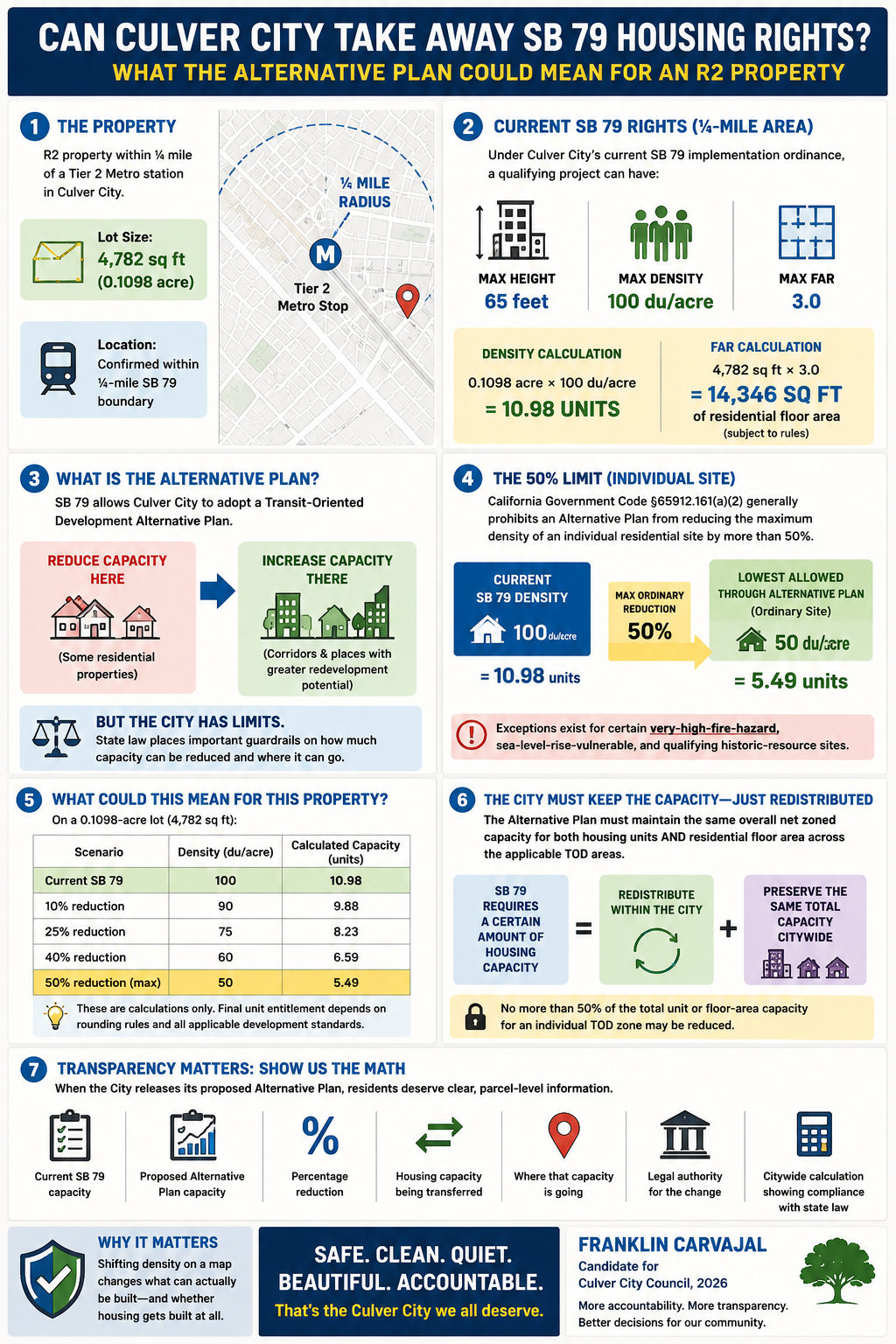
The lot is approximately 4,782 square feet, or about 0.1098 acre.
The City confirmed that the property is within the ¼-mile SB 79 boundary.
Under Culver City's current SB 79 implementation ordinance, a qualifying project in this area can have:
Maximum height: 65 feet
Maximum density: 100 dwelling units per acre
Maximum FAR: 3.0
For this particular lot:
0.1098 acre × 100 units per acre = 10.98 units of calculated density capacity
The 3.0 FAR also produces:
4,782 × 3 = 14,346 square feet of maximum residential floor area, subject to the applicable rules governing how FAR is calculated.
That's a dramatic change for an R2 property.
But then comes the Alternative Plan.
What Is Culver City's Alternative Plan?
SB 79 doesn't necessarily require Culver City to distribute all of this new housing capacity exactly where the state's default SB 79 rules put it.
State law allows the City to develop an Alternative Plan.
In very simple terms, the concept is:
Move some housing capacity away from certain properties and put additional housing capacity somewhere else.
Culver City has been exploring an approach that would concentrate more housing capacity along commercial and transit corridors.
That could mean less SB 79 density on some residential streets and more housing capacity along corridors.
But there is something extremely important residents and property owners should understand:
The City does not have unlimited authority to do this.
I Read the State Law
California Government Code §65912.161 establishes requirements for an SB 79 Alternative Plan.
One of them is particularly important.
The law generally prohibits an Alternative Plan from reducing the maximum allowed density of an individual residential site by more than 50%.
There are statutory exceptions involving certain properties, including qualifying sites affected by very-high-fire-hazard conditions, sea-level-rise vulnerability and certain historic resources.
But for an ordinary residential property that doesn't fall within an exception, that 50% limitation matters enormously.
What Would a 50% Reduction Mean?
Let's go back to our real Culver City example.
Today:
100 dwelling units per acre
On approximately 0.1098 acre:
100 × 0.1098 = 10.98 units
Now suppose Culver City used the Alternative Plan to impose the maximum ordinary 50% density reduction on that property.
The density would become:
50 dwelling units per acre
And:
50 × 0.1098 = 5.49 units
Here's the difference:
ScenarioDensityCalculated capacityCurrent SB 79100 du/acre10.98 units10% reduction90 du/acre9.88 units25% reduction75 du/acre8.23 units40% reduction60 du/acre6.59 units50% reduction50 du/acre5.49 units
These fractional calculations should not automatically be interpreted as final whole-unit entitlements; the applicable rounding rules still matter.
But look at the magnitude of the potential change.
A small residential property could theoretically go from a density calculation approaching 11 units to one approaching 5½ units.
That's not a minor zoning adjustment.
For a property owner considering redevelopment, that could fundamentally change what is economically feasible.
Can Culver City Reduce It Even Further?
For an ordinary individual residential site subject to the statutory 50% limitation, the Alternative Plan generally cannot reduce the site's maximum density by more than 50%.
There is also another protection in SB 79.
For applicable properties within one-half mile of a Tier 2 transit-oriented development stop, the Alternative Plan generally cannot reduce development standards below 30 dwelling units per acre and 1.0 FAR, subject to statutory exceptions.
In our example, however, the 50% rule provides the stronger density protection:
100 du/acre → 50 du/acre
rather than:
100 du/acre → 30 du/acre.
So the City generally cannot simply say:
“We're returning this property to ordinary R2 development and eliminating its SB 79 density.”
The Alternative Plan itself must comply with SB 79.
The City Also Has to Put the Housing Capacity Somewhere
There's another major restriction.
Culver City cannot simply reduce SB 79 capacity throughout residential neighborhoods and make the housing capacity disappear.
The Alternative Plan must maintain the required overall net zoned capacity for both residential units and residential floor area across the applicable transit-oriented development areas.
Think of it like moving water between containers.
If the state requires a certain overall amount of housing capacity, Culver City can potentially move some of that capacity:
Away from here → toward there.
But it cannot simply pour the housing capacity down the drain.
That is why commercial corridors are so important to this discussion.
If Culver City reduces SB 79 density on residential properties, it may need to compensate by allowing substantially greater housing capacity elsewhere.
This Creates an Interesting Policy Question
There are legitimate arguments on both sides.
Some residents may say:
“Good. Put larger apartment buildings on commercial corridors instead of residential streets.”
Others—particularly property owners affected by the change—may reasonably ask:
“Why is the City reducing development rights the state has already given my property?”
And housing advocates may ask:
“Will shifting capacity actually produce housing, or will the City move theoretical units onto parcels where redevelopment is unlikely?”
Those are important questions.
And There Is an Economic Question
This is something zoning discussions often overlook.
Suppose someone owns a small property where the current SB 79 rules potentially support approximately 11 units.
Maybe that project works financially.
Now reduce the density substantially.
Perhaps the property can accommodate only something closer to five or six units under the Alternative Plan.
Construction costs don't necessarily fall proportionately.
The land still costs the same.
Architectural and engineering expenses remain.
Permits remain.
Financing remains.
Fire and building-code requirements remain.
Suddenly a project that might have been financially viable may no longer make sense.
So when government moves density around on a map, it isn't simply moving numbers.
It can change whether housing actually gets built.
Can a Property Owner Challenge the Alternative Plan?
Potentially.
But simply saying:
“I don't want the City to reduce my density”
would not establish that the Alternative Plan violates SB 79.
State law specifically gives cities an Alternative Plan mechanism.
The stronger question is:
Did Culver City's Alternative Plan comply with the requirements California imposed on Alternative Plans?
If the City proposes reducing development capacity on a particular property, residents and property owners should be able to ask:
How much capacity is being removed?
Where is that capacity being moved?
Does the individual-site reduction comply with the statutory limit?
Does the affected transit area retain the capacity required by state law?
Does the Alternative Plan preserve the required overall residential-unit and floor-area capacity?
Is the property subject to one of the statutory exceptions?
Those are measurable questions.
Show Us the Math
This is where I think Culver City's Alternative Plan process needs to be exceptionally transparent.
When the City releases its proposed Alternative Plan, residents shouldn't simply receive a colorful zoning map.
For every area losing SB 79 capacity, the City should clearly show:
Current SB 79 capacity
Proposed Alternative Plan capacity
Percentage reduction
Housing capacity being transferred
Where that capacity is going
The legal authority for the change
And then show the citywide calculation demonstrating that the Alternative Plan satisfies state law.
In other words:
Show us the math.
This Is About More Than SB 79
Whether you support SB 79 or oppose it isn't really my point.
My concern is transparency.
A property owner shouldn't discover years later that the development potential of a property changed because of an Alternative Plan few people understood.
A renter shouldn't be told that a plan will create more housing without being shown where that housing can realistically be built.
And residents shouldn't have to become land-use attorneys to understand what their City Council is considering.
If Culver City wants to redistribute SB 79 housing capacity, residents deserve to see exactly:
Who gains density.
Who loses density.
How much.
Why.
And where all the housing capacity ultimately goes.
That is what accountable local government should look like.
Safe. Clean. Quiet. Beautiful. Accountable.
Franklin Carvajal
Candidate for Culver City Council, 2026
0 Comments
Comments are reviewed before they appear.