
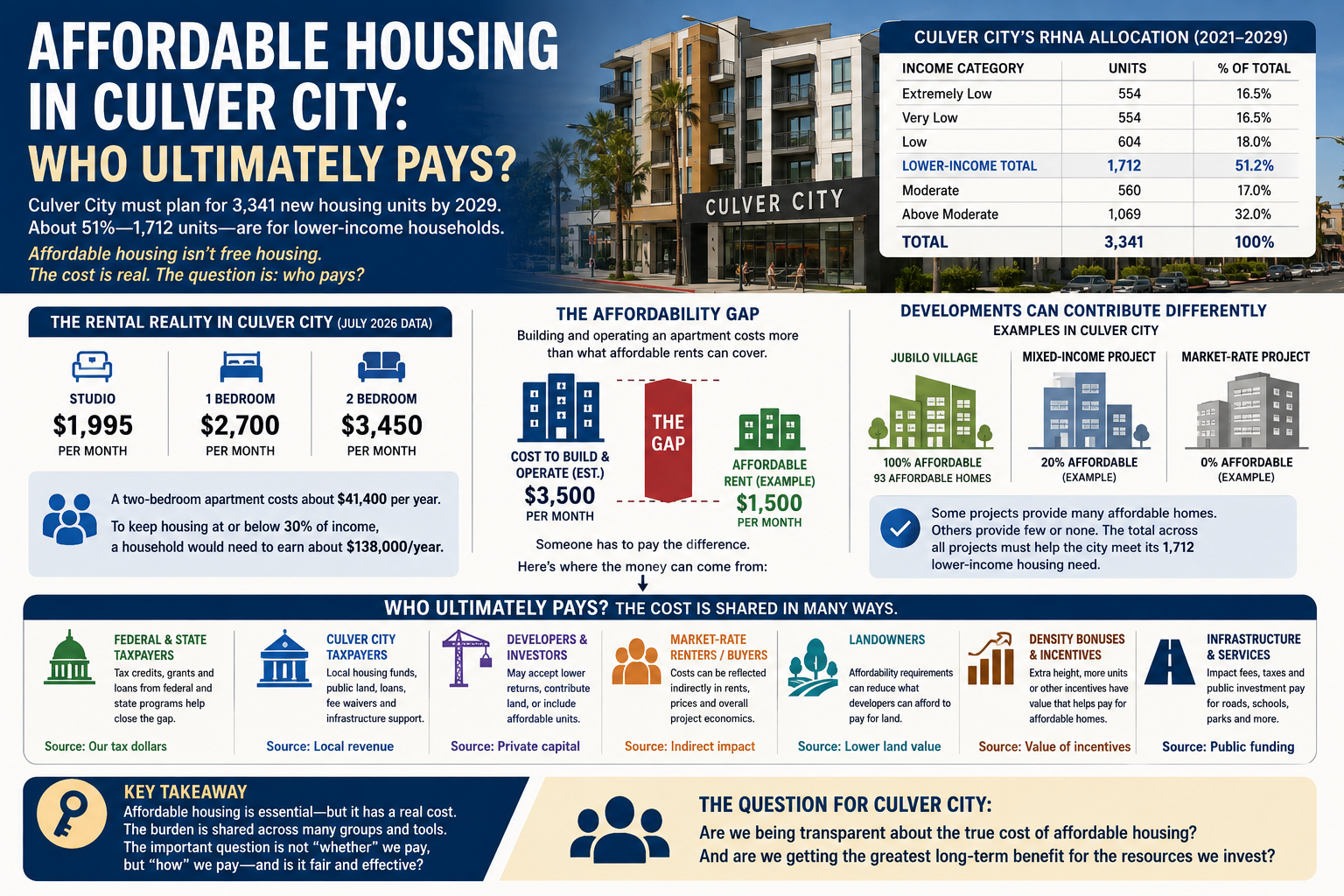
California has assigned Culver City a major housing challenge.
For the 2021–2029 housing cycle, Culver City's Regional Housing Needs Allocation calls for planning for 3,341 additional housing units.
Of those, 1,712—approximately 51%—fall within the lower-income housing categories.
That sounds like a housing goal.
But it is also an economic question.
And it is a question Culver City residents deserve to have answered clearly:
Who ultimately pays for affordable housing?
Because affordable housing is not free housing.
The land costs money.
Architects and engineers must be paid.
Construction workers must be paid.
Concrete, lumber, plumbing and electrical systems cost money.
Financing carries interest.
Insurance, maintenance, management and utilities continue long after construction is finished.
Yet if an apartment costs more to develop and operate than can be supported by its restricted rent, there is a financial gap.
Someone has to absorb that gap.
The real debate, therefore, isn't simply whether Culver City should have affordable housing.
It is how the cost of providing it should be distributed.
Start With Today's Rental Reality
Consider Culver City's current rental market.
Recent market data have put average rents at roughly:
Studio: $1,995 per month
One bedroom: $2,700 per month
Two bedrooms: $3,450 per month
A two-bedroom apartment renting for $3,450 costs a household approximately $41,400 per year.
Using the traditional 30% housing-affordability benchmark, a household would need roughly $138,000 in annual gross income for that rent to consume no more than 30% of its income.
That explains why affordable housing is needed.
But it doesn't explain who pays for it.
Suppose a new apartment could command $3,500 per month on the open market, but affordability restrictions allow the owner to collect substantially less.
The tenant benefits from the lower rent.
But the cost of constructing the apartment hasn't disappeared.
Neither have the costs of operating it.
Some combination of money, incentives, reduced land value, additional development rights, tax benefits or foregone revenue must close the gap.
So where does it come from?
1. Federal and State Taxpayers Can Pay
One major mechanism for financing affordable housing is government assistance.
The federal Low-Income Housing Tax Credit, for example, provides tax benefits that can be converted into equity for qualifying affordable-housing developments.
California also has housing programs that provide grants, loans, tax credits and other financial assistance.
These programs can make developments financially possible even when restricted rents cannot support conventional market-rate financing.
But government money ultimately has a source.
Taxpayers.
Sometimes those taxpayers live in Culver City.
Sometimes they live elsewhere in California.
Sometimes they live elsewhere in the United States.
The cost is spread across a much larger population, which is one reason public financing can support projects that would be difficult for a small city to finance alone.
That isn't necessarily good or bad.
It's simply important to understand that public subsidies don't eliminate housing costs.
They redistribute them.
2. Culver City Taxpayers Can Pay
Local government can also contribute.
A city can dedicate affordable-housing funds, contribute city-owned land, provide loans, waive certain fees, finance infrastructure or otherwise support affordable developments.
If Culver City owns land and makes it available below its potential market value for affordable housing, residents may never receive a tax bill saying:
"Affordable Housing Charge: $300."
But an economic contribution still occurred.
The city gave up some or all of the value it might otherwise have received from selling or leasing that property at market rates.
Likewise, if local government spends $10 million supporting affordable housing, that is $10 million unavailable for another public purpose unless additional revenue is raised.
That's called an opportunity cost.
Residents should therefore ask not simply:
"Did Culver City spend money?"
But:
"What public resources did Culver City contribute, and what alternatives did we give up?"
3. Developers Can Pay
Another approach is requiring private developers to include affordable apartments in otherwise market-rate developments.
Suppose a developer constructs 200 apartments.
If 20 must rent below market rates, the developer receives less revenue from those apartments than it potentially could have received at market rents.
At first glance, the answer seems simple:
The developer pays.
Sometimes the developer or its investors do absorb part of that cost through lower profits or lower returns.
But economics rarely stops with the person receiving the initial bill.
Developers can attempt to compensate in several ways.
They may seek a lower price for the land.
They may charge what the market will bear for unrestricted apartments.
They may alter the project's design.
They may seek additional density.
They may reduce other project costs.
And if requirements make a proposed development financially unattractive, the project may be delayed, redesigned or not built.
So saying "make the developer pay" doesn't necessarily tell us where the economic burden ultimately lands.
4. Market-Rate Renters May Indirectly Pay
This possibility deserves particular attention.
Imagine a 200-unit development where some apartments are rented below market rates.
If the unrestricted apartments can command higher rents, part of the project's economics may effectively involve revenue from market-rate apartments supporting the development as a whole.
That does not mean a landlord can arbitrarily add $500 to someone's rent and force the market to accept it.
Market rents remain constrained by what renters are willing and able to pay and by competing housing alternatives.
But it does mean that mixed-income developments are evaluated financially as a whole.
The restricted units produce less rental income.
The unrestricted units produce more.
If the overall numbers work, the project gets financed.
If they don't, something else has to change.
So some of the economic burden can potentially be reflected in the economics of market-rate housing.
This creates an uncomfortable policy question:
Could a policy designed to make some apartments more affordable make development more expensive—or reduce housing production—for everyone else?
The answer depends heavily on how the policy is designed.
5. Homebuyers May Bear Some Costs
The same principle can apply to condominium developments.
If a developer must sell certain homes below their unrestricted market value, that reduces potential project revenue.
Again, the developer may absorb some of that reduction.
But the developer may also bid less for the land, seek additional density, change the project's design or attempt to obtain greater revenue elsewhere.
Economic costs can move through the system.
They don't necessarily remain where government initially places them.
6. Landowners May Pay
This is perhaps the least visible possibility.
Suppose a parcel of land would be worth $20 million to a developer without affordability requirements.
Now suppose additional requirements reduce the revenue that can be generated from developing that property.
A rational developer may simply say:
"I can no longer pay $20 million for the land. I can only pay $17 million."
In that situation, part of the affordable-housing requirement has effectively been absorbed through a lower land price.
The landowner bears part of the economic cost.
This is one reason housing economics is more complicated than saying either taxpayers or developers pay.
The cost can be distributed across multiple parties.
7. Density Bonuses Can Pay Without Writing a Check
Government has another tool.
Instead of giving a developer cash, it can give the developer something valuable:
Permission to build more housing.
Imagine zoning would ordinarily permit 100 apartments.
In exchange for providing affordable apartments, state or local rules might allow significantly more units, greater height, reduced setbacks, fewer parking requirements or other concessions.
Those additional development rights have economic value.
A developer might lose revenue on certain affordable apartments but gain revenue from additional market-rate apartments that otherwise couldn't have been constructed.
In this case, government hasn't necessarily written a subsidy check.
Instead, it has used the value created by increased development rights to help finance affordability.
But there can still be a public tradeoff.
The surrounding community may experience a larger building, additional residents, greater demands on infrastructure, reduced parking requirements or changes in neighborhood scale.
So even here, the benefit isn't economically costless.
The subsidy may partly take the form of additional development intensity.
8. Future Residents Can Bear Infrastructure Costs
More housing requires infrastructure.
Water.
Sewers.
Transportation.
Fire protection.
Parks.
Schools.
Public safety.
Street improvements.
Electrical capacity.
If thousands of additional residents come to Culver City, those services must eventually be provided.
Developers may pay impact fees or construct some improvements.
Government may finance others.
Residents may pay through taxes, utility charges or assessments.
Future residents themselves may bear some of the cost.
Again, there is no single payer.
So Who Pays for Culver City's 1,712 Lower-Income Housing Need?
Potentially, all of us—but in different ways and in different proportions.
The federal taxpayer may contribute through tax credits.
California taxpayers may finance housing programs.
Culver City may contribute money or public land.
Developers and investors may accept reduced returns.
Landowners may receive less for developable property.
Market-rate renters and buyers may participate indirectly through the overall economics of mixed-income projects.
And neighborhoods may absorb the non-cash costs associated with greater development intensity.
That doesn't mean affordable housing is a bad policy.
It means affordable housing involves tradeoffs, just like every major public policy.
The relevant question isn't whether affordable housing costs money.
Of course it does.
The question is:
Who should bear that cost, and how much should each group bear?
The 51% Number Makes This Question Especially Important
Remember what Culver City's RHNA numbers tell us.
Of the city's 3,341-unit allocation, 1,712 units—about 51%—are assigned to lower-income categories.
That does not mean every development must contain 51% affordable apartments.
Some projects may contain relatively few.
Others might contain 50%, 75% or even 100%.
But if Culver City wants the actual production of lower-income housing to approach that 1,712-unit allocation, substantial financing will be necessary.
And if ordinary market-rate development isn't producing enough affordable units, the financing question becomes increasingly important.
Where will the subsidy come from?
How much will come from Sacramento?
How much from Washington?
How much from Culver City?
How much from developers?
How much from tax credits?
How much from public land?
How much from increased density?
Those numbers should be part of the public conversation.
Residents Should Be Shown the Full Cost
Every major affordable-housing project in Culver City should come with a simple public financial explanation.
Residents should be able to see:
Total development cost
Cost per housing unit
Number of affordable units
Income levels served
Expected restricted rents
Federal subsidy or tax-credit contribution
State contribution
County contribution
Culver City contribution
Value of city-owned land contributed
Developer contribution
Density bonuses and concessions granted
Other public incentives
That would allow residents to evaluate affordable housing based on actual economics rather than political slogans.
A project costing $80 million isn't automatically good or bad.
A project receiving $20 million in public assistance isn't automatically good or bad.
But taxpayers deserve to know those numbers.
We Should Also Calculate the Cost Per Affordable Home
This may be one of the most useful measurements of all.
If taxpayers and government programs contribute $30 million toward a development that produces 100 permanently affordable homes, residents should know that.
If another strategy can produce the same affordability for substantially less public money, residents should know that too.
Likewise, if public subsidies produce housing that remains affordable for 55 years or longer, that long-term benefit should be included in the analysis.
The objective shouldn't simply be:
Spend less.
Nor should it be:
Build at any cost.
It should be:
What approach produces the greatest long-term housing benefit for the public resources invested?
There Is No Such Thing as Free Affordable Housing
This may be the most important point.
When politicians say developers will pay, residents should ask whether some of the cost ultimately affects land prices, rents, housing production or development incentives.
When government says it will subsidize affordable housing, residents should remember that government money ultimately comes from taxpayers or other public resources.
When additional density is offered instead of cash, residents should recognize that development rights themselves have economic value.
None of these facts proves that affordable housing shouldn't be built.
Quite the opposite.
Culver City clearly has an affordability problem when ordinary apartments can cost thousands of dollars every month.
But good public policy requires acknowledging costs rather than pretending they don't exist.
The Question Culver City Should Be Asking
California has determined that a substantial portion of Culver City's housing need exists among lower-income households.
Culver City now has to determine how to respond.
But before we promise thousands of affordable housing opportunities, residents deserve an answer to a very basic question:
Who will pay?
Will it be federal taxpayers?
California taxpayers?
Culver City taxpayers?
Developers?
Landowners?
Market-rate renters?
Future residents?
Or some combination of all of them?
And once we know the answer, there is an equally important second question:
Is that the fairest and most cost-effective way to make Culver City more affordable?
Those are not arguments against affordable housing.
They are questions about how to pay for it responsibly.
Because ultimately, someone pays for every home we build.
The challenge for Culver City is deciding how that cost should be shared—and making sure residents understand the answer before the bill comes due.
0 Comments
Comments are reviewed before they appear.