
Affordable housing is something Culver City needs.
But there is another question that deserves just as much attention:
Can the way we are financing affordable housing be repeated over and over without eventually overwhelming the City's finances?
Jubilo Village provides a useful example.
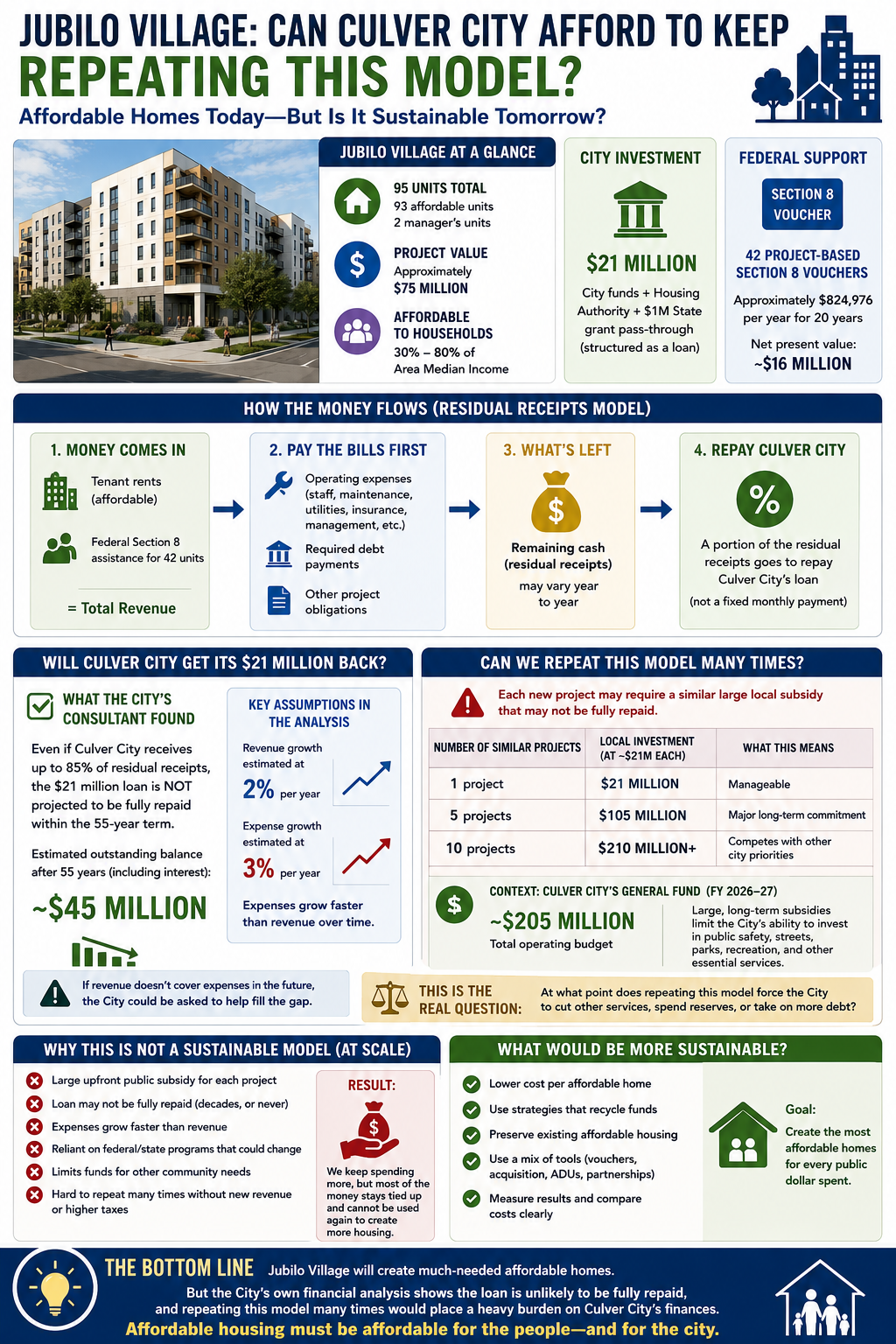
The project at 4464 Sepulveda Boulevard is expected to create 93 affordable apartments as part of a 95-unit development. Culver City describes the overall project value as approximately $75 million.
The City has made a very large financial commitment to make the project possible.
And that raises a question bigger than Jubilo Village itself:
If Culver City wants hundreds or thousands of additional affordable homes in the future, can we afford to build them using the same model?
First, Understand the Basic Problem
Affordable housing is expensive to build.
At the same time, the purpose of affordable housing is to charge people less than the full market rent.
That creates a very simple financial problem:
The building is expensive.
The rents are intentionally limited.
So somebody has to make up the difference.
That money can come from federal programs, state programs, tax credits, private financing, housing vouchers and local governments.
For Jubilo Village, Culver City became one of those major funding sources.
The City originally discussed a total $20 million loan commitment. A later September 2025 commitment letter increased the total commitment described by the City to $21 million, consisting of City funds, Housing Authority funds and a $1 million state grant passed through as a loan.
That is a substantial public investment for 93 affordable apartments.
But Isn't It a Loan?
Yes.
But this is where residents need to understand an important distinction.
This is not like a normal mortgage where the borrower makes a fixed payment every month and the loan is scheduled to be completely paid off.
The City's financing uses what is called a residual-receipts loan.
That sounds complicated, but the concept is simple.
Jubilo Village collects money.
It pays the costs of operating the building and other required financial obligations.
Then whatever qualifying money is left over is called the residual receipts.
A portion of that remaining money can then go toward paying Culver City back.
In other words:
Rent and subsidies come in.
↓
Expenses and required debts get paid.
↓
Culver City gets a share of what is left.
That means repayment depends on there actually being enough money left.
The City's Own Consultant Did Not Expect Full Repayment
This is probably the most important fact in this entire discussion.
When Culver City's financial consultant analyzed the earlier $20 million version of the City loan, it concluded that the loan would not be fully repaid during its 55-year term.
The analysis assumed revenues would increase approximately 2% each year while expenses would increase approximately 3% each year.
Under those assumptions, the consultant estimated that approximately $45 million could still be outstanding in year 55, including accumulated interest.
That does not mean the City will necessarily lose $45 million in cash.
It means the projected payments were not sufficient to pay down the original principal and accumulated interest over the loan period.
That is a very important distinction.
But it also leads directly to the larger policy question.
If One Project May Not Fully Repay the City, What Happens When We Build Five?
Imagine for simplicity that future projects required approximately the same $21 million local commitment.
One project:
$21 million
Five similar projects:
$105 million
Ten similar projects:
$210 million
Those numbers are only illustrations. Future affordable-housing developments could cost more or less, receive more state or federal funding, or require very different City contributions.
But they demonstrate the basic problem.
Culver City's entire FY 2026–27 General Fund operating budget is approximately $205.3 million.
That does not mean ten Jubilo-type projects would literally consume an entire annual General Fund budget. The money would likely come from different funds and could be spent over many years.
But it gives residents a sense of scale.
If every major affordable-housing project requires tens of millions of dollars of local financing that may take decades to repay—or may never be fully repaid—the City cannot simply repeat that strategy indefinitely.
This Is the Difference Between Building Affordable Housing and Creating a Sustainable Affordable-Housing System
Jubilo Village may successfully create 93 affordable apartments.
That is a real public benefit.
But a successful housing policy has to answer another question:
Can we do it again?
And again?
And again?
If Culver City creates one affordable project using a large City subsidy, the City may be able to absorb the cost.
But if the same model is required for every 100 affordable homes, eventually the City has to find another $20 million or $30 million.
Then another.
Then another.
At some point, those dollars compete with everything else the City pays for.
Police.
Fire and emergency services.
Streets.
Sidewalks.
Parks.
Recreation.
Homeless services.
Infrastructure.
City employees.
Pensions.
Debt payments.
And other community priorities.
That is why replicability matters.
When Would This Actually Bankrupt Culver City?
There isn't an honest number I can give residents such as:
"Six Jubilo Villages would bankrupt Culver City."
Municipal finances do not work that simply.
Whether a city experiences a serious fiscal crisis depends on many things:
How quickly the spending occurs.
How much state and federal funding is available.
How much the City borrows.
How large its reserves are.
Whether revenues increase.
Whether other spending is reduced.
Whether loans are repaid.
What interest rates are.
And what other financial obligations the City has at the same time.
So it would be misleading to claim that a particular number of projects automatically causes bankruptcy.
But we can ask a much more useful question:
At what point does repeating the model begin forcing Culver City to cut other services, spend reserves, increase debt, or find new revenue?
That is the real sustainability test.
Culver City Has Already Confronted Fiscal Pressure
This isn't a theoretical concern.
In early 2026, Culver City staff reported that the City's previous long-term General Fund forecast showed a serious structural imbalance and warned that, without action, reserves could be substantially depleted within the forecast period.
The City subsequently made financial changes and adopted a balanced FY 2026–27 budget. The adopted General Fund operating budget is approximately $205.3 million.
That is good news.
But balancing one year's budget doesn't eliminate the need to evaluate long-term commitments carefully.
When government agrees to financing lasting decades, we should consider not only whether we can afford it this year.
We should ask:
Can we afford to keep doing it?
Housing Vouchers Help — But They Are Also Subsidies
Jubilo Village will also receive substantial assistance through 42 project-based Section 8 vouchers.
The City estimates those vouchers will generate approximately $824,976 annually for 20 years, with a net present value of approximately $16 million. The funding source for those vouchers is federal Section 8 funding.
That helps make the building financially feasible.
But again, this demonstrates the economics of deeply affordable new construction.
The project does not depend only on what residents pay in rent.
It depends on multiple layers of public assistance.
That may be an appropriate use of public money.
But it means the model's ability to grow depends heavily on continued access to federal, state and local subsidies.
Why Can't We Just Charge More Rent?
Because that defeats the purpose.
Jubilo Village is affordable housing.
If rents were raised high enough to cover the entire cost of construction, operations, financing and repayment of all public loans, those rents might no longer be affordable to the households the project is designed to serve.
This is the fundamental challenge of affordable housing:
The more deeply affordable we make the rent, the larger the financial gap someone else may have to fill.
There is nothing inherently wrong with that.
Subsidy is part of affordable-housing policy.
The question is how much subsidy we can afford per apartment.
The Number We Should Start Talking About: Public Cost Per Affordable Home
This is where I believe Culver City's affordable-housing discussion needs to change.
Instead of simply asking:
"How many affordable units does this project create?"
we should also ask:
"How much local public money are we putting in for every affordable unit created?"
Using the later $21 million City commitment and 93 affordable units gives a very rough figure of approximately:
$226,000 of City-related loan commitment per affordable unit.
That is not the total cost of each apartment.
It also doesn't account for how much of the loan might eventually be repaid, or the fact that the $21 million package includes different City, Housing Authority and state-pass-through sources.
It is simply a useful way of understanding the scale of the local commitment.
The project's total value of approximately $75 million works out to roughly $806,000 per affordable unit if divided by 93 units, although that calculation is also simplistic because the project includes common areas and other facilities and financing costs.
These aren't arguments against the residents who will live there.
They are questions about how efficiently we create housing.
What If We Could Create Affordable Housing More Cheaply?
This is where the sustainability conversation becomes important.
Suppose Culver City has $20 million available for affordable housing.
There are many potential ways to use that money.
It might help finance one large affordable development.
It might finance multiple smaller projects.
It might help acquire existing apartments and preserve their affordability.
It might help homeowners build affordable ADUs.
It might be combined with private financing in other ways.
It might provide rental assistance.
Or the City might use several strategies at the same time.
The objective shouldn't be to choose one ideology.
It should be:
Create the greatest amount of long-term affordable housing for the public dollars available.
A Sustainable Model Should Recycle Money
There is another important principle.
Imagine two housing programs.
Program A
The City invests $20 million.
Most of the money remains tied up for decades.
The City receives only limited repayments.
To build the next project, the City needs to find another $20 million.
Program B
The City invests $20 million.
The investment produces housing.
Most of the money eventually comes back.
The City then lends that same money again to create more housing.
Program B is much easier to scale.
That doesn't mean every affordable-housing investment has to be fully repaid.
Some housing populations require significant subsidy.
But the more frequently Culver City uses financing that doesn't return substantial capital, the more frequently the City has to replenish that capital from somewhere else.
That is what makes sustainability so important.
Jubilo Village Should Become a Benchmark
Rather than arguing endlessly about whether Jubilo Village was right or wrong, we should use it as a benchmark.
Once the building opens, Culver City should publicly track:
How much the project ultimately cost.
How much Culver City contributed.
How much federal and state assistance was required.
How much rent the property collects.
How much Section 8 assistance it receives.
How much it spends operating the building.
How much money is left after expenses.
How much of the City's loan is actually repaid each year.
And how much public subsidy was ultimately required for every affordable apartment.
Then compare those numbers with other ways of creating affordable housing.
That is how we learn.
My Concern Is Not Affordable Housing. It Is Whether Our Financing Model Scales.
Culver City should create affordable housing.
But affordable-housing policy cannot consist of repeatedly writing enormous checks without asking how the next project will be financed.
One Jubilo Village may be financially manageable.
Several may become difficult.
Dozens using the same level of local subsidy would obviously require resources far beyond what Culver City currently spends on housing.
That's why the question isn't:
"Can Culver City afford Jubilo Village?"
The more important question is:
"Can Culver City afford the next ten Jubilo Villages?"
If the answer is no, then Jubilo cannot by itself represent our long-term affordable-housing model.
A Better Standard for Future Projects
Before Culver City commits large amounts of public money to another affordable-housing development, I believe residents should receive a simple financial explanation answering several questions.
How many affordable homes are we getting?
How much is Culver City contributing?
How much does that equal per affordable home?
How much of the City's money is realistically expected to come back?
How long will repayment take?
What happens if expenses exceed projections?
Could Culver City afford to repeat this project five or ten times?
And finally:
Is there another strategy that could produce more affordable homes with the same public investment?
Those shouldn't be partisan questions.
They are basic financial questions.
The Bottom Line
Jubilo Village will create 93 affordable apartments.
That is its benefit.
It also requires substantial public financial support.
That is its cost.
The City's consultant concluded that the earlier $20 million City loan was not projected to be fully repaid over its 55-year term, and staff warned that the project's construction and operating economics carried additional risks.
The later City commitment was described as $21 million.
That doesn't prove Jubilo Village is a bad investment.
But it does demonstrate why this model cannot simply be repeated without limits.
Affordable housing has to be affordable for the people who live in it.
But our affordable-housing strategy also has to be affordable for the City that finances it.
The goal should not simply be to complete the next project.
The goal should be to build a system capable of producing affordable housing for decades.
If every new project requires another enormous local subsidy that may not return to the City, eventually we run out of money—or we have to take that money from somewhere else.
That is not a scalable housing strategy.
Culver City's challenge now is to develop affordable-housing models that don't just work once.
They need to work again and again.
0 Comments
Comments are reviewed before they appear.