
One of the strangest things about running for office is discovering how quickly your world changes once your name officially appears as a candidate.
One day, you're filling out forms, collecting signatures, opening campaign accounts, trying to understand political committees and figuring out who stamps what document.
Then suddenly, the media starts calling.
Welcome to Episode 10 of The Strange World of Politics.
An Unexpected Message
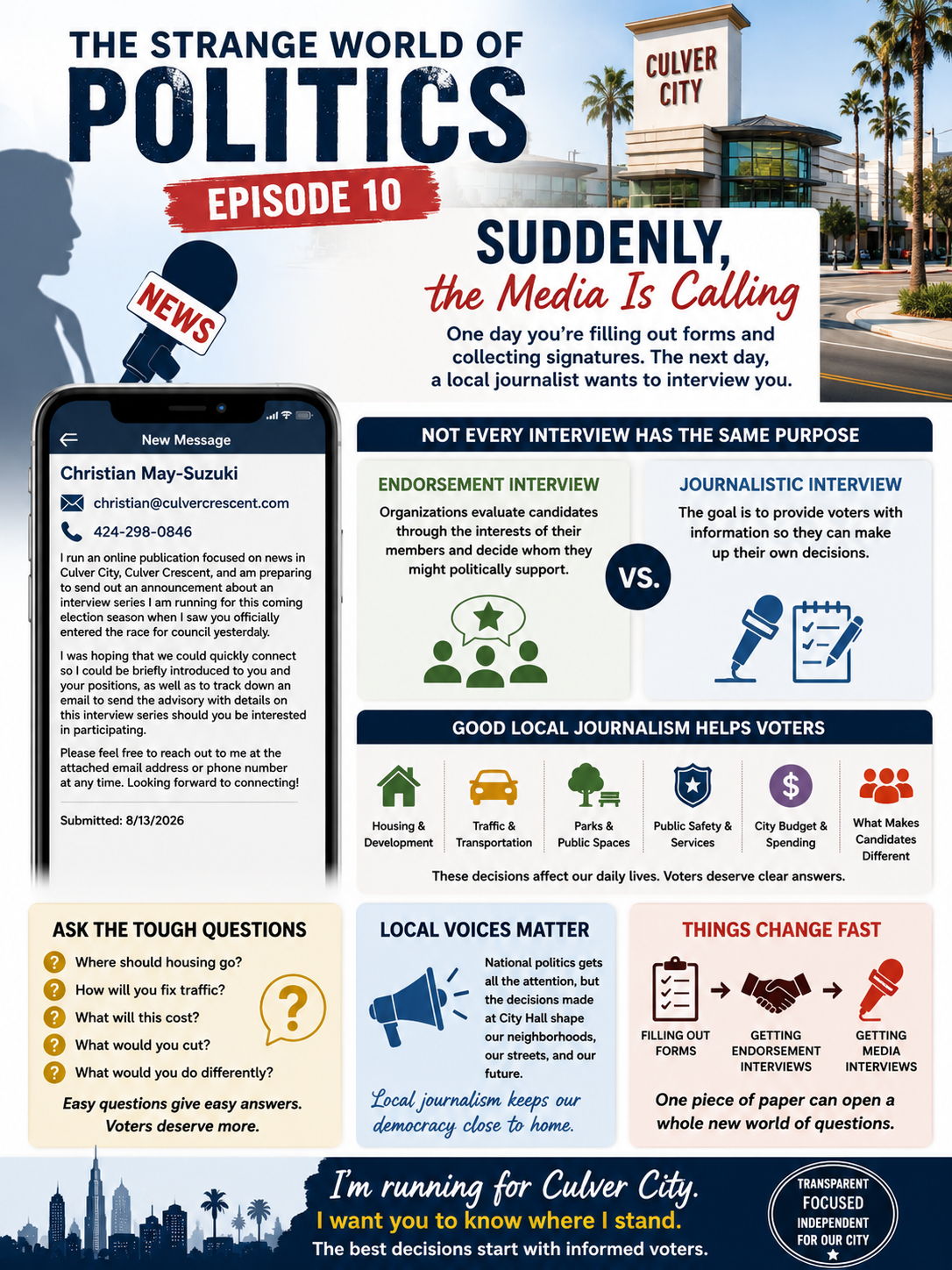
On August 13, 2026, shortly after I officially entered the race for Culver City Council, I received a message from Christian May-Suzuki, who runs the online Culver City news publication Culver Crescent.
He explained that he was preparing an interview series for the upcoming election season and had noticed that I had officially entered the council race.
He wanted to connect briefly, learn more about me and my positions, and send me information about participating in his candidate interview series.
This was something new.
Until now, much of becoming a candidate had involved me going to other people.
I went to the city clerk.
I collected signatures.
I filled out state forms.
I contacted organizations.
I completed questionnaires.
I attended endorsement interviews.
Now someone was contacting me because I was a candidate.
Why Would a Local Publication Want to Interview Candidates?
The answer is actually pretty simple.
Most Culver City residents are not going to personally meet every candidate.
They're not going to sit through every city council meeting.
They're probably not going to read every campaign website from beginning to end.
And they're definitely not going to spend their evenings studying campaign-finance forms.
Local journalists therefore play an important role during an election.
They can ask candidates questions and then give residents an opportunity to compare the answers.
For example:
What do you think about housing?
What should Culver City do about traffic?
How do you feel about development and density?
What should the city do about homelessness?
How should Culver City spend taxpayers' money?
What distinguishes you from the other candidates?
Instead of a voter trying to track down every candidate individually, a publication can interview everyone and put those answers in one place.
That is extremely useful.
But This Is Different From an Endorsement Interview
This is something I'm beginning to understand as I move through this strange political process.
Not every interview has the same purpose.
In Episode 9, I wrote about interviewing with the Greater Los Angeles REALTORS®.
That organization was evaluating candidates through the interests and priorities of its members and deciding whom it might politically support.
A news interview serves a different purpose.
Ideally, the journalist isn't asking:
"Does this candidate agree with us?"
The journalist is asking:
"Who is this candidate, what does he believe, and what should our readers know about him?"
That's an important difference.
An endorsement interview is partly about an organization evaluating the candidate.
A journalistic interview should primarily help the public evaluate the candidate.
And Then I Realized Something Else
When you're campaigning, you spend an enormous amount of time trying to explain what you believe.
You build a website.
You write policy positions.
You answer questionnaires.
You knock on doors.
You attend events.
You talk to residents.
But journalism introduces another person into that process.
The journalist asks the questions.
The journalist decides which issues to explore.
The journalist may challenge your answers.
And ultimately, the journalist decides how the interview or story is presented to readers.
For someone accustomed to explaining his own ideas in his own words, that is an interesting adjustment.
But it's also an important part of democracy.
Candidates shouldn't only answer questions they wrote themselves.
Ask Me the Difficult Questions
I actually think candidate interviews are most useful when the questions aren't easy.
Don't just ask me:
"Why are you running?"
Ask me what I would actually do.
If I say Culver City needs more housing, ask me where it should go.
If I say I oppose unplanned density, ask me what level of density I would support.
If I complain about traffic, ask me what my solution is and how much it would cost.
If I say the city should spend money differently, ask me what I would cut.
If I criticize something the current council has done, ask me what I would have done instead.
Those questions force candidates to move beyond slogans.
And voters deserve those answers.
Local Journalism Matters More Than I Realized
National politics receives enormous attention.
Presidential elections dominate television.
Members of Congress appear constantly in the news.
But the decisions that can affect your daily life very directly often happen a few blocks away at city hall.
Where apartments get built.
What happens to your street.
Whether a traffic signal gets installed.
How much parking exists.
Where bicycle lanes go.
How parks are maintained.
How development is approved.
How local tax dollars are spent.
These aren't abstract political debates.
They're decisions about the place where we actually live.
Yet finding detailed information about local government and local candidates can be surprisingly difficult.
That's why publications devoted specifically to Culver City can play an important role.
There's Also Something Slightly Strange About It
A few days earlier, I was just Franklin trying to figure out election paperwork.
Now someone wants to interview me about what I think Culver City should look like in the future.
Nothing about me changed overnight.
What changed was a piece of paper.
I became an official candidate.
And apparently that simple designation changes the questions people want to ask you.
Suddenly your opinion about an intersection isn't merely your opinion about an intersection.
It's potentially a policy position.
Your thoughts about an apartment building become a housing position.
Your complaints about speeding become a transportation policy.
Your thoughts about city spending become a budget position.
That's when running for office begins to feel real.
So, Yes, I'll Talk
I want residents to know what I believe before deciding whether to vote for me.
I also want them to hear from the other candidates.
And I want journalists to challenge all of us.
The purpose of an election shouldn't be to determine who has the best postcard, the most lawn signs or the cleverest slogan.
It should be to determine who voters trust to make decisions for their city.
That requires information.
It requires questions.
And occasionally, it requires a candidate to sit down with a journalist and explain himself without knowing exactly what the next question is going to be.
Apparently, that's another part of running for office nobody tells you about.
Yesterday you're filling out forms.
Today you're getting calls from reporters.
Tomorrow?
At this point, I have absolutely no idea.
Welcome once again to The Strange World of Politics.
2 Comments
Comments are reviewed before they appear.Franklin Carvajal
Paulette Greenberg