
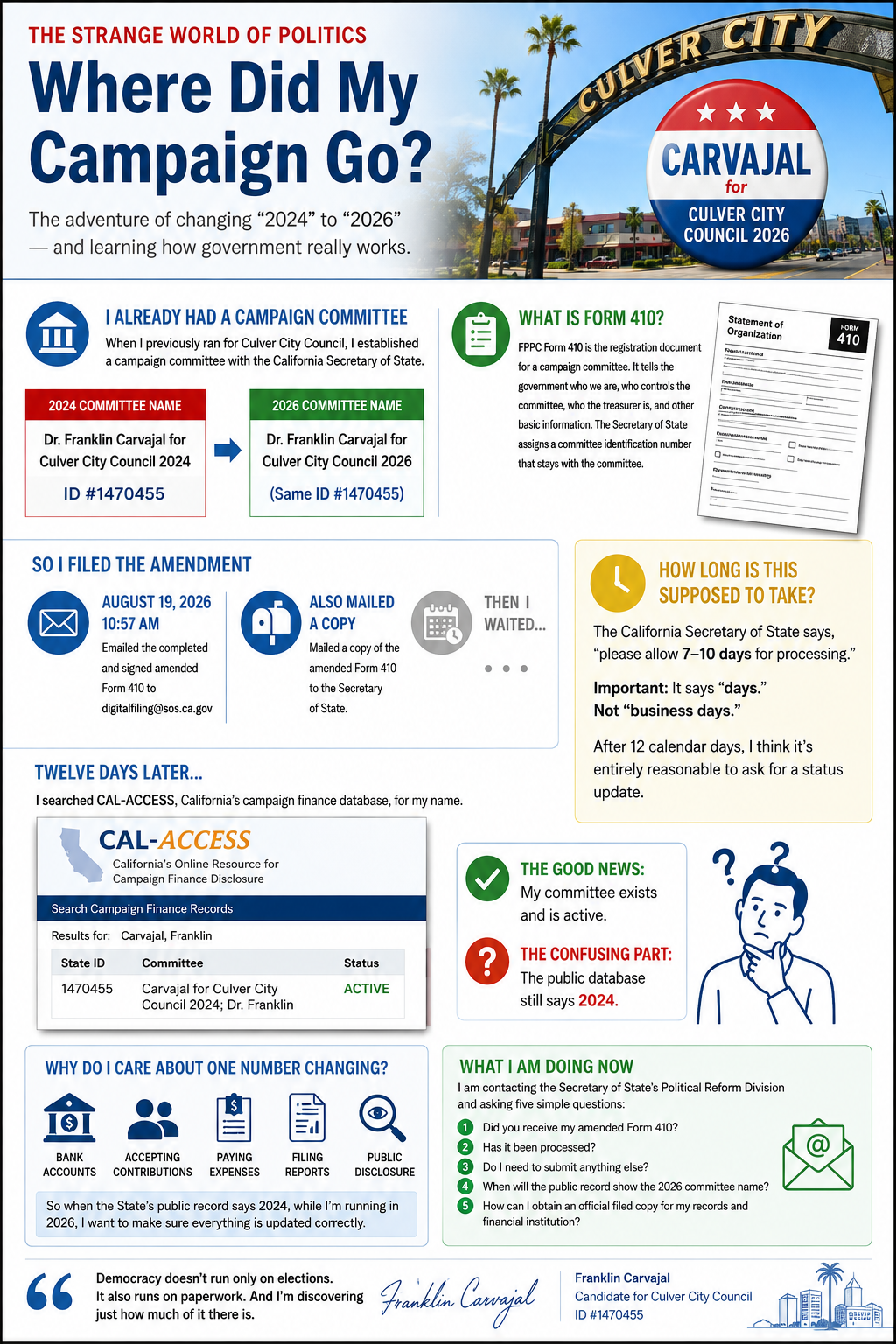
Running for City Council continues to teach me things about politics that I never expected to learn.
Here is the latest one:
Apparently, changing “2024” to “2026” can become an adventure involving email, regular mail, government databases, and a lot of waiting.
Let me explain.
I Already Had a Campaign Committee
When I previously ran for Culver City City Council, I established a campaign committee with the California Secretary of State.
The committee was called:
Dr. Franklin Carvajal for Culver City Council 2024
The State assigned the committee identification number 1470455.
For my 2026 campaign, I did not create an entirely new committee. Instead, I filed an amended FPPC Form 410 — Statement of Organization to update my existing committee for the new election.
The new name is:
Dr. Franklin Carvajal for Culver City Council 2026
Sounds simple enough.
What Is Form 410?
This is another one of those things that most voters understandably never have to think about.
Form 410 is essentially the registration document for a campaign committee.
It tells the government who the committee is, who controls it, who the treasurer is, where it operates, and other basic information.
When a committee is registered, the California Secretary of State assigns it an identification number. Mine is 1470455.
That number stays important because campaign finance filings can be associated with the committee and made available to the public.
So I Filed the Amendment
On August 19, 2026, I emailed my completed and signed amended Form 410 to the California Secretary of State.
I also mailed a copy to the Secretary of State.
My email explained exactly what I was doing:
I was updating my existing committee from the 2024 Culver City Council election to the 2026 Culver City Council election, while keeping the existing committee identification number.
Then I waited.
Twelve Days Later...
On August 31, I searched California's CAL-ACCESS campaign-finance database for my name.
There I was.
But there was a problem.
The database showed:
State IDCommitteeStatus1470455Carvajal for Culver City Council 2024; Dr. FranklinACTIVE
The good news?
My committee exists and is active.
The confusing part?
The public database still says 2024.
I had submitted the amendment 12 days earlier.
How Long Is This Supposed to Take?
This is where government instructions can become interesting.
The California Secretary of State's Form 410 FAQ says filings are reviewed and processed in the order received and asks filers to allow approximately 7–10 days for processing.
Importantly, it says “days.”
It does not say “business days.”
That distinction caught my attention because the Secretary of State uses the phrase “business days” elsewhere when that is what it means.
So, after 12 calendar days, I think it is entirely reasonable to ask:
Did you receive my amendment, and has it been processed?
That is exactly what I am doing.
Why Do I Care About One Number Changing?
Because this isn't merely about whether a website says 2024 or 2026.
Running for office involves opening and maintaining a campaign bank account, accepting contributions, paying campaign expenses, filing disclosure reports, and making sure the public can see who is financing a campaign.
Financial institutions may also want documentation showing the campaign committee's official information.
So when the State's public record says 2024, while I am running in 2026, I want to make sure everything has actually been updated correctly.
I don't want to assume.
I want to verify.
What I Am Doing Now
I am contacting the Secretary of State's Political Reform Division and asking five simple questions:
Did you receive my amended Form 410?
Has it been processed?
Do I need to submit anything else?
When will the public record show the 2026 committee name?
How can I obtain an official filed copy for my records and financial institution?
And then I will wait for the answer.
Why Am I Writing About This?
Because this is exactly why I started writing about my experience running for City Council.
Most residents see the final product.
You see candidates' names on the ballot. You receive campaign mailers. You see lawn signs. You may attend a candidate forum.
What you don't normally see is everything that happens behind the scenes just to become and operate as a candidate.
There are nomination papers.
There are financial disclosure forms.
There are campaign committees.
There are bank accounts.
There are filing deadlines.
There are local filings and state filings.
There are identification numbers.
And apparently, there are moments when you find yourself staring at a government database wondering:
Why does it still say 2024?
None of this is necessarily evidence that anyone did anything wrong. My amendment may simply still be waiting to be processed or for the public database to be updated.
But it is another small lesson from my campaign:
Democracy doesn't run only on elections. It also runs on paperwork.
And I am discovering just how much of it there is.
0 Comments