
If you follow Culver City politics long enough, you may notice something unusual: many of our biggest political fights aren't really between Democrats and Republicans.
They are fights within the left itself.
Culver City is a largely progressive community, but "progressive" can mean very different things. Increasingly, I see two broad approaches competing over the direction of our city.
For simplicity, I will call them the center-left and the left-left.
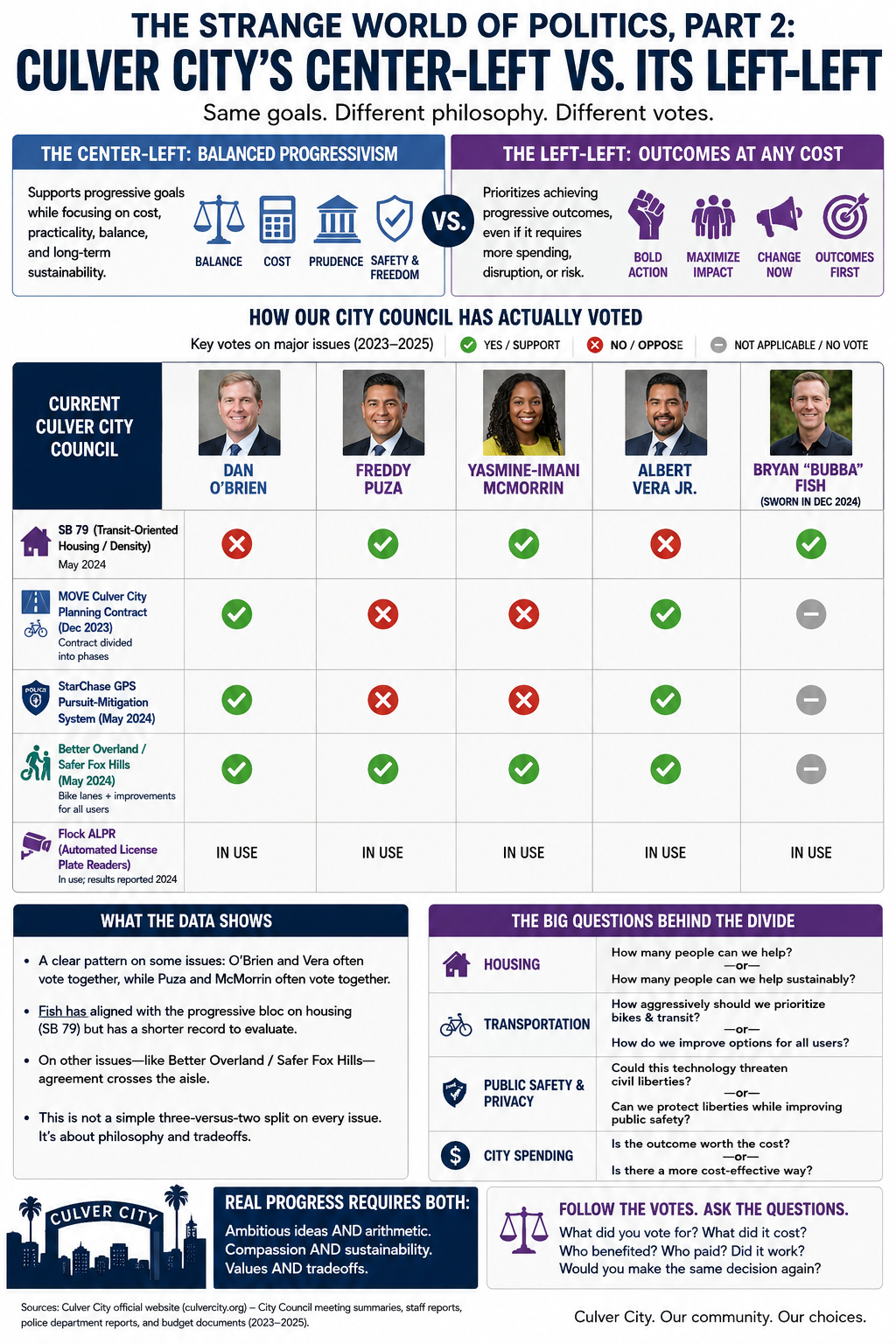
These aren't official political parties, and not every councilmember fits perfectly into either category. In fact, the voting record sometimes crosses these lines. But looking at actual City Council decisions reveals a meaningful philosophical divide over housing, transportation, policing, privacy, spending, and the role of local government.
Look at the Votes, Not Just the Labels
The current City Council consists of Dan O'Brien, Freddy Puza, Yasmine-Imani McMorrin, Albert Vera Jr., and Bryan "Bubba" Fish.
Rather than simply assigning ideological labels to them, let's look at what councilmembers have actually supported or opposed.
The voting patterns suggest that O'Brien and Vera frequently represent the more moderate or pragmatic side of the council, while Puza and McMorrin frequently represent its more progressive wing.
Fish appears aligned with the progressive side on some major issues, particularly housing, although his shorter council record means it is important not to assume that he will vote with one bloc on every issue.
That distinction matters.
Local government should be judged by decisions, not labels.
Housing: SB 79 Shows the Divide
Housing provides one of the clearest examples.
When the council considered supporting California SB 79, legislation intended to facilitate greater housing development around transit, the council split 3–2.
Puza, McMorrin, and Fish supported it.
O'Brien and Vera opposed supporting it.
Everyone can agree that California has a housing affordability problem. The disagreement is over how aggressively cities should pursue density, how much local control they should surrender, and how the consequences of those policies should be distributed.
That illustrates the larger philosophical divide.
One side tends to ask:
How do we build as much housing as possible?
The other is more likely to ask:
How do we create housing while balancing density, infrastructure, neighborhood impacts, affordability, and local control?
Those aren't the same questions.
Affordable Housing: The Question Nobody Should Be Afraid to Ask
The same distinction applies to subsidized affordable housing.
Consider Jubilo Village, a 93-unit, 100% affordable housing development with an estimated project cost of approximately $75 million.
Culver City's involvement includes substantial public financial support.
The city previously approved a $4 million loan, and the developer later sought an additional $16 million residual-receipts loan from Culver City. The city's FY2025–26 budget subsequently included the $4 million loan plus the additional $16 million contribution directed by the council.
Affordable housing unquestionably provides an important public benefit.
But residents should still be allowed to ask:
How much does each project cost taxpayers?
How much of the city's investment will ultimately be repaid?
How long will repayment take?
Could the same money produce more affordable units using another model?
And perhaps most importantly:
Can we repeat this model many times without compromising other city services or the city's long-term finances?
Those questions do not make someone anti-affordable housing.
They make someone concerned about whether affordable housing policy is financially sustainable.
The center-left and left-left may share the objective of increasing affordable housing while disagreeing dramatically over how much financial risk and public subsidy the city should accept to accomplish it.
Bikes vs. Cars: MOVE Culver City Shows Another Divide
Transportation provides another example.
In December 2023, the council considered a planning contract related to MOVE Culver City.
Vera, O'Brien, and then-councilmember Göran Eriksson supported a compromise dividing the contract into phases.
McMorrin and Puza opposed it.
The subsequent MOVE redesign is interesting because it demonstrates what a more balanced transportation model can look like.
The project retained protected bus-bike infrastructure while also restoring a general-purpose automobile lane.
That gets to the heart of the philosophical disagreement.
One approach emphasizes moving Culver City away from automobile dependence, even when doing so imposes significant inconvenience on drivers.
Another asks:
Why does improving bicycle infrastructure necessarily require making driving substantially worse?
We can create safer bicycle routes.
We can identify lower-traffic streets.
We can improve intersections.
We can use technology to guide cyclists toward safer routes.
We can even encourage navigation companies—or potentially create a city application—to distinguish between optimal automobile routes and safer bicycle routes.
The goal should not be bikes defeating cars.
It should be designing a transportation system that works better for people.
After all, the cyclist and the driver are often the same Culver City resident on different days.
The Voting Record Is More Complicated Than Two Camps
There is an important caveat.
The council does not divide neatly into two camps on every issue.
For example, in May 2024, McMorrin, O'Brien, Vera, and Puza all supported conceptual plans for Better Overland/Safer Fox Hills, including approximately three route-miles of concrete-protected bicycle lanes and improvements for pedestrians, transit users, and drivers.
That's important evidence.
It demonstrates that supporting bicycle infrastructure doesn't automatically make someone "left-left," just as supporting automobile access doesn't make someone anti-bike.
The real distinction may be how competing interests are balanced.
Public Safety: Technology vs. Privacy
Public-safety technology reveals another philosophical difference.
Culver City has used automated license-plate-reader technology to assist police investigations.
According to information presented by the Culver City Police Department in 2024, its automated license-plate-reader technology had contributed to more than 100 arrests involving stolen vehicles, 25 arrests of people wanted for serious violent crimes, and identification of more than 20 suspects in crimes committed in Culver City.
Those are significant claimed public-safety benefits.
But technologies such as Flock cameras also raise legitimate concerns about surveillance, data retention, government access, information sharing, and civil liberties.
The question therefore shouldn't be reduced to:
"Do you support surveillance?"
Almost nobody wants unlimited government surveillance.
A better question is:
Can Culver City obtain the public-safety benefits of this technology while establishing strict protections against abuse?
That might mean limits on data retention, restrictions on who can access information, auditing requirements, transparency reports, prohibitions on inappropriate sharing, and meaningful council and civilian oversight.
The left-left approach tends to give greater weight to eliminating the surveillance risk.
The center-left approach tends to ask whether the risk can be regulated while preserving a useful crime-fighting tool.
Police Technology Has Produced Clear Divisions Before
We have seen a similar disagreement with other policing technology.
In May 2024, the council considered the StarChase GPS pursuit-mitigation system, technology designed to allow police to track vehicles while potentially reducing the need for dangerous high-speed pursuits.
The vote produced a revealing division:
O'Brien, Vera, and Eriksson voted yes.
McMorrin and Puza voted no.
Again, the disagreement wasn't necessarily between people who care about safety and people who don't.
It reflected different assessments of police technology, government power, civil liberties, risk, and public safety.
Same Goals, Different Philosophy
This is what makes Culver City's political environment so interesting.
The two sides can begin with remarkably similar goals.
Both may want affordable housing.
Both may want safer streets.
Both may care about civil liberties.
Both may want to address climate change.
Both may want less homelessness.
Both may want a compassionate city.
Both may want safe neighborhoods.
The disagreement is frequently about tradeoffs.
On housing:
How many people can we help?
versus:
How many people can we help sustainably?
On transportation:
How aggressively should we prioritize bicycles and alternative transportation?
versus:
How do we improve those alternatives without unnecessarily damaging automobile mobility?
On police technology:
Could this technology threaten civil liberties?
versus:
Can we protect civil liberties while retaining technology that provides measurable public-safety benefits?
And on spending:
Is the objective important enough to justify the expenditure?
versus:
Is there a more cost-effective way to accomplish the same objective?
The Danger of "At Any Cost"
Where I become concerned is when legitimate political objectives become absolutes.
Affordable housing is important.
But at any cost?
Bicycle safety is important.
But regardless of the consequences for every other form of transportation?
Privacy is important.
But should every technology presenting a privacy risk automatically be rejected regardless of its potential public-safety benefits?
Environmental protection is important.
But should cost and economic consequences become irrelevant?
Government exists largely because communities have to choose among competing goods.
That's the difficult part of governing.
It isn't difficult to say we want affordable housing, safer streets, less crime, fewer emissions, better parks, excellent city services, help for the homeless, and lower taxes.
The difficulty begins when someone has to decide how to pay for all of it and what happens when those objectives conflict.
Culver City May Not Really Be Left vs. Right
This may be the most interesting feature of Culver City politics.
The traditional American political spectrum doesn't describe us particularly well.
Our important political disagreement may increasingly be between two versions of progressive government.
One emphasizes achieving progressive social outcomes, even when accomplishing them requires significant intervention, spending, or disruption of the status quo.
The other generally supports progressive objectives but places greater emphasis on cost, practicality, competing interests, measurable results, and unintended consequences.
I would describe that second philosophy as balanced progressivism.
It says:
Build affordable housing—but understand the financing.
Build bicycle infrastructure—but don't unnecessarily punish drivers.
Use public-safety technology—but establish strict civil-liberty protections.
Help people experiencing homelessness—but measure whether programs actually work.
Address climate change—but consider economic consequences.
Spend public money—but remember that every dollar belongs to the public.
Follow the Votes
Residents don't have to accept my description of either political camp.
They should examine the voting record themselves.
Sometimes O'Brien and Vera will vote with McMorrin or Puza.
Sometimes Fish may align with one group and sometimes another.
Sometimes the council may be unanimous.
That is exactly why actual votes matter more than political labels.
But when enough votes are examined over enough issues, governing philosophies begin to emerge.
And that's what residents should pay attention to.
Not whether someone calls themselves progressive.
Not whether someone calls someone else conservative.
Not endorsements.
Not slogans.
Ask instead:
What did you vote for?
What did it cost?
What happened afterward?
Who benefited?
Who paid?
Did it work?
And perhaps the most important question of all:
Would you make the same decision again?
That may be the real political divide emerging in Culver City.
Not Democrat versus Republican.
Not even left versus right.
But progressivism focused primarily on achieving an objective versus progressivism that insists the objective must also survive the tests of cost, practicality, balance, and long-term sustainability.
Welcome to the strange world of Culver City politics.
0 Comments