
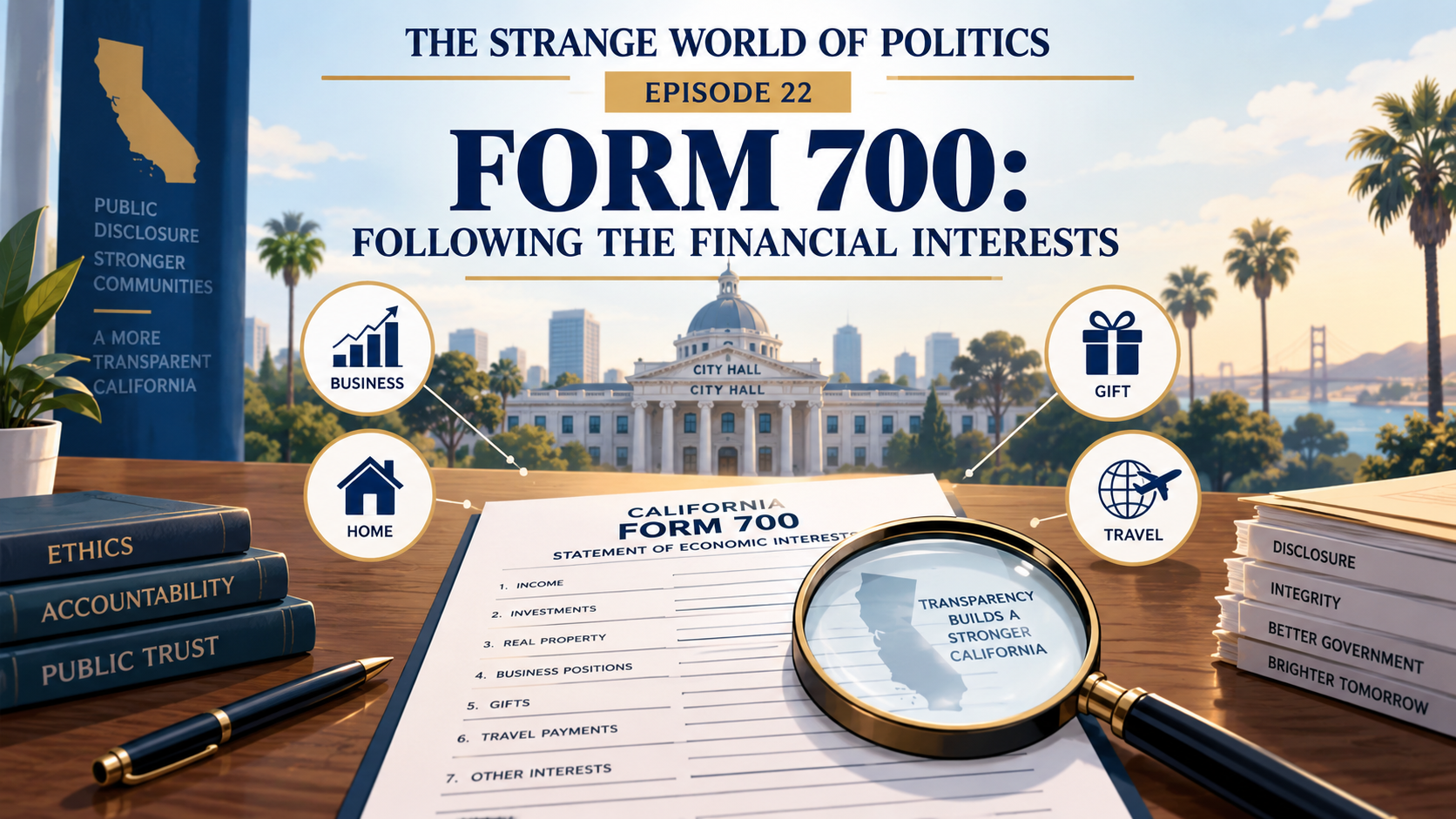
Most voters know that candidates submit nomination papers and campaign-finance reports. Far fewer know about another important public document: California’s Form 700, Statement of Economic Interests.
Form 700 allows voters to examine certain financial interests held by candidates and public officials. It is not a tax return, and it does not reveal every detail of someone’s finances. Its purpose is to identify financial interests that could create—or appear to create—a conflict when an official participates in government decisions.
I recently completed the form as a candidate for Culver City City Council. The process taught me not only what candidates must disclose, but also how voters can use these filings to better understand the people seeking public office.
What does Form 700 disclose?
Depending on a person’s financial circumstances, Form 700 may disclose:
Investments in individual companies
Ownership interests in businesses
Positions held with businesses
Real property located within the relevant jurisdiction
Rental income
Certain sources of income
Gifts
Travel payments
Certain loans
Arrangements for prospective employment
The form generally reports financial information through ranges rather than exact dollar amounts. For example, a filer might indicate that an interest is worth between $100,001 and $1 million without stating its exact value.
This gives the public meaningful information while avoiding disclosure of every personal financial detail.
Why is this important to voters?
Imagine that a council member is asked to vote on a project involving a company from which the council member receives income. Or imagine that an official owns property near an area being rezoned for significantly greater development.
That does not automatically mean the official has done anything improper. However, voters deserve to know about the financial connection. The disclosure allows the public, city attorneys, journalists, and watchdog organizations to identify possible conflicts and determine whether an official should participate in a particular decision.
The form can help voters ask informed questions:
Does the official own a business that could benefit from city contracts?
Does the official receive substantial income from an entity affected by city decisions?
Does the official own rental property affected by housing regulations?
Has the official accepted reportable gifts or travel payments?
Is the official voting on development rules that could affect property the official owns?
Disclosure does not prove misconduct. It gives the public information needed to evaluate potential conflicts.
How can voters read a Form 700?
Start with the cover page. It identifies the public office, jurisdiction, type of statement, and schedules attached.
Then review the applicable schedules:
Schedule A-1: Investments
This schedule generally identifies reportable investments of less than 10% in a business, including individual stocks. Many diversified mutual funds and qualifying diversified exchange-traded funds are not reportable.
Schedule A-2: Businesses and trusts
This schedule identifies businesses or trusts in which the filer has an ownership interest of 10% or more. It may show the general type of business, the filer’s position, the value range of the interest, the business’s gross-income range, and certain major sources of income.
Schedule B: Real property
This schedule reports qualifying real-estate interests within the official’s jurisdiction or generally within two miles of its boundaries. Rental income and tenants who meet the reporting threshold may also have to be disclosed.
A home used exclusively as a personal residence is generally excluded. A residence that is partly rented or used for business may be reportable.
Schedule C: Income, loans, and business positions
This schedule identifies other reportable sources of income, business positions, and certain loans. Income already properly reported on Schedule A-2 or Schedule B generally should not be duplicated here.
Schedules D and E
Schedule D covers reportable gifts. Schedule E covers certain travel payments, advances, and reimbursements.
What Form 700 does not tell voters
The form has important limitations.
It does not provide a complete financial biography. It generally does not disclose ordinary bank accounts, exact account balances, every debt, or every investment. Certain governmental income and qualifying diversified funds are excluded. Some personal information may also be redacted from the version posted online when there is a recognized privacy concern.
Income and asset values are usually shown as broad ranges. Therefore, voters should not treat Form 700 as if it were a candidate’s tax return or complete net-worth statement.
It is a conflict-of-interest disclosure document.
Filing the form should be easier
The current electronic filing system performs error checks, but the interface is dated and the questions can be difficult for a first-time filer to interpret. Terms such as “pro rata share of gross income,” “reportable single source,” and “fair market value of an investment” are not self-explanatory.
The system would benefit from secure AI assistance that could:
Explain every question in plain language
Ask relevant follow-up questions
Help filers identify the correct schedules
Warn against reporting the same income twice
Distinguish business revenue from personal income
Flag missing information before submission
Explain privacy and redaction options
Direct difficult legal questions to FPPC staff
AI should not make the legal certification for the filer. The candidate or official must still review the information and certify its accuracy under penalty of perjury. But well-designed assistance could reduce confusion, prevent honest mistakes, and improve the quality of information available to the public.
Filing notices also matter
In my case, I provided a Form 700 to the City Clerk during the candidate process. I was not told at that time that a separate electronic submission would be required. The email providing access to the state electronic system arrived after the deadline stated in that same email.
Once I learned that electronic submission was required, I completed it and supplied an explanation for the late electronic filing.
This illustrates why government agencies should provide clear and timely instructions. A filing system should tell candidates, before the deadline:
Which form must be filed
Where it must be filed
Whether both local and electronic submission are required
How to obtain access
What reporting period applies
Whom to contact for help
Transparency works best when the public receives complete information and filers receive understandable instructions.
How can voters find these Form 700 disclosures?
Online access
Go to the FPPC Form 700 Search page.
Click “Search Filed Form 700s.”
Search using:
First name:
Last name:
Agency: City of Culver City
Position: City/Town Council Member
Statement type: Candidate
Filing year: 2026, if requested
Open or download the official PDF.
The system also lets voters download the filing data as an Excel spreadsheet. They can choose a summary or full schedule details, making it easier to compare multiple officials or candidates. Open the direct public search portal.
Because you just submitted the form, it may not appear immediately. The FPPC may need time to process it and apply your requested residence-location redaction.
Requesting it locally
A voter can also ask the Culver City City Clerk for a copy of a candidate’s Form 700. This may be useful if:
The filing has not yet appeared in the FPPC portal;
The candidate originally provided a copy to the City Clerk; or
The voter is looking for another locally maintained disclosure.
Form 700 is a public record. However, an approved redaction may conceal the exact location of a filer’s personal residence from the online version.
What the voter receives
The voter can review:
Business ownership and business positions
Reportable sources of income
Real-property interests
Rental income and qualifying tenants
Gifts and paid travel
Certain loans
Potential financial connections relevant to government decisions
The filing uses dollar ranges instead of exact amounts, and it is not a complete tax return or net-worth statement. A disclosed interest is also not proof of wrongdoing—it gives voters information to identify and ask about possible conflicts.
How voters can use these disclosures responsibly
Voters should read Form 700 filings carefully and in context. A disclosed financial interest is not evidence of corruption. In fact, disclosure is the system working as intended.
The important questions are whether the interest was accurately disclosed, whether it creates a conflict in a particular decision, and whether the official properly recuses themselves when required.
Form 700 gives voters another tool for evaluating transparency and accountability. It helps the public move beyond rumors and examine information that candidates and officials are legally required to disclose.
In local government, decisions about development, contracts, transportation, housing, taxes, and public spending can significantly affect businesses and property owners. Knowing the financial interests of the people making those decisions is therefore not a minor administrative detail.
It is an essential part of public oversight.
0 Comments
Comments are reviewed before they appear.