
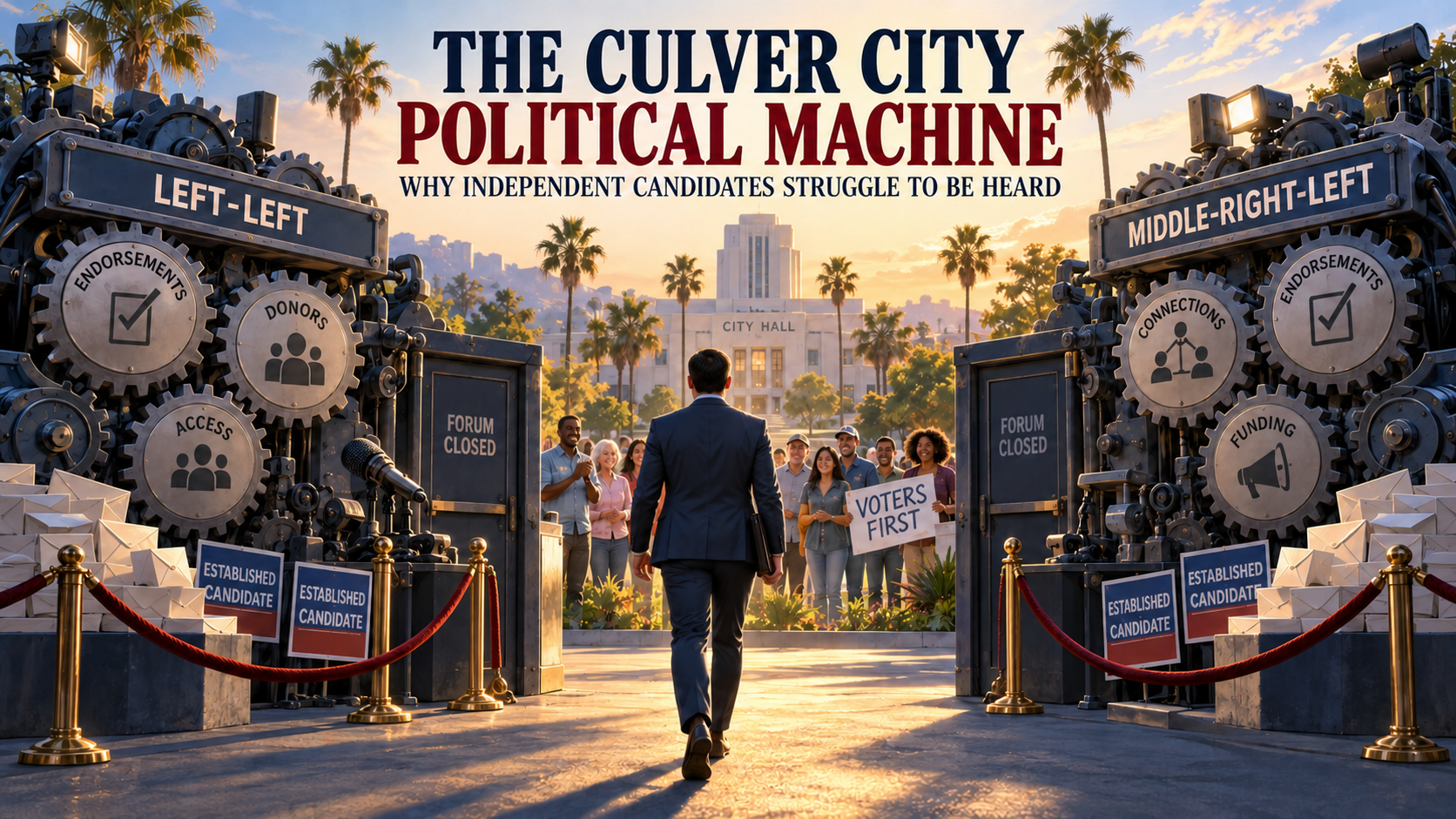
When most people hear the words “political machine,” they imagine something from national politics: wealthy donors, professional operatives, party bosses and organizations deciding who will receive money, endorsements and attention.
But political machines can also exist at the local level. They may be smaller, less formal and more difficult to see, but their influence can be enormous.
I am not alleging an illegal conspiracy or claiming that everyone involved secretly meets in a room to decide Culver City’s future. I am using “political machine” to describe an established network of elected officials, former officials, political clubs, advocacy organizations, donors, campaign volunteers, neighborhood leaders and local opinion-makers who repeatedly support familiar candidates.
That network can determine who is treated as a “serious” candidate long before voters receive their ballots.
Culver City’s Two Established Political Networks
From my perspective, Culver City currently has two principal political networks.
The first is what I call the left-left, associated with political figures such as Yasmine-Imani McMorrin, Freddy Puza and Bubba Fish. This network is generally connected to progressive organizations and voters who favor more aggressive approaches to housing, transportation, environmental policy and social programs.
The second is what I call the middle-right-left, associated with figures such as Albert Vera and Dan O’Brien. I use that term because traditional national labels do not adequately describe Culver City politics. These leaders may be viewed as more moderate or conservative than the left-left group on certain local issues, but they still operate in a city where most candidates and elected officials identify as Democrats or hold broadly liberal positions.
These descriptions are my own political shorthand. They are not official parties, and the individuals within each group do not necessarily agree on every issue.
Nevertheless, candidates often find themselves being placed into one of these camps. Once that happens, the machinery begins to operate.
I Was Personally Asked Not to Run—Twice
For me, this is not merely a political theory.
On two separate occasions, I was personally asked not to run for the Culver City City Council by people I understood to be connected to the established political machinery.
Think about what that means.
Before voters had an opportunity to evaluate me, before they could hear my positions and before they could decide whether I deserved their support, I was being encouraged to remove myself from consideration.
Why should anyone other than the voters decide who is allowed to compete?
Someone may believe that asking a person not to run is simply practical political advice. Perhaps they believe another candidate has a better chance of winning. Perhaps they fear that an additional candidate will divide votes. Perhaps they want to protect a preferred candidate or preserve the balance of power between the established camps.
But whatever the reason, the effect is the same: the political choices available to voters are narrowed before the election even begins.
No one physically prevented me from becoming a candidate. No law was used to keep me off the ballot. The pressure was more subtle: Do not run. Wait your turn. Step aside. Let the established candidates compete.
That is how a local political machine can exercise power without issuing an official command.
The people involved may characterize these conversations differently. I can only report what I personally experienced and how I understood it. But I know that I was asked not to run twice—and I know that candidates already accepted by the established networks do not face the same pressure to justify their presence in the race.
My answer was that the decision belongs to the voters.
Candidates do not own Council seats. Political clubs do not own Council seats. Current officeholders do not own Council seats. No established political group should decide that someone else’s candidacy is inconvenient.
If a candidate should not serve, let the voters reach that conclusion at the ballot box.
What Does a Local Political Machine Actually Do?
A local political machine does not need a headquarters or an official membership list. It works through relationships.
An established candidate may begin a campaign with:
Endorsements from current and former elected officials
Access to political clubs and their members
Invitations to candidate forums and private gatherings
Experienced campaign volunteers
Lists of reliable donors
Introductions to neighborhood leaders
Positive attention from local publications and political websites
Assistance with signs, mailers, canvassing and social media
An existing reputation among residents who regularly vote
Each individual advantage may appear minor. Combined, however, they can create a powerful political infrastructure.
For example, the Culver City Democratic Club’s public endorsement page lists Freddy Puza as its endorsed City Council candidate for the November 3, 2026 election. The page also states that additional endorsements may be considered. An endorsement like this can provide more than a name on a website. It can signal to members, donors, volunteers and politically active residents that one candidate has already been evaluated and accepted by an established organization. (Culver City Democratic Club endorsement page)
The problem is not that organizations endorse candidates. They have every right to do so. The problem arises when endorsements, invitations and visibility circulate primarily among people who already belong to the same political networks.
The Candidate Who Starts Outside the Machine
A candidate running without one of these networks begins from a very different position.
First, that person must learn an extraordinarily complicated process. Becoming a candidate involves nomination signatures, financial disclosures, committee registrations, campaign bank accounts, reporting requirements, deadlines, sign regulations and numerous government forms.
I have personally experienced how confusing this process can be. Information is spread across city, county and state agencies. One office may refer a candidate to another office. A bank may require a stamped form, while the government agency processing that form operates on its own timeline. Even a well-educated person can struggle to understand what must be filed, where it must be sent and when it becomes official.
An established political organization often has people who already understand this process. An independent candidate may have to discover everything alone—and mistakes can result in fines, delays or questions about the candidate’s credibility.
Second, an independent candidate must build an audience from nothing. The established candidates may already have supporters ready to donate, place signs, walk neighborhoods and promote them online. A newcomer must locate every volunteer, every donor and every voter individually.
Third, the independent candidate must persuade political organizations to provide access—even when those organizations already have longstanding relationships with other candidates.
The Gatekeeping Power of Candidate Forums
Candidate forums are one of the most important ways voters learn about local candidates. They allow residents to compare people directly, hear different opinions and decide who appears prepared to serve.
But a forum can only inform voters about candidates who are invited.
I experienced this problem when approximately 50 residents attended a local candidate forum and I was not invited, even though I was a candidate for the same office. Those residents heard from selected candidates, but they were not given an opportunity to hear from everyone seeking to represent them.
This is how gatekeeping works.
The organizers do not have to tell voters, “Do not support this candidate.” They can simply exclude the candidate from the room. The audience may never know someone was missing. Later, the excluded candidate may be criticized for lacking visibility or public support—the very visibility that the forum could have provided.
Every organization has the right to endorse whomever it chooses. But a candidate forum should not be confused with an endorsement meeting. If an event is presented as an opportunity for voters to learn about an election, every qualified candidate should ordinarily be invited.
Let the voters hear everyone. Let the candidates answer the same questions. Then let the voters decide.
The Appearance of Momentum
Political machinery also creates what I call the appearance of inevitability.
One organization endorses a candidate. That endorsement is promoted on social media. Another official repeats it. Volunteers display the candidate’s signs. A local publication covers the endorsement. More people donate because they believe the candidate is likely to win.
Soon, voters begin hearing that the candidate has “momentum.”
But where did that momentum originate?
Sometimes it reflects genuine widespread public support. At other times, it begins with a relatively small group of politically connected people validating someone they already know. Their support then creates greater visibility, and the visibility attracts additional support.
The candidate outside the system faces the reverse cycle: fewer invitations lead to less coverage; less coverage leads to fewer donations; fewer donations mean fewer mailers and signs; and the resulting lack of visibility is treated as evidence that the candidate is not viable.
That does not mean the public rejected the candidate. It may mean that much of the public never had an opportunity to hear from that person.
The Cost of Independence
Running independently does not mean running without values or experience. It means refusing to allow an established camp to determine every position.
That independence has a cost.
A candidate may agree with the left-left group on one issue and with the middle-right-left group on another. That candidate may support affordable housing while questioning excessive density, support bicycle safety while recognizing the needs of drivers, support strong public services while demanding financial accountability, and support the police while insisting that police authority ultimately comes from the public.
The political machine prefers predictable candidates. It wants to know how someone will vote, which coalition that person will join and whether the candidate will reliably support the group’s priorities.
An independent thinker is harder to categorize—and therefore harder for established organizations to trust.
I do not believe every decision should be made according to whether it pleases one political camp. My responsibility is to examine the facts, listen to residents and decide what is best for Culver City.
That may leave me without the automatic support of either machine. But City Council members are supposed to represent the entire city, not merely the organizations that helped elect them.
This Is Not an Argument Against Political Organizations
Political clubs, advocacy groups, unions, business organizations and neighborhood associations can perform valuable work. They help residents become involved, study issues and organize around shared values.
The solution is not to silence these organizations or prevent them from endorsing candidates.
The solution is transparency and broader access.
Voters should ask:
Who organized this candidate forum?
Were all qualified candidates invited?
How was an endorsement decided?
How many people actually participated in that decision?
Does the endorsing organization disclose its process?
Are the same candidates repeatedly endorsed by connected groups?
Is a publication reporting news or advocating for a political camp?
Is a candidate’s apparent popularity coming from ordinary voters or from an established network?
Are independent candidates being given a meaningful opportunity to speak?
Has anyone attempted to discourage a candidate from running before voters could hear from that person?
These questions do not attack democracy. They strengthen it.
What Voters Can Do
Voters have more power than the political machinery wants them to realize.
Do not assume that the candidate with the most endorsements is automatically the best candidate. Do not assume that the person with the most signs has the most public support. Do not assume that candidates excluded from forums were unqualified or unwilling to participate.
Visit every candidate’s website. Read their positions in their own words. Attend forums that invite everyone. Ask organizations why certain candidates were excluded. Look at campaign financial reports. Examine who contributes money and which individuals or groups repeatedly support the same political network.
Most importantly, speak directly with candidates.
A local election should not be decided solely by the small number of people who regularly attend political club meetings, organize endorsements and communicate with elected officials. It should be decided by renters, homeowners, workers, parents, seniors, business owners, immigrants and residents from every neighborhood.
Opening the Political Doors
Culver City does not need fewer political voices. It needs more.
The left-left deserves to present its ideas. The middle-right-left deserves to present its ideas. Independent candidates deserve the same opportunity. Then voters—not clubs, insiders or established networks—should make the final decision.
I entered this race knowing that I did not have the automatic support of Culver City’s established political machinery. I also entered it after being asked twice not to run.
Instead of discouraging me, those experiences showed me why running was important.
Local democracy can appear open while still being extremely difficult to enter. The barriers are not always written into law. Sometimes they are created through relationships, invitations, endorsements, access, pressure and silence.
My purpose in writing this is not to ask voters to feel sorry for independent candidates. Running for office is a voluntary decision, and every candidate should expect hard work.
My purpose is to help voters see the system operating behind the campaign signs.
When a candidate seems to be everywhere, ask who helped put that person there. When another candidate is missing, ask whether that person was invited. When an organization tells you whom to support, ask how it reached that decision. When someone asks a candidate not to run, ask whose interests are being protected—and why the voters are not being allowed to make that decision for themselves.
No political group owns Culver City. No organization owns its voters. No elected official has the right to choose who will be heard next.
The political machinery may help decide who receives the microphone—but voters still decide whose voice matters.
0 Comments