
I decided to run for Culver City Council.
Sounds complicated, right?
That is what I thought.
Then I went to the city clerk's office and discovered something surprising: getting yourself nominated as a candidate is actually much easier than most people probably think.
The entire process is supervised by the city clerk's office, and I have to give them credit. They do an excellent job of walking prospective candidates through the process.
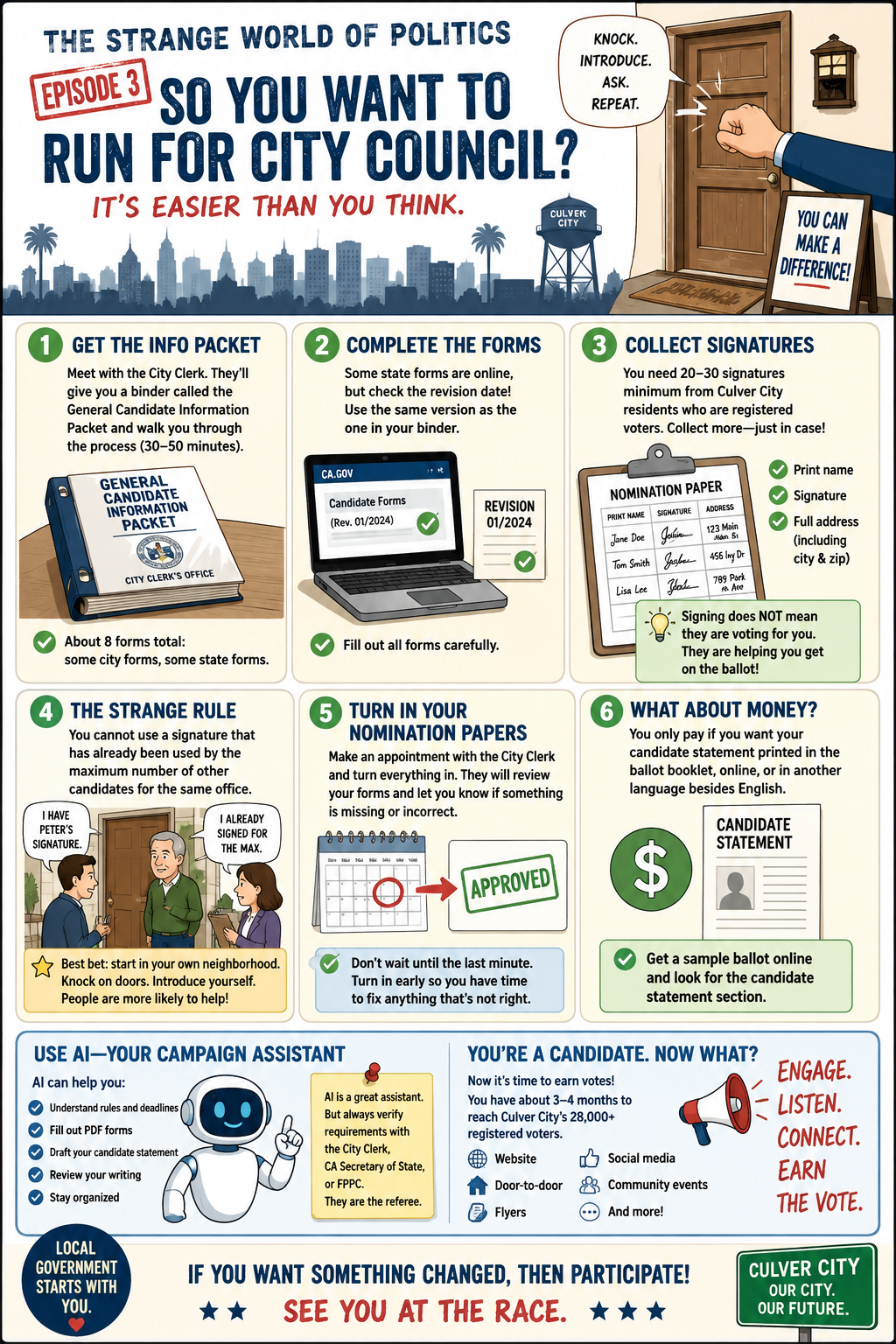
You sit down in their conference room for about 30 to 50 minutes, and they go through a binder called the General Candidate Information Packet with you.
And that binder becomes your political instruction manual.
The Mysterious Binder
Inside are roughly eight forms that you need to deal with. Some are city forms and others are required by the State of California.
Many of the state forms are available online, but here is something I learned: pay attention to the revision date.
Government forms get updated.
If the city clerk gives you a particular version in your candidate packet, make sure the version you download online matches the revision being used for the election.
Or make life easier and work directly from the forms the city clerk gives you.
Once you understand the paperwork, you move on to the part that takes considerably more time:
Signatures.
Now Go Find Some Voters
For reasons that still seem a little strange when you first encounter the process, you need signatures from Culver City residents who are registered voters and eligible to nominate you.
And you shouldn't collect only the minimum.
Collect extras.
Why?
Because some signatures may not qualify.
The process itself is wonderfully low-tech.
I went around my neighborhood, knocked on doors and basically said:
"I'm running for Culver City Council. Would you be willing to sign my nomination paper?"
That's essentially it.
Signing the nomination paper does not mean someone is promising to vote for you. They are helping you qualify to appear on the ballot.
The voter prints their name, signs the form and provides the required address information.
Then you move on to the next door.
It sounds intimidating until you actually do it.
Then I Learned About Another Rule
Here is where the strange world of politics makes another appearance.
There are rules governing how many candidates the same voter can nominate.
Imagine Jason and Janet are running for office and Peter signs nomination papers for candidates up to the number permitted for that office.
You may discover that Peter cannot also provide another valid nomination signature for you.
That can feel strange because nobody is actually voting yet.
These signatures are simply part of qualifying candidates for the ballot.
But election law has rules about nomination signatures, so you need to understand exactly what applies to your particular race.
This also gives you another reason to collect more signatures than the minimum.
My practical solution?
Start with your own neighborhood.
Knock on doors. Introduce yourself. Tell people you are running.
You might be surprised how many neighbors are willing to spend 30 seconds helping someone participate in their local democracy.
I Made a Mistake Too
I initially thought I needed only 15 signatures.
So I collected 17.
Then I discovered the requirement for my nomination papers was 20 to 30 signatures.
Oops.
Back to the neighborhood I went.
More doors. More conversations. More signatures.
And that taught me one of the most useful lessons of the entire process:
Do not wait until the last minute.
Get your paperwork organized. Collect your signatures early. Make your appointment with the city clerk and turn in your nomination papers as soon as you reasonably can.
If something is missing or incorrect, you want time to fix it.
The city clerk reviews what you submit and can identify problems with the paperwork. That is much better than discovering a problem when you have almost no time left to correct it.
"But I Don't Have a Political Machine"
Neither do most ordinary residents thinking about running for office.
You may look at incumbents or candidates supported by established political organizations and think:
How am I supposed to compete with that?
Don't confuse running for office with winning an election.
Those are two very different challenges.
Getting yourself qualified for the ballot is surprisingly manageable.
Winning is where the real work begins.
What About Money?
Here is another thing that surprised me.
The basic nomination process is not necessarily the giant financial barrier people might imagine.
One expense you may encounter involves your candidate statement—the short statement voters see in election materials.
Depending on the options you select, there can be costs associated with printing, electronic publication and translations.
If you have never seen a candidate statement, find an old sample ballot or voter information guide online.
You will immediately recognize it.
It is the little section where candidates introduce themselves, describe their qualifications and explain why they think you should vote for them.
And Yes, Use AI
This is 2026.
Use the tools available to you.
AI can help you understand confusing instructions, organize deadlines, draft a candidate statement, review your writing and help you work through government forms.
But there is an important distinction:
Use AI to help you understand and prepare. Do not use AI as your final authority on election law.
For official requirements, deadlines, forms and eligibility questions, verify everything with the city clerk, the California Secretary of State, the FPPC or whichever government agency actually administers the requirement.
Think of AI as your very fast assistant.
Think of the government agency as the referee.
Congratulations. You're a Candidate. Now Comes the Hard Part.
Once your nomination paperwork is accepted and you qualify for the ballot, the equation changes completely.
Now you need voters.
Culver City has tens of thousands of registered voters.
How do you reach them?
A good website.
Door-to-door conversations.
Flyers.
Social media.
Community events.
Neighborhood groups.
Candidate forums.
Emails.
Phone calls.
And probably a lot of walking.
You may not have the campaign infrastructure of an incumbent or someone backed by established political organizations.
But you have something else:
Time and the ability to talk directly to your neighbors.
Depending on when you begin, you may have roughly three or four months to introduce yourself to the community and make your case.
Is that easy?
No.
Is it impossible?
Absolutely not.
And that is really the point of this episode.
Local government can sometimes look like a mysterious institution operated by people who somehow know rules the rest of us were never taught.
But once you actually walk into city hall, ask questions, read the instructions and start filling out the forms, much of the mystery disappears.
You realize something important:
Regular residents can run for office.
You don't need to spend your entire life in politics.
You don't need to belong to the political establishment.
You don't need someone's permission to participate.
You need to learn the rules, complete the paperwork, collect your signatures and make your case to the voters.
So if there is something in Culver City you want changed, don't just complain about it.
Participate.
Maybe show up at a council meeting.
Maybe join a commission.
Maybe organize your neighbors.
Or maybe pick up that candidate binder yourself.
See you in the race.
The Strange World of Politics — Episode 3
0 Comments