
One of the unexpected things about running for Culver City Council is that I have started learning about city policy from both sides.
I can sit at a meeting and hear people talk about housing production, zoning, density, rent protections and development. But recently, I have also had the unusual experience of examining these issues as a property owner trying to understand whether my own property could actually be redeveloped.
That journey has taught me something important:
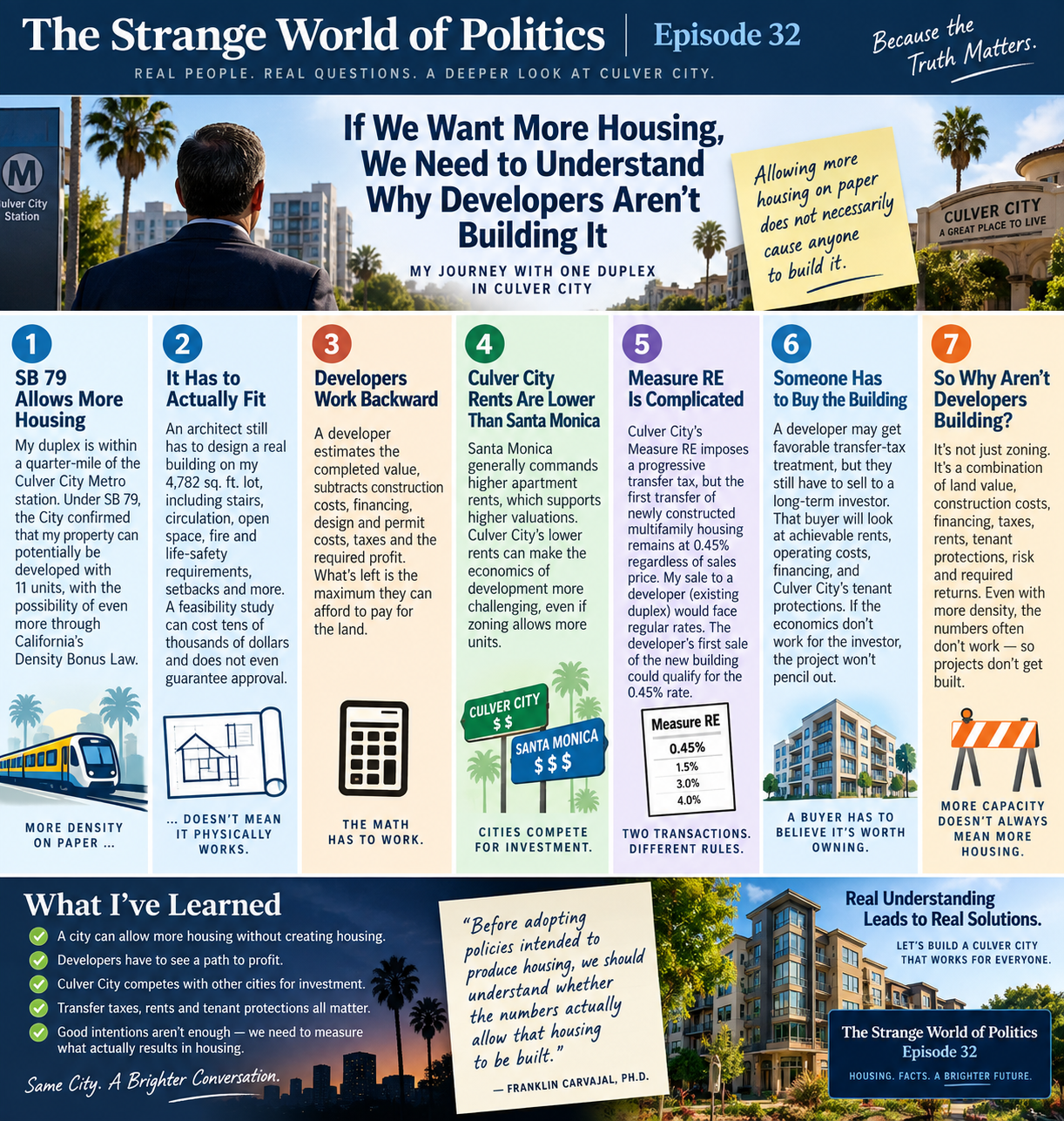
Allowing more housing on paper does not necessarily cause anyone to build it.
And I think voters deserve to understand why.
My little experiment on Wesley Street
I own a duplex on Wesley Street near the Culver City Metro station. I live in one unit and rent the other.
Then SB 79 took effect.
SB 79 allows substantially greater housing density near qualifying transit stops. Culver City adopted interim standards implementing the law, and the City confirms that qualifying projects near transit can receive substantially greater height and density than the underlying zoning would otherwise allow. Culver City
My property is within the quarter-mile area.
So I started asking a seemingly simple question:
How many apartments could actually be built on my property?
The City's Planning Director confirmed to me that the SB 79 calculation for my parcel produces 10.98 units and that the City rounds that to 11 units. She also confirmed that development standards must be modified where necessary to allow an SB 79 project to achieve its applicable capacity. Pasted markdown (2)
That sounded remarkable.
I currently have two units.
The law potentially allows 11 units as the SB 79 base, with the possibility of additional units through California's Density Bonus Law, depending on affordability and other requirements.
So I thought: This land must suddenly be extremely valuable to a developer.
It turns out that things are much more complicated.
Lesson #1: Zoning doesn't create a building
The first thing I learned was the difference between what is legally permitted and what is physically feasible.
A law can say 11 units.
But an architect still has to put those units somewhere.
My lot is only about 4,782 square feet. An architect has to figure out where the apartments go along with stairs, circulation, entrances, open space, fire and life-safety requirements, setbacks and all the other pieces necessary to create an actual building.
That is why architects perform feasibility studies.
I received proposals ranging from a relatively modest preliminary feasibility study to a much more extensive approximately $35,000 architectural study plus roughly $15,000 for a land-use consultant.
One architect's proposal explicitly says that this approximately $35,000 initial architectural phase would produce conceptual plans, sections, massing, circulation and unit information—but would not itself constitute a Culver City entitlement submission. AG_Service_Order_2609_3565 Wesl…
That was another education.
Before a developer pours a single yard of concrete, substantial amounts of money can be spent simply answering:
Can the building that the law theoretically permits actually be designed on this particular piece of land?
Lesson #2: More units don't automatically mean more land value
Then I started talking to developers.
One developer working on an SB 79 project in Santa Monica gave me an important reality check.
He told me that the small size of my lot could be a problem and that apartment and condominium returns in the neighborhood could make development economics difficult. He emphasized that the price paid for the property would be critical.
Then a broker who specializes in apartment and development properties analyzed my property.
His conclusion surprised me even more.
His preliminary opinion was that my property might actually be worth more today as a duplex with my already-approved plans for two additional ADUs than as a small SB 79 development site. His estimated value for the duplex with the ADU plans was approximately $1.45 million to $1.575 million, while his preliminary SB 79 development-site range was approximately $1.10 million to $1.40 million. Pasted text
Think about that.
Two existing units can potentially be worth more to a buyer than land legally capable of supporting 11 or more units.
That sounds crazy until you understand how developers calculate value.
Lesson #3: Developers work backward
A developer doesn't simply say:
Eleven apartments! I'll pay a fortune for the land.
The calculation is closer to this:
What will the completed building be worth?
minus
What will it cost to build?
minus
Financing
minus
Architects, engineers and consultants
minus
Entitlement and permit costs
minus
Taxes and selling costs
minus
The return the developer needs for taking all that risk
equals
what the developer can afford to pay for the land.
This is called residual land value.
And suddenly my experience started making sense.
Lesson #4: Culver City competes with other places for investment
Developers don't have to build in Culver City.
Their money can go somewhere else.
Santa Monica, for example, generally commands higher apartment rents than Culver City. That matters enormously.
Imagine two buildings that cost roughly similar amounts to construct. If apartments in one location generate substantially more rent, the finished building there can support a higher valuation.
That means the developer can potentially pay more for the land and still achieve the required return.
This is something we sometimes forget when discussing housing policy.
Cities compete for investment.
A city can allow additional density, but if the economics are more attractive somewhere else, capital can simply go somewhere else.
Lesson #5: I misunderstood Measure RE at first
This part of my journey was particularly interesting.
Culver City's Measure RE imposes a progressive real-estate transfer tax. The City's normal rates rise from 0.45% in the first bracket to 1.5%, 3% and eventually 4% as transaction value moves through progressively higher brackets. Culver City
At first, I thought:
Wouldn't that make it extremely expensive for a developer to build an apartment building and then sell it?
Then I discovered an important exception.
Culver City specifically retains the 0.45% flat rate for the first transfer of newly constructed multifamily housing. Culver City
That's an important incentive.
Suppose a developer buys my existing duplex.
My sale to the developer is one transaction. I am selling an existing property—not newly constructed multifamily housing—so that special new-construction treatment does not arise merely because the buyer plans to redevelop it.
The developer then constructs a new apartment building.
If the developer subsequently makes the qualifying first transfer of that newly constructed multifamily housing, the City's Measure RE materials say the 0.45% rate remains applicable. Culver City
That can significantly reduce the developer's exit cost.
I initially thought I had found the answer.
Maybe Culver City actually provides a substantial advantage to developers who build and sell rather than build and hold.
Then I realized I was still missing something.
Lesson #6: Someone has to buy the completed building
Imagine the chain:
Property owner → Developer → New apartment building → Long-term investor
The developer may receive favorable Measure RE treatment on the qualifying first sale of the newly constructed multifamily property.
But who buys it?
Probably an investor who intends to own the apartments and collect rent.
And that investor asks an entirely different question:
If I spend millions of dollars buying this apartment building, what return will I receive from owning it?
Now we are right back to rents, operating expenses, financing and regulation.
Culver City has extensive tenant protections. Its local Rent Stabilization Ordinance generally applies to rental units built on or before February 1, 1995, while newer units are exempt from that local rent-stabilization provision. The City's Tenant Protections Ordinance, however, applies much more broadly, and state tenant-protection laws may also apply depending on the circumstances. Culver City
That distinction is important. It would be inaccurate simply to say that a newly constructed apartment building would be subject to Culver City's local rent cap in exactly the same way as my 1947 duplex.
But investors still evaluate the entire regulatory environment along with achievable rents.
And if an investor concludes that a completed Culver City apartment building is worth $8 million rather than $10 million, that difference travels backward through the entire transaction.
The investor pays the developer less.
The developer therefore has less money available for construction and land.
And ultimately:
The developer offers the original property owner less.
Lesson #7: The housing problem isn't just zoning
This has probably been the biggest lesson for me.
California can pass SB 79.
Culver City can permit 11 units where two units exist today.
The State Density Bonus Law may allow even more.
We can increase height.
We can increase density.
We can reduce regulatory barriers.
And the project still might not get built.
Why?
Because somebody still has to risk millions of dollars and believe that the completed building will be worth sufficiently more than everything it costs to create.
That's the strange part.
We can create housing capacity without creating housing.
So what am I doing with my own property?
Rather than guessing, I decided to go directly to the City.
I paid Culver City $792.80 and submitted a formal request, P2026-0205, asking the City to tell me exactly what can be developed on my property.
I want the City to clarify the 11-unit SB 79 base, how Density Bonus could apply, the potential maximum number of units, affordability requirements, applicable development standards, and what concessions or waivers might be available.
Then an architect can answer the second question:
What actually fits?
And then the market answers the third:
Is it economically worth building?
I have learned that those are three completely different questions.
And that is why this matters to voters
My experience with one tiny lot on Wesley Street has become a miniature lesson in housing policy.
When somebody says:
“Developers aren't building because the zoning doesn't allow enough housing.”
Sometimes that may be true.
When somebody else says:
“Just increase density and developers will build.”
That can also be incomplete.
Housing production sits at the intersection of zoning, architecture, construction costs, financing, taxes, rents, tenant protections, affordability requirements, land prices and investor returns.
Change one variable and you can change the entire project.
That doesn't mean we should eliminate tenant protections.
It doesn't mean we should eliminate taxes.
And it doesn't mean we should simply give developers whatever they request.
It means something much less ideological and much more practical:
Before adopting policies intended to produce housing, government should understand whether the numbers actually allow that housing to be built.
We should ask:
What does this policy accomplish in the real world?
How many units were actually constructed?
How long did approval take?
What prevented approved projects from being financed?
Which requirements materially affected feasibility?
Which incentives actually resulted in construction?
And which policies sounded good but produced little housing?
That is the kind of information I want Culver City to measure and make understandable to the public.
Because after spending weeks investigating my own 4,782-square-foot property, talking with architects, land-use professionals, brokers, developers and City Planning, I've learned something surprisingly simple:
A city doesn't create housing merely by allowing someone to build it.
Someone still has to be willing to build it, someone has to finance it, and ultimately someone has to believe it is worth owning.
That is the strange world of politics—and, apparently, the equally strange world of real estate development.
0 Comments
Comments are reviewed before they appear.