
Something very interesting happened at the September 14 Culver City Council meeting.
On the same agenda where the City was discussing major real-estate transactions, Culver City also considered joining the Westside Cities Affordable Housing Trust.
At first glance, these may look like completely separate issues. And, to be clear, I have seen no evidence that the City's negotiations involving the former Sony Animation campus are connected to the Housing Trust.
But both raise a much larger question that Culver City needs to confront:
How much financial risk should a city take in pursuit of important public goals?
First, what is the Westside Cities Affordable Housing Trust?
The name makes it sound more complicated than it is.
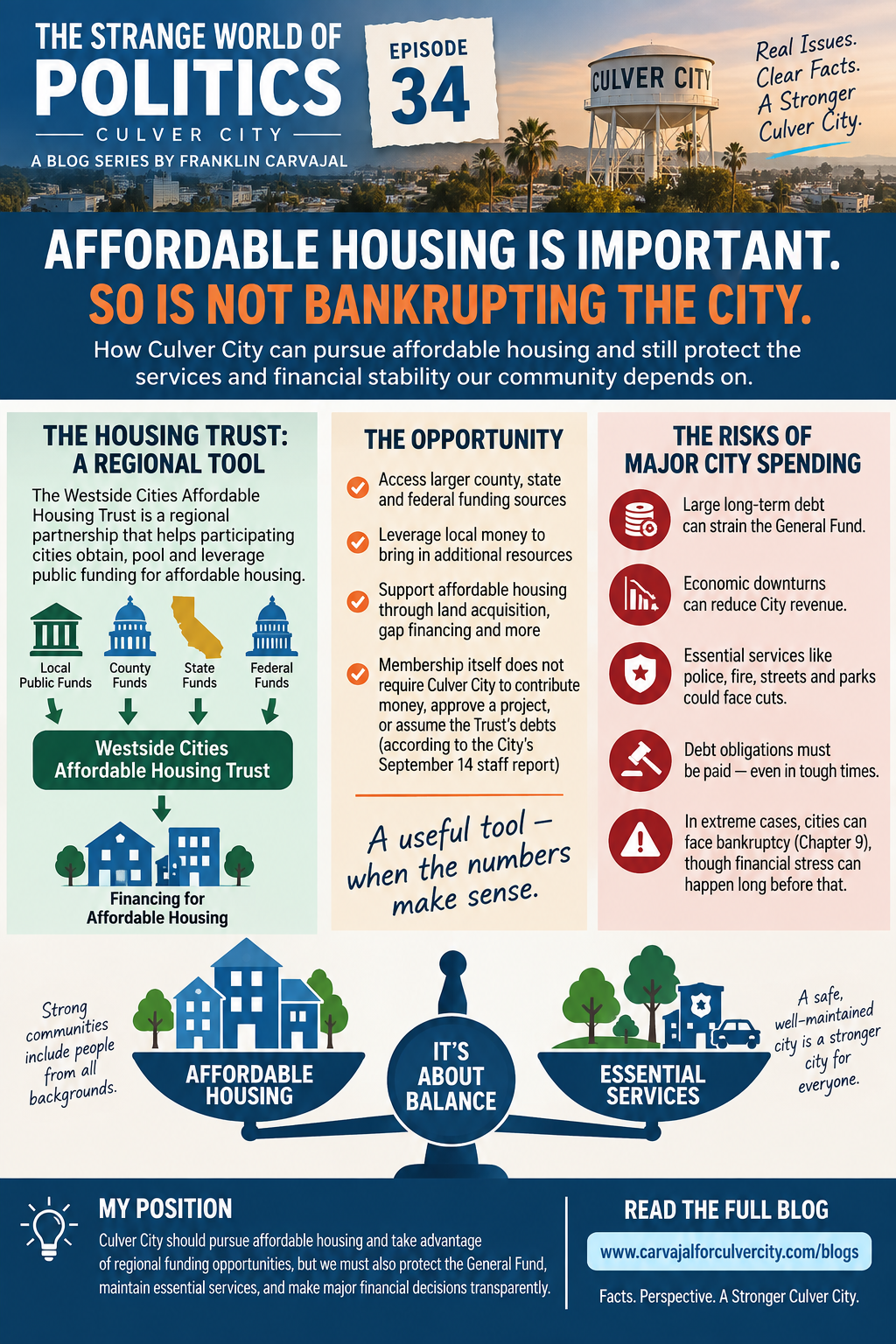
The Westside Cities Affordable Housing Trust is a regional Joint Powers Authority designed to help participating cities obtain, pool, manage and leverage money for affordable housing.
The Westside Cities Council of Governments says the Trust can help obtain state and federal funding and use tools including land acquisition, gap financing and development of a pipeline of affordable-housing projects.
In very simple terms:
Public money → Housing Trust → affordable-housing financing.
Some of that public money can originate locally. Other money can come from county, state or federal programs.
The idea is to leverage resources. Instead of Culver City attempting to finance an entire affordable-housing project by itself, regional cooperation can potentially help bring additional outside public funding into a project.
That can make sense.
Culver City's September 14 staff report also contains an important protection: simply joining the Trust does not obligate Culver City to contribute money to a housing project, approve a particular development, give up its land-use authority, or assume the Trust's liabilities.
The staff report stated that joining itself had no General Fund fiscal impact.
I Support the Goal of Affordable Housing
Affordable housing is a real need.
Teachers, healthcare workers, service employees, young families, seniors and many other people increasingly struggle with the cost of living in Southern California.
Government has a legitimate role in addressing that problem.
But supporting affordable housing does not mean that every proposed expenditure on affordable housing is automatically a good financial decision.
That distinction is extremely important.
We should be able to say two things at the same time:
We need affordable housing.
And:
We need to protect Culver City's financial health.
Those aren't contradictory positions.
In fact, responsible government requires both.
Because There Is No Such Thing as Free Government Money
When we hear that money is coming from a "state grant," "federal funding," "county funding," a "housing trust," or a "local housing fund," it can sound as though the money appeared from somewhere else.
It didn't.
These are public resources.
Local money can include taxes, fees, General Fund appropriations and dedicated housing funds. County, state and federal programs are also funded through public revenues.
A regional housing trust can be extremely useful because it may allow Culver City to leverage relatively limited local resources to obtain substantially greater outside funding.
But taxpayers are still ultimately funding government.
That doesn't make the expenditure bad.
It means we should care about how effectively that money is being spent.
And Now We Get to the Bigger Culver City Question
At the same September 14 meeting, Culver City was also dealing with potential purchases of some extraordinarily valuable real estate.
After closed session, the City announced that it would not pursue acquisition of The Culver Steps at 9300 Culver Boulevard.
However, the Council gave its negotiators instructions concerning the former Sony Animation campus at 9050 Washington Boulevard, meaning those negotiations continue.
The Sony campus reportedly changed hands following foreclosure for approximately $71 million.
We still don't publicly know what Culver City ultimately wants to do with that property.
Maybe it has nothing to do with housing.
Maybe housing will eventually be proposed.
Maybe the City has an entirely different public purpose in mind.
Until the City tells us, we shouldn't pretend to know.
But we absolutely should ask questions.
Seven Former Mayors Raised a Serious Warning
Before the September 14 meeting, seven former Culver City mayors publicly raised concerns about the City's potential property acquisitions.
They estimated that the broader group of properties then under consideration could cost approximately $200 million to $275 million.
They further estimated that, if financed similarly to the City's recent borrowing, the obligation could have reached approximately $14 million to $19 million every year for 30 years from the General Fund.
Those are estimates from the former mayors—not an adopted City financing plan.
But think about what they are warning about.
The General Fund is the money Culver City relies upon to provide many of the services residents expect from their government.
Police.
Fire.
Streets.
Parks.
Infrastructure.
City employees.
Maintenance.
And many other essential services.
Debt doesn't disappear because the economy gets bad.
The Danger Is Not Simply "Debt"
Cities borrow money all the time.
Borrowing can be completely appropriate.
If Culver City borrows money to acquire an asset that produces enormous public value and the City can comfortably afford the payments, debt can be a useful financial tool.
The danger comes when long-term financial commitments become too large relative to the City's ability to pay them.
Imagine a family earning $150,000 a year.
Having a mortgage isn't inherently irresponsible.
But if the mortgage, car loans, credit cards and other fixed obligations consume nearly everything the family earns, the family has a problem.
The same basic principle applies to government.
A city can become so burdened by debt and other fixed obligations that less money remains available for everything else.
And unlike a household, a city cannot simply decide:
"This month we're not paying the bondholders because we'd rather repair the sidewalks."
Debt obligations have to be paid according to their contracts.
Could Culver City Actually Go Bankrupt?
Municipal bankruptcy is possible under Chapter 9 of the federal Bankruptcy Code, subject to federal and state-law requirements.
But bankruptcy is the extreme scenario.
The more immediate concern is what can happen long before bankruptcy.
A financially stressed city may have to postpone infrastructure projects, leave positions vacant, reduce services, defer maintenance, seek additional revenue, sell assets, or make other difficult budget choices.
That's the risk I care about.
We shouldn't wait until someone uses the word "bankruptcy" before becoming concerned about a city's finances.
The better question is:
How much of tomorrow's City budget are we committing today?
Affordable Housing Has to Be Part of the Equation
This is where I don't want this discussion to become ideological.
I don't believe the answer is:
"Stop spending money on affordable housing."
And I don't believe the answer is:
"Affordable housing is important, therefore whatever it costs is justified."
Government has to balance competing needs.
If Culver City can contribute $1 and leverage that contribution into several additional dollars from county, state or federal programs, that deserves serious consideration.
If an affordable-housing investment creates a valuable long-term public asset while maintaining the City's financial stability, that deserves consideration too.
But if a project requires enormous continuing General Fund subsidies, substantial borrowing, or decades of financial commitments that could jeopardize essential services, residents deserve to know that before the commitment is made.
Show Us the Numbers
For a major City investment, I want residents to be able to see:
What are we buying?
Why are we buying it?
What is the independent appraisal?
What will the City borrow?
What will the annual payments be?
How many years will we be paying?
What revenue will the project generate?
How much money could ultimately come from the General Fund?
What happens if revenues don't meet projections?
What is the public benefit?
And what City services could be affected under a worst-case financial scenario?
Those aren't anti-housing questions.
They're responsible-government questions.
More Open Government, Not More Closed Meetings
This also gets to one of the central reasons I am running for Culver City Council.
I want more City business conducted in public whenever the law allows it—not more decisions disappearing behind closed doors.
California law legitimately permits closed sessions for certain matters, including aspects of real-estate negotiations. There are good reasons for that. You don't want the City publicly announcing its maximum negotiating price while trying to buy property.
But protecting the City's negotiating position does not mean residents should be kept in the dark about everything surrounding a transaction.
When legally permitted, residents should know the purpose, financial implications, alternatives and long-term consequences of major City investments before irreversible commitments are made.
The larger the financial commitment, the greater the need for public scrutiny.
My Position
Culver City should pursue affordable housing.
Culver City should take advantage of county, state and federal resources when doing so makes financial sense.
Regional cooperation through organizations such as the Westside Cities Affordable Housing Trust may provide useful ways of leveraging those resources.
But we must also protect Culver City's General Fund and its ability to provide essential services.
Affordable housing and fiscal responsibility should not be enemies.
Our job should be to accomplish both.
Because helping people afford a place to live is an important public responsibility.
And so is making sure the City can still afford to provide police and fire protection, repair streets and sidewalks, maintain parks and infrastructure, and serve its residents ten, twenty and thirty years from now.
That's the balance I want Culver City to have.
And before we commit future generations of Culver City residents to decades of payments, I want the public to see the numbers.
That's not opposition to affordable housing.
That's accountability.
0 Comments
Comments are reviewed before they appear.