
One of the things I have learned while running for Culver City City Council is that campaigning is also a crash course in an entire industry that most voters probably never see.
Mailers. Digital advertising. Campaign consultants. Voter files. Door hangers. Social media. And now, text messages directly to voters' cell phones.
Welcome to Episode 35 of The Strange World of Politics.
The Email That Started It
This morning, I received an email from a company offering something called peer-to-peer texting, often abbreviated P2P.
The basic concept is simple: campaigns can send text messages to large numbers of voters.
The company described two types of messages:
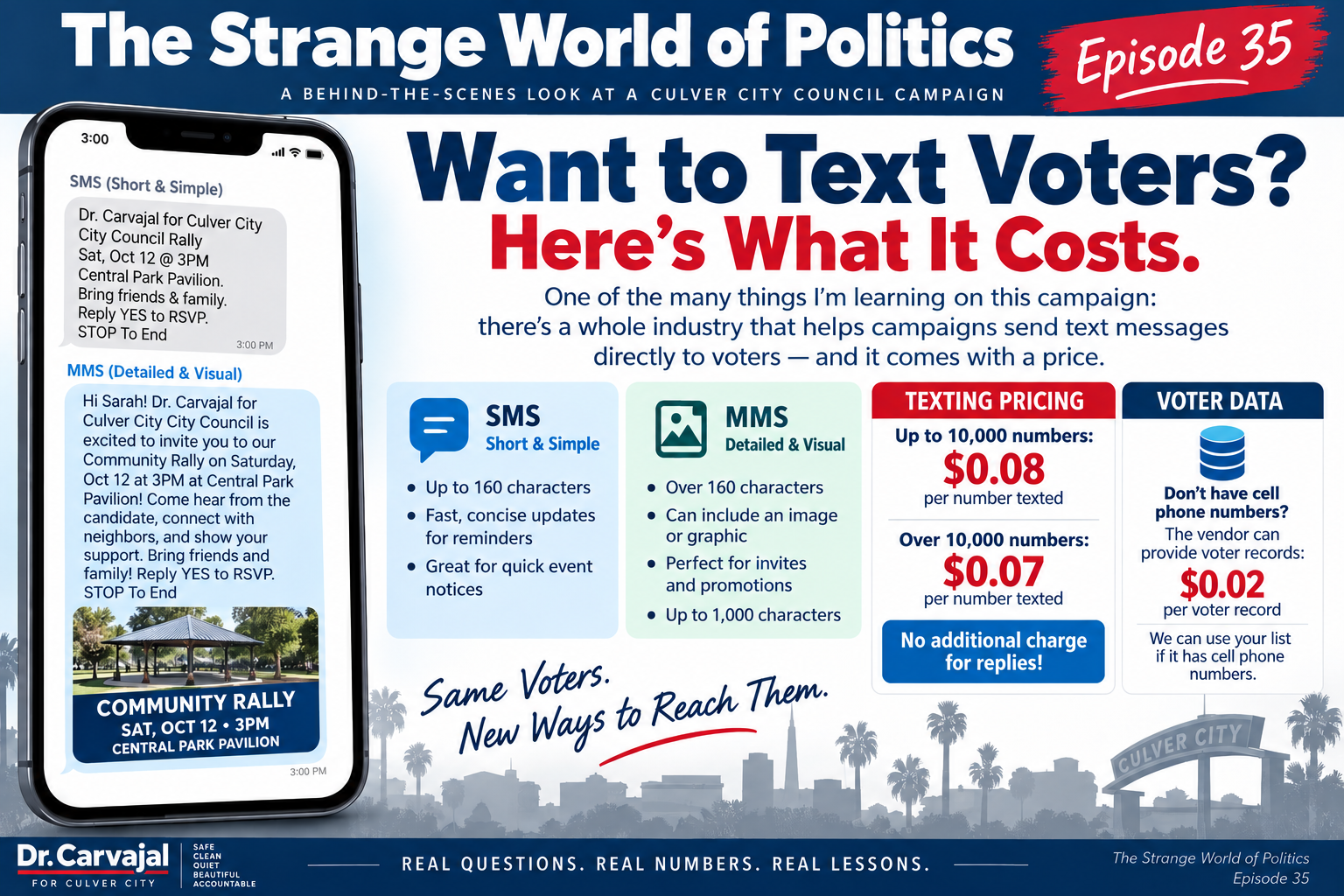
SMS is the traditional short text message.
MMS allows a longer message and can include an image or campaign graphic.
That immediately raised two questions for me:
How much does this cost?
And:
Can I use the voter list I obtain for my Culver City campaign to decide which voters receive the messages?
So I asked.
Here's the Quote I Received
The response was surprisingly straightforward.
The company quoted:
Up to 10,000 numbers:
$0.08 per number texted.
More than 10,000 numbers:
$0.07 per number texted.
According to the quote, there is no additional charge for replies, and a message can contain up to 1,000 characters and an image or graphic.
That means the basic math looks like this:
1,000 texts = $80
5,000 texts = $400
10,000 texts = $800
20,000 texts = $1,400, assuming the quoted $0.07 rate applies to all 20,000.
That is when campaign communications start becoming very real.
Eight cents doesn't sound like much.
Multiply it by thousands of voters and suddenly you are talking about hundreds or thousands of dollars.
But You Need Cell Phone Numbers
There is another important detail.
A traditional voter file doesn't necessarily give a campaign everything it needs to send text messages. The vendor told me that it can use my voter list if the list contains cell phone numbers.
If it doesn't, the company also offered to provide voter records.
The quoted price:
$0.02 per voter record.
So, for example, 10,000 voter records would cost another $200.
Combine that with texting 10,000 numbers at the quoted eight cents each, and the cost could be around:
$1,000.
And that could be for essentially one round of communication.
This Is the Part of Campaigning Voters Rarely See
When you receive a political postcard, text message, email, digital advertisement, or door hanger, it may look simple.
Behind it is an entire campaign communications system.
Someone has to identify the voters.
Someone has to obtain or prepare the voter data.
Someone has to design the message.
Someone has to determine which voters should receive it.
Someone has to send it.
And, of course, someone has to pay for it.
Running for a small city's City Council has introduced me to an industry built around helping campaigns communicate with voters.
Nearly every new thing I learn seems to come with another price per voter.
Why Targeting Matters
There is also an interesting distinction between simply sending thousands of texts and using a voter file.
A campaign may have information in its voter data that allows it to select recipients according to lawful voter-file fields and other available data rather than sending the same communication indiscriminately.
That makes the voter list an important campaign tool.
But campaigns also have responsibilities when handling voter information and sending political texts. Applicable federal and state rules, carrier requirements, opt-out procedures, and restrictions on the use of voter data all have to be considered before launching a texting program.
I am learning about those requirements as I investigate whether this is something my campaign will use.
Another Campaign Expense
This experience also illustrates something I didn't fully appreciate before becoming a candidate.
Campaigning can become expensive through lots of relatively small decisions.
A few hundred dollars for printing.
Another expense for postage.
Another for advertising.
Another for voter data.
Another for texting.
Another for signs.
Another for a website.
Individually, some of these expenses don't sound enormous.
Together, they can become a substantial campaign budget.
And that helps explain why fundraising—and how campaigns spend their money—becomes such an important part of running for office.
What I Learned Today
Today's lesson from the strange world of politics:
Yes, political campaigns can text thousands of voters.
Yes, those messages can include graphics and longer messages.
Yes, campaigns can potentially use voter lists to determine whom they contact, subject to the applicable rules governing the data and political messaging.
And, naturally:
There is an industry ready to sell campaigns the technology and data to do it.
My quote was 7–8 cents per texted number, with voter records available for an additional 2 cents each.
Tomorrow, I will probably discover another part of campaigning I didn't know existed.
And I'm guessing there will be a price attached to that, too.
The Strange World of Politics is my continuing account of what I am learning while running for Culver City City Council— including the paperwork, money, rules, vendors, technology, and behind-the-scenes mechanics that voters normally don't get to see.
0 Comments
Comments are reviewed before they appear.