
Here is a question I think Culver City residents deserve to have answered:
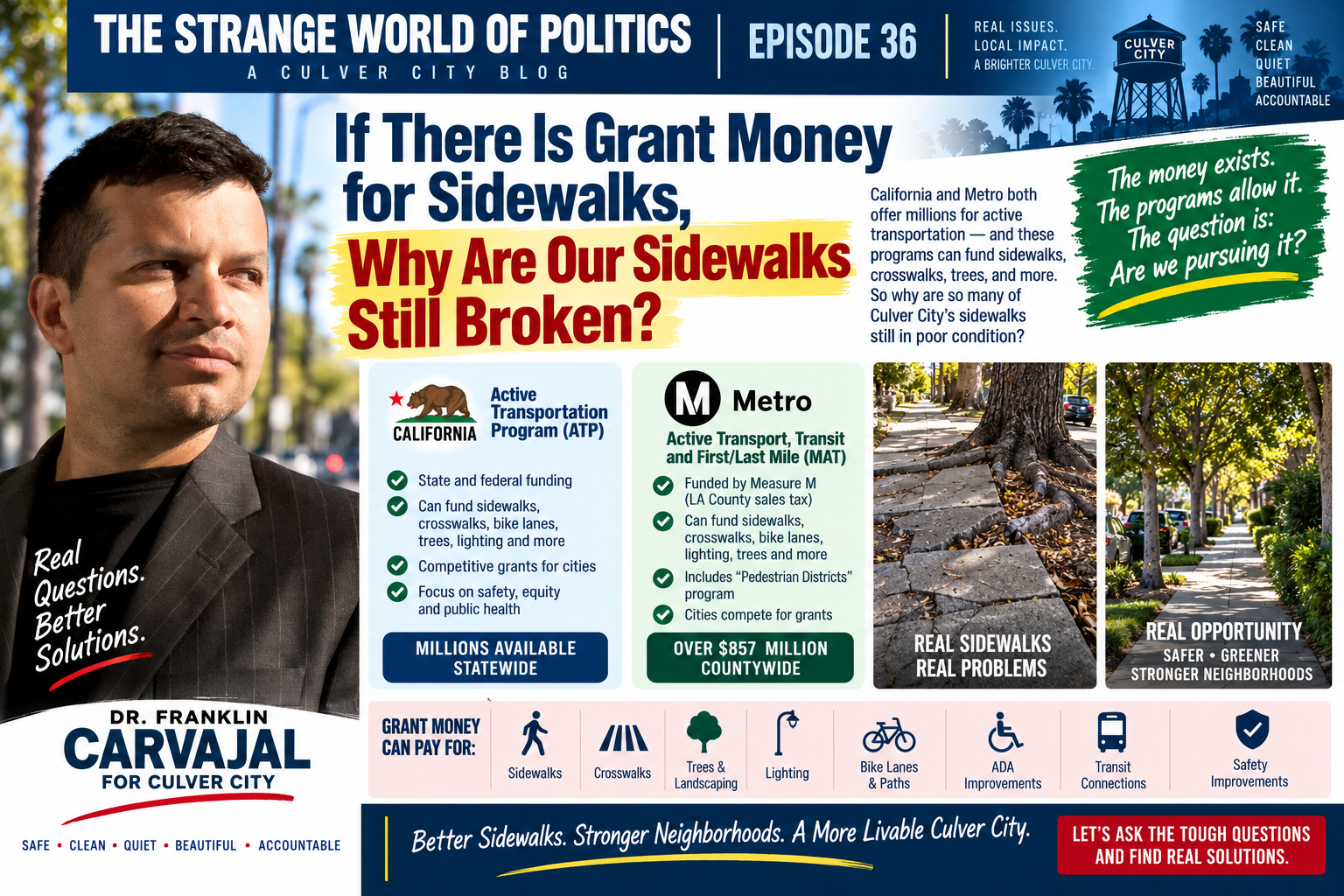
If California offers millions of dollars in active-transportation grants, and Los Angeles Metro also offers millions of dollars in active-transportation grants—and those programs can pay for pedestrian and sidewalk improvements—why do we still have so many sidewalks that need repair?
That question became more interesting to me when I started following the money.
There Isn't Just One Source of Outside Money
California has an Active Transportation Program, or ATP.
Los Angeles Metro has its own Active Transport, Transit and First/Last Mile Program, or MAT, supported by Measure M.
These programs are designed to encourage alternatives to driving.
But here is the important part:
Active transportation does not mean bicycles only.
Metro specifically says eligible projects can include:
sidewalks;
crosswalks;
pedestrian improvements;
bicycle lanes and paths;
pedestrian and bicycle signals;
lighting;
shade structures;
landscaping; and
other improvements supporting people walking, biking and rolling.
Metro even has an entire grant category called Pedestrian Districts.
California's programs also support pedestrian infrastructure.
So this raises an obvious question.
Why Aren't We Going After More Money Specifically for Sidewalks?
Culver City has demonstrated that it knows how to compete successfully for transportation grants.
Consider Better Overland.
Culver City applied to Metro for funding for Phase 2.
Metro awarded the City $5.4 million.
And Metro required no local matching money for that grant.
That is impressive.
But there is an important detail that residents should understand.
Metro did not simply arrive in Culver City one morning and announce:
"Here's $5.4 million. Build bike lanes on Overland."
Culver City chose what project to submit.
According to the City's own staff report, City staff reviewed Metro's eligibility requirements and scoring system, developed the scope for Better Overland Phase 2, and submitted the application.
Metro subsequently selected it for funding.
That means the conversation shouldn't simply be about what Metro wants.
It should also be about what Culver City chooses to ask Metro to fund.
Better Overland Isn't Just a Bike Project
To be fair, Better Overland Phase 2 does include pedestrian improvements.
The project includes protected bike lanes, but it also includes repairs to damaged and uplifted sidewalks, ADA curb ramps, sidewalk-facing lighting, trees and landscaping where possible, and traffic-signal improvements.
Those are worthwhile pedestrian improvements.
But they are concentrated along a particular transportation corridor.
Meanwhile, residents throughout Culver City encounter broken, uneven and uplifted sidewalks in their own neighborhoods.
And that leads me back to the larger question:
If we can put together sophisticated multimillion-dollar grant applications for major transportation corridors, can we put the same energy into obtaining outside funding for a systematic pedestrian infrastructure program?
Imagine a "Better Sidewalks Culver City" Program
Suppose Culver City systematically identified:
Every severely damaged sidewalk.
Every missing sidewalk segment.
Every dangerous uplift caused by tree roots.
Every missing ADA curb ramp.
Every location where someone using a wheelchair has difficulty getting through.
Every school route with inadequate pedestrian infrastructure.
Every neighborhood lacking adequate shade trees.
Then rank them according to objective criteria:
Safety. Accessibility. Condition. Pedestrian use. Schools. Seniors. Disability access. Equity.
Now take that plan and aggressively pursue every applicable county, state and federal grant.
California ATP.
Metro MAT.
Safe Routes to School.
ADA funding.
Federal transportation grants.
County programs.
And anything else for which the City qualifies.
Instead of waiting until sidewalks become part of a larger bicycle or corridor project, make pedestrian infrastructure itself the project.
Follow the Money—and Follow the Applications
I've written before that residents should follow government money.
I'm beginning to think we also need to follow something else:
The grant applications.
Because grants don't normally fall out of the sky.
Cities decide which projects to develop.
Staff searches for funding opportunities.
Applications are written.
Projects are submitted.
Some score highly enough to receive funding.
Others don't.
So when Culver City receives millions for one type of infrastructure but another basic need remains unfinished, residents should be able to ask:
What grants did we apply for?
What projects did we submit?
How much did we request?
Which applications won?
Which applications lost?
And perhaps most importantly:
What opportunities didn't we pursue at all?
This Doesn't Have to Be Bikes Versus Cars
Culver City spends an enormous amount of political energy debating bicycles and automobiles.
Bike lanes.
Traffic lanes.
Parking.
Congestion.
Road diets.
Protected lanes.
Those debates aren't going away.
But while we're arguing about who gets what portion of the roadway, there is another transportation network literally underneath our feet.
The sidewalk network.
Everyone uses it.
Children use it.
Older adults use it.
People with disabilities use it.
Dog walkers use it.
Transit riders use it.
Customers walking to local businesses use it.
And bicyclists and drivers become pedestrians the moment they park their bicycle or car.
Maybe We Need a Third Transportation Priority
Not pro-bike.
Not pro-car.
Pro-pedestrian.
Fix the sidewalks.
Repair the curbs.
Build the missing ADA ramps.
Plant and maintain the trees that provide shade.
Make it possible for people to walk safely through every neighborhood in Culver City.
And when somebody says:
"We don't have enough money."
My next question is going to be:
Which grants did we apply for?
Because if California and Metro are offering competitive money for active transportation—and sidewalks qualify as active transportation—then residents deserve to know whether Culver City is pursuing those dollars as aggressively for its pedestrian network as it does for its other transportation priorities.
That seems like a conversation worth having.
The Strange World of Politics continues.
0 Comments
Comments are reviewed before they appear.