
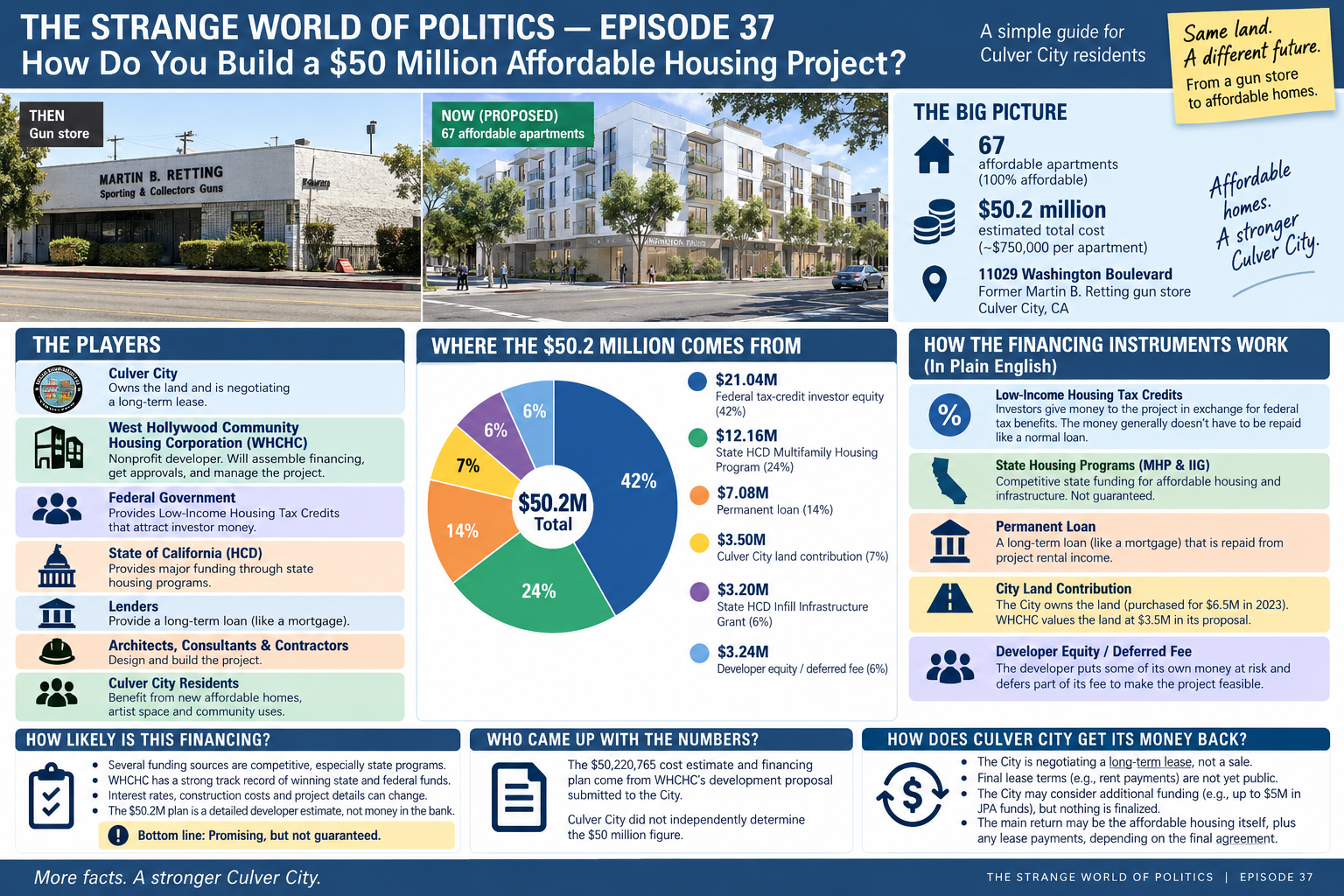
THE STRANGE WORLD OF POLITICS — EPISODE 37
How Do You Build a $50 Million Affordable Housing Project?
Most Culver City residents probably remember the Martin B. Retting gun store on Washington Boulevard.
The gun store is gone.
In 2023, Culver City purchased the property at 11029 Washington Boulevard for $6.5 million, plus up to $250,000 in closing costs.
Now the City has selected a proposal for a 67-unit, 100% affordable housing development on the property. The developer calls the project Washington Fig, although it appeared as Washington Palms in the proposal submitted to Culver City. The developer currently anticipates beginning construction in summer 2028 and completing it in spring 2030.
And here is where we enter the strange world of affordable-housing finance.
The developer's estimated cost?
$50,220,765.
That's approximately $750,000 per apartment.
Where does $50 million come from?
Not one place.
It comes from a financial puzzle involving Culver City, the State of California, the federal government, lenders, investors and a nonprofit developer.
So let's translate it into normal English.
PLAYER #1: CULVER CITY
Culver City owns the land.
The City paid $6.5 million in cash for the former gun-store property in 2023. Traditional financing wasn't necessary.
But here's something I found particularly interesting.
Culver City didn't simply write a $6.5 million check from its General Fund.
The City's September 2023 staff report identifies the money this way:
$1,106,115 — 2011 Redevelopment Agency bond proceeds
$1,847,898 — Fund 485, Economic Development Capital Projects
$3,545,987 — General Fund
That totals:
$6,500,000.
The City also authorized another $250,000 from the General Fund for closing costs.
And that raises an obvious question.
WAIT. DIDN'T CALIFORNIA ABOLISH REDEVELOPMENT AGENCIES?
Yes.
California eliminated redevelopment agencies more than a decade before Culver City bought this property.
Culver City's old Redevelopment Agency was dissolved along with redevelopment agencies throughout California.
A Successor Agency to the Culver City Redevelopment Agency remained behind.
But a Successor Agency isn't supposed to be a brand-new redevelopment agency.
Think of it more like the person left behind to clean up after the old organization closed.
It deals with the old agency's assets, debts, bonds and other obligations.
So why does redevelopment money appear in the purchase of a gun-store property in 2023?
That's where it gets interesting.
SOME OF THE MONEY WAS ACTUALLY OLD REDEVELOPMENT MONEY
The City's own September 2023 staff report specifically identifies:
$1,106,115 in "2011 RDA Bond Proceeds currently held with Fiscal Agent."
In other words, this wasn't a new bond Culver City issued in 2023 to buy the gun store.
It was money remaining from bonds issued by the old Redevelopment Agency in 2011.
The staff report also identifies another:
$1,847,898 from Fund 485 — Economic Development Capital Projects.
Together:
$1,106,115 + $1,847,898 = $2,954,013.
That's essentially the $3 million in Successor Agency-related funding that later City documents refer to when discussing this property.
The remaining approximately $3.546 million of the purchase price came from the City's General Fund, plus the $250,000 authorized for closing expenses.
So a simplified picture looks like this:
Old redevelopment-related money: ~$2.95 million
General Fund: ~$3.55 million
=
$6.5 million purchase
SO DID THE SUCCESSOR AGENCY START FUNDING NEW PROJECTS AGAIN?
Not exactly.
This is an important distinction.
The City wasn't creating a new Redevelopment Agency in 2023.
Some money originating in the old redevelopment system was still sitting in redevelopment-related accounts, including the remaining 2011 bond proceeds.
The September 2023 staff report even contemplated transferring the $1.106 million from Fund 550 into Fund 485, noting that the transfer would occur “if required per SA”—meaning the Successor Agency mechanics were part of handling that money.
And there's another important point.
The affordable-housing project didn't exist yet.
When Culver City bought the property in 2023, the Council had not selected WHCHC to build 67 affordable apartments there.
The City bought the property first.
It subsequently asked the community what should happen to it. In 2024, Culver City conducted a public-input process. By 2025, it was considering different possibilities for the property. In January 2026, the City Council selected WHCHC's affordable-housing proposal and directed staff to negotiate a lease.
So saying:
“The Successor Agency gave $3 million to this new affordable-housing development”
would be misleading.
A more accurate description is:
Old redevelopment-related money helped Culver City buy the property in 2023. Culver City later decided to pursue affordable housing on the property.
Those are two separate decisions.
BUT THE OLD $3 MILLION DIDN'T JUST DISAPPEAR
Here's the part I find especially interesting.
In 2025, Culver City considered what would happen financially if it simply sold the former gun-store property.
City staff estimated that the property might then sell for approximately $4 million, substantially less than the $6.5 million purchase price.
And staff said something very important:
Of that $4 million, approximately $3 million would have to be refunded to the Successor Agency.
That would leave only about:
$1 million for Culver City's General Fund.
So that old redevelopment money still matters.
It isn't simply interchangeable with ordinary General Fund money.
NOW THE CITY IS DOING SOMETHING DIFFERENT: LEASING THE LAND
Instead of simply selling the property, the City selected WHCHC's affordable-housing proposal.
The January 2026 Council action directed City staff to negotiate a lease with WHCHC.
That means Culver City would continue owning the underlying land while allowing the nonprofit developer to build and operate affordable housing on it.
This makes the final lease extremely important.
Because remember what is sitting underneath this project:
Approximately $3 million of old redevelopment-related public money
Approximately $3.5 million originally taken from Culver City's General Fund
=
A property Culver City bought for $6.5 million.
What happens financially to those public investments under a long-term lease?
That's something residents should be able to understand before the final agreement is approved.
PLAYER #2: THE DEVELOPER
The developer selected by Culver City is the West Hollywood Community Housing Corporation, usually abbreviated WHCHC.
Despite the name, this isn't the City of West Hollywood.
WHCHC is an independent nonprofit affordable-housing developer.
For this project, WHCHC is responsible for assembling the development and financing plan.
And that's an important distinction:
WHCHC is the developer. It isn't necessarily the company whose construction workers will physically build the building.
The developer puts the project together—financing, architecture, approvals, consultants and ultimately construction.
The final general contractor does not appear to have been publicly finalized in the documents I've reviewed.
WHO CAME UP WITH THE $50 MILLION NUMBER?
This is another important distinction.
Culver City did not independently determine that this building will cost exactly $50,220,765.
That figure comes from WHCHC's proposal and development budget submitted to the City.
WHCHC estimates:
$29.65 million — construction
$2.22 million — architecture/design/engineering
$3.67 million — construction financing
$3.15 million — contingencies
$5.86 million — developer overhead/profit
plus numerous additional expenses.
Total:
$50,220,765
That's approximately:
$749,564 per unit.
That doesn't mean anyone has done something wrong.
It means voters should understand what the number represents.
It is presently a development budget prepared by the developer, not the final bill for a completed building.
PLAYER #3: THE TAX-CREDIT INVESTOR
One of the biggest proposed sources of money is something called the Low-Income Housing Tax Credit, or LIHTC.
This is one of those government programs that sounds almost impossible to understand until you put actual numbers behind it.
Here's a simplified example.
Imagine a bank or large corporation expects to owe:
$10 million in federal income taxes.
An affordable-housing project has federal tax credits available.
The investor might invest money in the partnership that owns the affordable-housing project in exchange for receiving those tax credits over a period of years.
Suppose, just for illustration, the investor eventually receives:
$8 million in federal tax credits.
Those credits are particularly valuable because a tax credit reduces the investor's tax bill dollar-for-dollar.
So if the investor otherwise owed:
$10 million in federal taxes
and could claim:
$8 million in tax credits
its tax liability, in this deliberately simplified example, could be reduced to:
$2 million.
That's very different from an $8 million tax deduction.
A deduction generally reduces the amount of income subject to tax.
A tax credit reduces the actual tax liability.
The investor may also receive other tax benefits associated with its ownership interest in the affordable-housing partnership, including depreciation and potentially deductible losses, subject to complicated federal tax rules.
So why would an investor put millions of dollars into an affordable-housing project?
Not simply because it wants to help build apartments.
There is an economic transaction taking place:
Investor puts money into the affordable-housing partnership
↓
Project receives equity that helps pay for construction
↓
Investor receives federal tax credits and potentially other tax benefits over time
That is how federal tax policy can attract private investment into affordable housing.
For Washington Palms/Washington Fig, WHCHC's financing model estimates approximately:
$21 million
in tax-credit investor equity.
That's roughly 42% of the entire estimated $50.2 million development cost.
One important caution: $21 million of investor equity does not mean the investor necessarily receives exactly $21 million in tax credits.
The amount an investor is willing to contribute depends on the amount and timing of the credits, the price investors are willing to pay for them, other tax benefits, the structure of the partnership, compliance risk and market conditions when the financing actually closes.
So the easiest way for voters to think about it is:
The federal government provides the tax incentive. A private investor values that incentive and puts money into the project in exchange for the associated tax benefits. The developer then uses that investor money as part of the financing needed to build the affordable housing.
Unlike the project's conventional mortgage, that investor equity generally isn't repaid through ordinary monthly principal-and-interest payments.
And that's one reason these tax credits are so valuable to affordable-housing developers: they can convert a federal tax incentive into actual private capital available to build the project.
PLAYER #4: THE STATE OF CALIFORNIA
WHCHC is also proposing substantial state financing.
One proposed source is California's Multifamily Housing Program, or MHP.
Approximately:
$12.16 million
Another proposed source is an Infill Infrastructure Grant, or IIG.
Approximately:
$3.2 million
Together, that's roughly:
$15.4 million
from those two state programs.
But there is an important word here:
Proposed.
These funding sources involve competitive government programs.
A developer can have a reasonable financing strategy without every anticipated dollar already being committed.
PLAYER #5: THE LENDER
WHCHC's plan also includes approximately:
$7.08 million in permanent debt.
This is much easier to understand.
Think:
Mortgage.
The apartment building receives rent.
The project pays operating expenses.
The remaining income supports repayment of the permanent loan.
The financial model assumes approximately a 6.2% interest rate.
If market conditions change before the permanent financing closes, those assumptions can change too.
PLAYER #6: THE DEVELOPER'S OWN FINANCIAL CONTRIBUTION
The financing model also contains developer equity and/or deferred developer fees.
A deferred developer fee essentially means:
The developer earns a fee but doesn't take all of it immediately.
Instead, some stays in the project to help complete the financing package.
SO HOW LIKELY IS THIS $50 MILLION FINANCING TO ACTUALLY HAPPEN?
Nobody can responsibly tell voters today:
“There is a 90% chance.”
or
“There is a 60% chance.”
There are too many moving parts.
State funding must be obtained.
Tax-credit financing must work.
Interest rates can change.
Construction costs can change.
The project design can change.
Lenders' requirements can change.
And the final City agreement still matters.
WHCHC is an experienced affordable-housing developer, which is relevant when evaluating whether its financing plan is realistic. But experience isn't a guarantee that every source will be obtained at exactly the amount estimated today.
WHCHC currently lists Washington Fig as scheduled to begin construction in summer 2028 and finish in spring 2030.
So we're talking about financial assumptions that must survive several more years.
Think of the $50.2 million financing package as:
a detailed roadmap for how the developer expects to finance the project—not $50 million already sitting in a bank account.
AND HOW DOES CULVER CITY GET ITS MONEY BACK?
This may be the most important financial question.
If Culver City lends a developer $5 million, you can ask:
What's the interest rate?
When does the developer repay it?
If Culver City sells land for $5 million:
The City receives $5 million.
But this arrangement is different.
Culver City owns the land and is negotiating a lease with WHCHC. The January 2026 action directed staff to draft an Exclusive Negotiating Agreement and negotiate the lease; it did not itself establish the final economic terms of that ground lease.
So we should not pretend that we already know the answer.
Before the final deal is approved, residents should be able to see:
How long is the lease?
How much rent does WHCHC pay Culver City?
Does Culver City contribute additional cash?
If additional City money is a loan, when is it repaid?
What happens to the building when the lease ends?
What happens if the expected state money doesn't arrive?
What happens if construction costs exceed $50 million?
Who bears that risk?
And now we have another question:
How does the final ground lease account for the approximately $3 million of redevelopment-related money already invested in the property?
That question matters because we already know what would happen under one alternative.
If the City sold the property, City staff said approximately $3 million of the proceeds would have to be returned to the Successor Agency.
A long-term ground lease is different.
Residents deserve to understand the financial consequences of that difference.
THE REALLY INTERESTING PART
Look at what is happening.
Culver City owns a relatively small piece of land.
A nonprofit developer proposes turning it into a project costing approximately $50 million.
The developer attempts to combine:
City land
Federal tax incentives
California housing programs
Private/project debt
Developer money
=
67 affordable apartments
That's essentially how modern affordable-housing financing works.
No single participant writes a $50 million check.
The developer's job is to assemble the puzzle.
MY QUESTION AS A CULVER CITY RESIDENT
The useful question isn't simply:
“Do you support affordable housing?”
The financial questions are more specific:
What exactly is Culver City contributing?
What are residents receiving in exchange?
Which financing sources are committed and which remain estimates?
Who bears the risk if those estimates change?
What happens to the City's $3.5 million General Fund investment?
What happens to the approximately $3 million connected to the old redevelopment system?
What does WHCHC ultimately pay Culver City for use of publicly owned land?
And:
What happens if the financial plan doesn't work as projected?
Those aren't arguments for or against the project.
They're questions that allow residents to evaluate the deal themselves.
The City Council selected WHCHC's proposal in January 2026 and directed staff to negotiate the lease.
So selection of the developer isn't the end of the financial story.
In many ways, it's the beginning.
I want residents to be able to see the final agreement and understand it in ordinary English:
Tell us what the City already spent.
Tell us what the City is contributing now.
Tell us what comes from the state and federal governments.
Tell us what is borrowed.
Tell us what must be repaid.
Tell us what happens to the old redevelopment money.
Tell us what Culver City receives financially under the ground lease.
Tell us who absorbs the loss if the assumptions don't work.
Then residents can decide for themselves whether the final agreement makes sense.
That is what transparency should look like.
0 Comments
Comments are reviewed before they appear.