
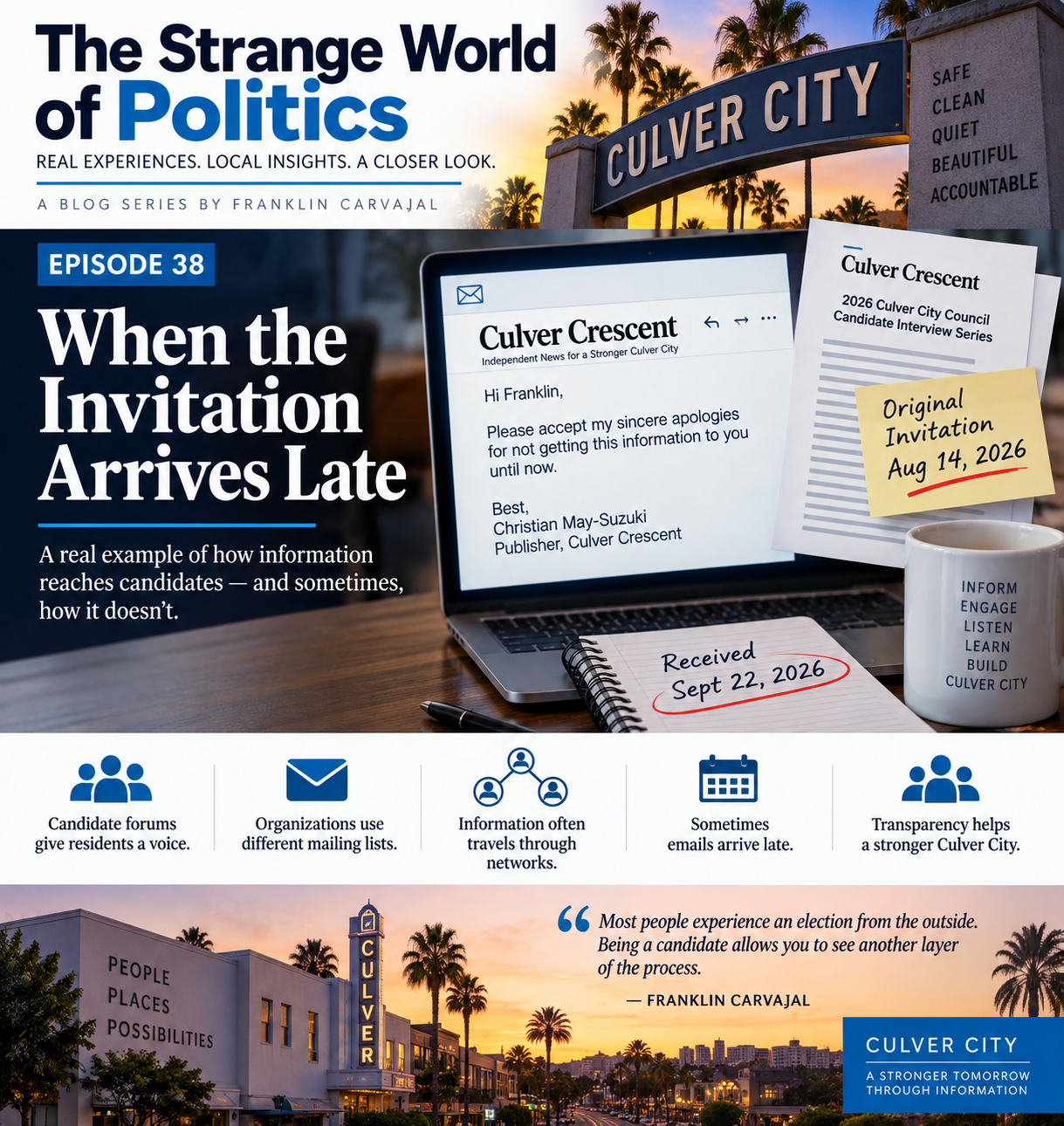
One reason I started The Strange World of Politics was to document what I have actually experienced while running for local office—the paperwork, forums, organizations, interviews, endorsements, emails, and occasionally the emails that never arrive.
Today provided another example.
On September 22, I received an email from Christian May-Suzuki, publisher of the Culver Crescent, regarding its 2026 Culver City Council candidate interview series.
Christian began with an apology:
“Please accept my sincere apologies for not getting this information to you until now.”
The message he forwarded contained the original invitation.
Its date was August 14, 2026.
So, more than a month after the original candidate invitation was sent, I received mine.
The Culver Crescent Interview
The Culver Crescent describes itself as a nonpartisan Culver City news publication. Its candidate series is intended to give residents information about the people running for City Council and allow them to compare candidates' positions.
The proposed interviews are extensive.
Candidates receive three minutes for an opening statement, 30–50 minutes for general topics, as much as 20 additional minutes for campaign-specific questions, and two minutes for a closing statement.
The proposed subjects include city finances, transportation, Vote 16, homelessness, Jubilo Village, SB 79 and housing, parks, technology, City Council meetings, the 2028 Olympics, lobbying disclosure, DEI, and how candidates hope their Council tenure would be remembered.
I intend to participate.
I also appreciate that Christian acknowledged the delay and apologized.
But I was annoyed.
And part of the reason is that this isn't the first time during this campaign that I have found myself learning about a candidate opportunity after the fact.
Haven't I Written About This Before?
Yes.
In Episode 23, “The Culver City Political Machine: Why Independent Democrat Candidates Struggle to Be Heard,” I wrote about my experience with the networks and organizations surrounding local politics.
Read Episode 23: The Culver City Political Machine
One of the experiences that prompted that article was a candidate forum where I was not invited.
That experience made me start paying much closer attention to something I hadn't thought much about before becoming a candidate:
How does information actually reach candidates?
There Isn't One Master List
Before becoming a candidate, I assumed the process was relatively straightforward.
You file the required documents.
The City Clerk certifies the candidates.
Your name becomes public.
Organizations interested in the election know who the candidates are.
Everyone gets the same invitations.
What I have learned is that local politics can be considerably less formal than that.
Different organizations maintain different lists. Political clubs have their own contacts. Neighborhood organizations have theirs. Newspapers and websites have theirs. People know candidates from previous elections, commissions, organizations and community activities.
Someone new to those networks may not necessarily be connected to all of them.
That doesn't establish that anyone is deliberately excluding anybody.
It does demonstrate why something as mundane as an email distribution list can matter.
Democrats United
The earlier experience involving Democrats United was particularly frustrating to me because candidate forums provide residents with an opportunity to hear directly from the people seeking office.
I wasn't invited to that forum.
I wrote about the experience because I thought it illustrated a part of local politics that residents normally don't see.
Now, weeks later, I have another example—although involving an entirely different organization and different circumstances.
This time, the Culver Crescent had prepared a detailed candidate interview process, but the original August 14 invitation didn't reach me at the time.
On September 22, Christian corrected the omission and apologized.
Those are the facts.
I don't know why I was missed, and I don't think it would be fair to speculate.
What Happens Behind the Campaign Signs
Most people experience an election from the outside.
They see lawn signs.
They receive mailers.
They read endorsements.
They attend forums.
They watch interviews.
Eventually, they vote.
Being a candidate allows you to see another layer of the process.
There are mailing lists, political clubs, questionnaires, endorsement interviews, media requests, community organizations and personal networks operating behind all of those visible events.
Sometimes everything works.
Sometimes it doesn't.
And sometimes an email dated August 14 arrives on September 22 with an apology.
That's not evidence of a conspiracy.
It is another small glimpse into how local politics actually functions—and another entry in my continuing record of experiencing it firsthand.
I accepted the invitation.
I'll do the interview.
And I've asked to make sure I'm on the list from now on.
Welcome to Episode 38 of The Strange World of Politics.
0 Comments
Comments are reviewed before they appear.