
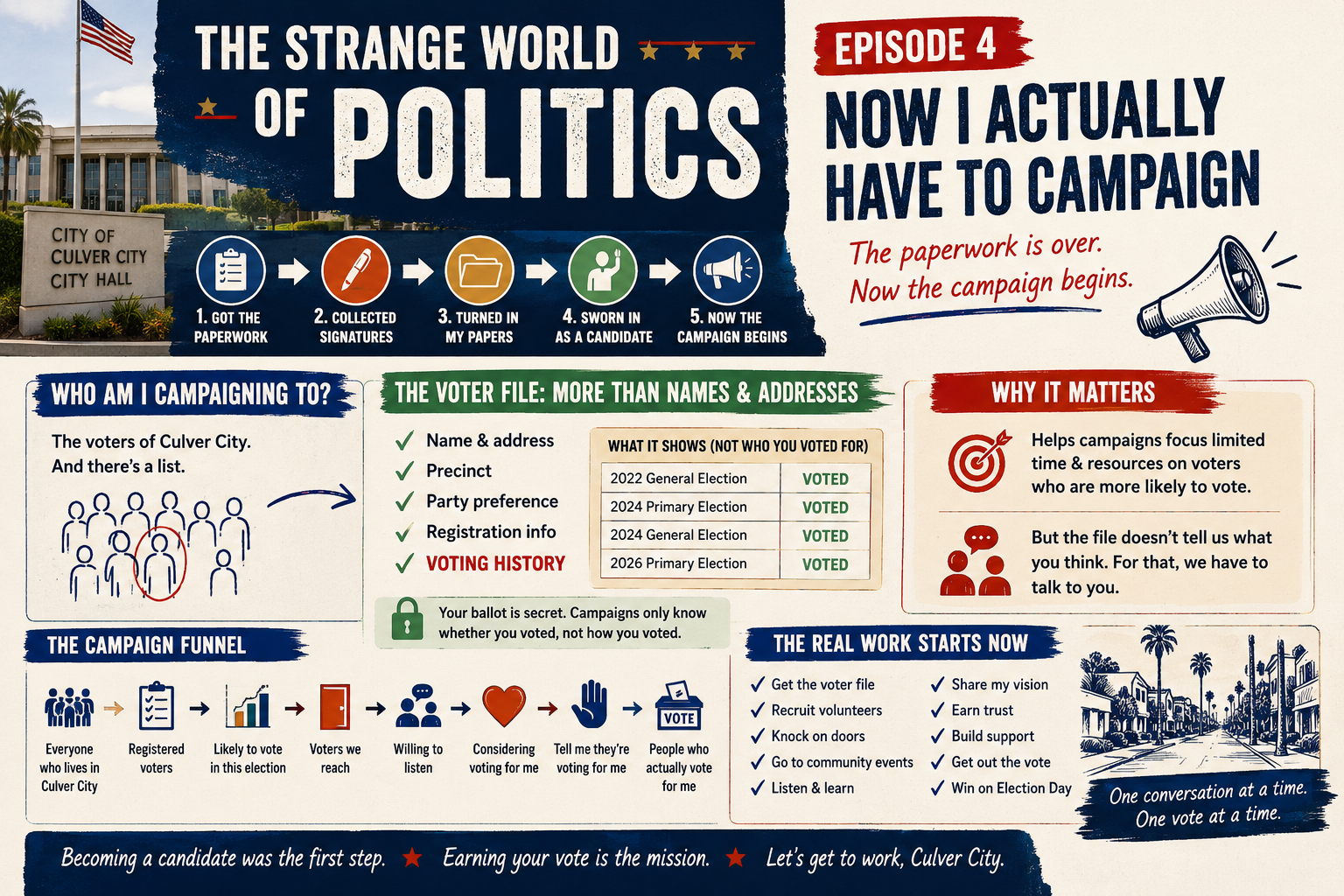
In the last episode of The Strange World of Politics, I found myself walking around Culver City collecting signatures from registered voters so I could qualify to run for City Council.
After knocking on doors, explaining why I was standing on people's porches with government paperwork, and collecting more signatures than required just in case some didn't qualify, it was time to go back to where this adventure started:
The Culver City city clerk's office.
I brought back my candidate binder and all the forms I had carefully completed.
The city clerk's staff reviewed everything.
Forms.
Signatures.
Dates.
Disclosures.
More forms.
Everything that seemed so intimidating when I first received that binder was suddenly completed.
Then something happened that made the whole thing feel considerably more real.
I was sworn in.
After all the paperwork, signatures and explanations, I was officially moving from being someone who wanted to run for Culver City Council to someone who was actually running for Culver City Council.
For a moment, there was a sense of accomplishment.
I had figured out the process.
I had completed the forms.
I had collected the signatures.
I had turned everything in.
I had been sworn in.
Done.
Except, of course, I wasn't done.
Not even remotely.
Because now I had to figure out how to run an actual political campaign.
Welcome to Episode 4 of The Strange World of Politics.
Okay. I'm Running. Now What?
This was the strange realization.
The government explains how to become a candidate.
It doesn't run your campaign for you.
The city clerk can explain the forms you need to file. The clerk can tell you where to sign. The clerk can explain deadlines and election procedures.
But once you walk out that door as a candidate, an entirely different world begins.
The campaign.
And my first question was embarrassingly basic:
Who exactly am I campaigning to?
The obvious answer is:
The voters of Culver City.
Wonderful.
Where are they?
Apparently, There Is a List
This was my next discovery.
Political campaigns don't necessarily start by randomly walking around town trying to locate voters.
There is an official voter-registration file.
Because Culver City is in Los Angeles County, qualified candidates can obtain voter-registration information through the Los Angeles County Registrar-Recorder/County Clerk for legitimate election purposes.
Los Angeles County even provides voter/election files for individual cities, districts and precincts.
So apparently one of my first campaign tasks is to obtain the voter file for Culver City.
And this is where things started getting interesting.
I Thought I Was Getting Names and Addresses
My assumption was that a voter list would be something like:
John Smith
123 Main Street
Culver City
That's useful.
I could knock on John's door.
But voter-registration data can contain considerably more information.
Depending on what information is available in the record and legally releasable, it may include things such as a voter's name, address, precinct, party preference, registration information and—this is the interesting part—
voting participation history.
At first, that sounded a little alarming.
Wait.
Can a political candidate find out how I voted?
No.
Absolutely not.
Your ballot is secret.
The campaign cannot see whether you voted for Candidate A or Candidate B.
But voting history can tell an authorized campaign something very different:
whether you voted.
For example:
2022 General Election — Voted
2024 Primary Election — Voted
2024 General Election — Voted
2026 Primary Election — Voted
It doesn't tell me who received that person's vote.
But it does tell me something very important for a campaign:
This person votes.
And Suddenly Politics Became Data Science
Now imagine another registered voter.
2022 General Election — Did not vote
2024 Primary Election — Did not vote
2024 General Election — Voted
2026 Primary Election — Did not vote
Both people are registered voters.
Both people matter.
But if I have only a certain number of hours available to knock on doors, suddenly I understand why campaigns care about voting history.
One person has demonstrated a consistent pattern of voting.
The other hasn't.
That doesn't tell me what either person believes.
It doesn't tell me whom either person supports.
And it certainly doesn't mean I should ignore anyone.
But it helps answer a fundamental campaign question:
Who is actually likely to participate in this election?
And that's when I began realizing that running for office is very different from what most of us see from the outside.
Those Door Knocks Aren't Necessarily Random
We've all seen them.
Someone appears at your door holding campaign literature.
“Hi! I'm volunteering for…”
Before running for office, I never really thought much about how that person ended up at that particular door.
Now I'm beginning to understand.
A campaign can organize voters geographically.
It can organize them by precinct.
It can look at participation history.
Then volunteers can receive lists of doors to visit.
So when someone knocks, the campaign may already know that a registered voter lives at that address.
What the campaign doesn't necessarily know is the most important thing:
What does that voter think?
That's what the conversation is for.
Now Comes the Part I Actually Care About
This is where campaigning becomes much more interesting to me.
I don't simply want a database telling me that someone votes.
I want to know why people vote the way they do.
What frustrates Culver City residents?
What do they love about the city?
What are they afraid we're losing?
What do they want changed?
Housing?
Traffic?
Homelessness?
Public safety?
Taxes?
Development?
Bike infrastructure?
City spending?
Schools?
Quality of life?
And perhaps most importantly:
What do residents think City Hall isn't listening to?
The voter file can tell me where voters are.
It can't tell me what they're thinking.
For that, I actually have to go talk to them.
So Now I Need to Build a Campaign
This is where my journey changes.
Episodes 1 through 3 were largely about becoming a candidate.
Now the story becomes about becoming a campaign.
I need to figure out who the voters are.
I need to organize them.
I need volunteers.
I need to knock on doors.
I need to attend community events.
I need to raise money.
I need signs.
I need mailers.
I need social media.
I need endorsements.
I need to answer questionnaires.
I need to explain my positions.
I need to listen to people who agree with me.
More importantly, I need to listen to people who don't.
And somewhere in the middle of all of this, I need to convince enough Culver City voters that I should represent them on the City Council.
The Funnel Gets Smaller
I'm beginning to see an election as a giant funnel.
At the top:
Everyone who lives in Culver City.
Then:
Registered voters.
Then:
Registered voters likely to vote in this election.
Then:
Voters my campaign actually reaches.
Then:
People willing to listen to me.
Then:
People considering voting for me.
Then:
People who tell me they're voting for me.
And finally:
People who actually vote for me.
That last group is the only one that determines whether I win.
Which is both incredibly obvious and strangely easy to forget.
And So the Campaign Begins
I walked into the city clerk's office carrying paperwork.
I walked out a candidate.
Now comes the hard part.
I have to turn a candidacy into a campaign.
And a campaign into conversations.
And conversations into trust.
And trust, hopefully, into votes.
My first campaign assignment is therefore remarkably simple:
Find the voters.
Apparently, Los Angeles County can give me the file.
Then I have to figure out what to do with it.
Something tells me that will lead to another episode.
Because if the process of simply becoming a candidate taught me anything, it's this:
Nothing in politics is ever quite as simple as it sounds.
Welcome to Episode 4 of The Strange World of Politics.
The paperwork is over.
Now the campaign begins.
0 Comments
Comments are reviewed before they appear.