
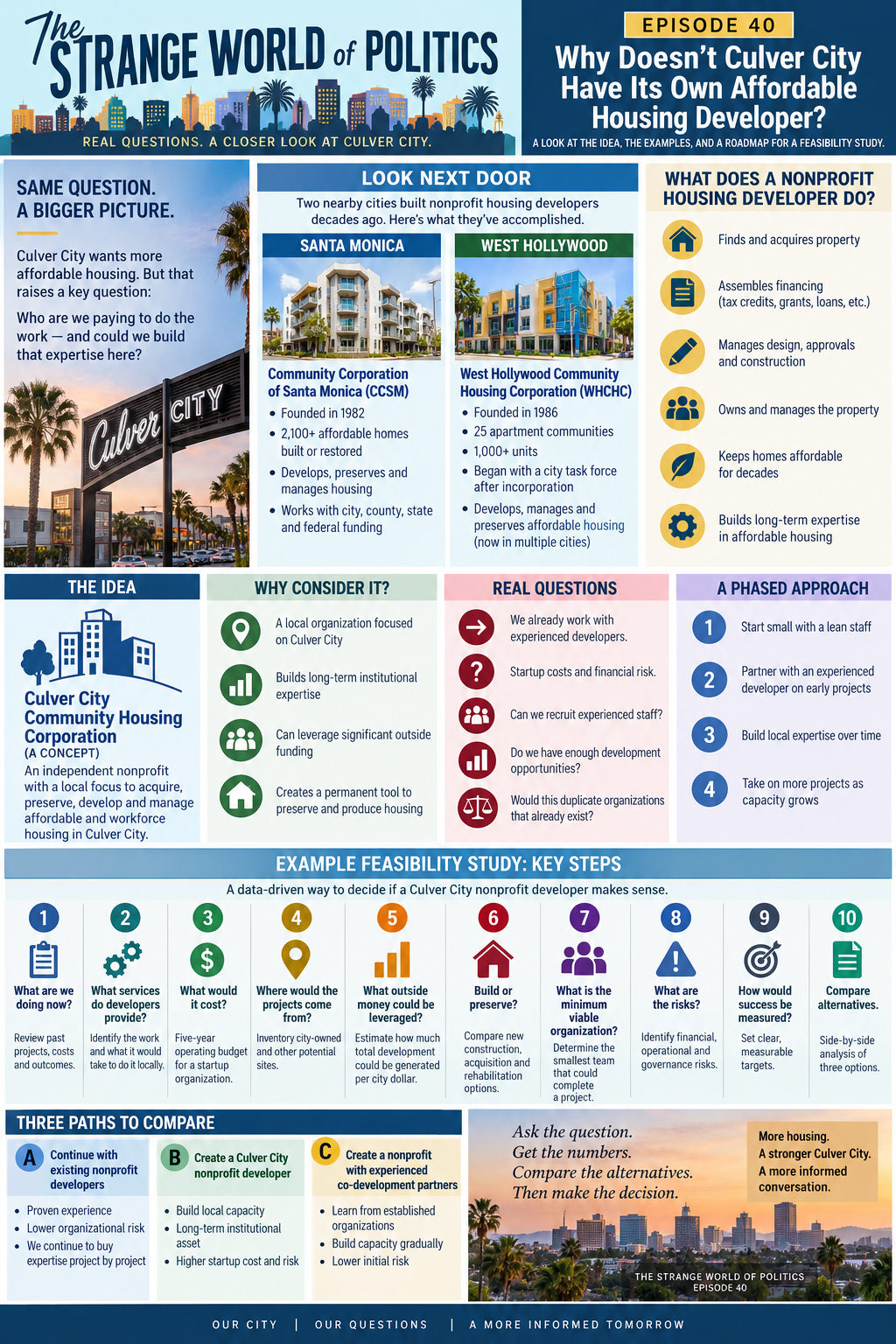
One thing I have learned while looking at how local government works is that sometimes the most interesting question isn't, “How much money are we spending?”
It is:
Who are we paying to do the work, and could we build that expertise here?
Affordable housing provides a good example.
Culver City wants more affordable housing. But developing affordable housing is complicated. Someone has to find property, assemble financing, obtain tax credits and grants, hire architects and contractors, oversee construction, manage the property and maintain affordability requirements for decades.
Cities generally don't do all of that themselves.
Instead, they often work with nonprofit affordable-housing developers.
And that led me to a question:
Why doesn't Culver City have its own community-based nonprofit affordable-housing developer?
Look next door
We don't have to travel very far to see what this could look like.
Community Corporation of Santa Monica is a Santa Monica-based nonprofit that develops, restores and manages affordable housing. It says it has built or restored more than 2,100 affordable homes in Santa Monica over roughly four decades.
West Hollywood has another example.
West Hollywood Community Housing Corporation, or WHCHC, is an independent 501(c)(3) nonprofit affordable-housing developer founded in 1986. According to the organization, it now has 25 apartment communities containing more than 1,000 units.
The history is particularly interesting.
After West Hollywood incorporated in 1984, the new city created a task force to develop a housing-policy blueprint. One of its recommendations was the creation of a community housing development organization. WHCHC was subsequently established in 1986.
Nearly forty years later, the organization develops affordable housing not only in West Hollywood but in other Southern California communities. Its current development pipeline includes projects outside West Hollywood as well.
That is institutional capacity that accumulated over decades.
What exactly does a nonprofit developer do?
This is where affordable-housing discussions can become confusing.
Creating a nonprofit doesn't magically make apartment buildings inexpensive.
The organization still has to pay for land, architects, engineers, construction, insurance, financing and property management.
The difference is what happens to the organization and its properties over time.
Instead of developing a building primarily to generate returns for private investors, a nonprofit housing corporation can acquire, develop and preserve housing under a charitable mission.
It also develops something extremely valuable:
expertise.
WHCHC, for example, has a housing-development department and works with multiple public agencies, lenders and tax-credit programs to assemble financing for its projects.
Community Corporation of Santa Monica has development, finance, property-management, maintenance and resident-services functions.
That doesn't happen overnight.
It took decades.
Could Culver City create something similar?
Potentially.
Imagine an independent organization called, simply for purposes of discussion:
Culver City Community Housing Corporation
It wouldn't necessarily be another City department.
It could be an independent nonprofit with its own board, employees, financial statements and legal responsibilities.
Its mission could be straightforward:
Acquire, preserve, develop and manage affordable and workforce housing in Culver City.
The City could potentially help establish it, provide startup funding, contribute or lease appropriate public property, and provide housing funds or other assistance for individual projects.
But the nonprofit would have to build its own professional capacity and compete for outside funding.
That distinction is important.
Where would the money to build housing come from?
Not simply from Culver City's General Fund.
Affordable-housing projects frequently combine many different sources of financing.
A project might include:
City land or a long-term ground lease.
City housing funds.
County funding.
California housing programs.
Federal housing programs.
Low-Income Housing Tax Credits.
Tax-exempt financing.
Federal Home Loan Bank programs.
Private construction loans.
Permanent financing.
Project-based housing vouchers.
Philanthropic grants.
WHCHC's completed projects demonstrate how complicated these financing structures can become. Individual developments list combinations of city and county agencies, state housing programs, tax-credit programs, banks and other investors.
That expertise is one of the things a specialized nonprofit developer provides.
But why create another organization?
That's exactly the question Culver City should answer before doing anything.
Creating an organization simply because Santa Monica or West Hollywood has one wouldn't make sense.
There are already experienced nonprofit developers operating throughout Los Angeles County.
So Culver City should compare two approaches.
Option A: Continue partnering with established outside nonprofit developers.
The advantage is obvious: these organizations already have experienced employees, financing relationships, property-management systems and development histories.
Option B: Develop permanent nonprofit housing-development capacity centered in Culver City.
That would require upfront investment and involve organizational risk, but over time Culver City could develop an institution whose primary geographic focus is this community.
There is also a third possibility.
Start small
Culver City wouldn't need to create a 50-person organization and immediately start constructing apartment buildings.
A new nonprofit could begin with a small professional staff.
For its first development, it could partner with an experienced organization such as WHCHC, Community Corporation of Santa Monica or another qualified affordable-housing developer.
The experienced organization could provide development expertise while the new Culver City organization learns the process.
The second project could involve greater responsibility.
Eventually the organization might become capable of independently acquiring and developing properties.
That could take years.
But institutions are built over time.
Santa Monica's Community Corporation traces its history to 1982.
WHCHC dates to 1986.
Culver City would be starting almost forty years later.
Before doing anything: study it
This is exactly the type of question where I think government should resist jumping immediately to either YES or NO.
Run the numbers first.
So here is an example of what I would want a feasibility study to examine.
SAMPLE FEASIBILITY STUDY
Culver City Community Housing Corporation
Purpose
Determine whether creating a locally based independent nonprofit affordable-housing development corporation would provide Culver City with a financially and operationally viable additional tool for producing and preserving affordable and workforce housing.
Question 1: What are we doing now?
Identify affordable-housing developments undertaken or funded by Culver City during the previous 10–15 years.
For every project identify:
• Developer
• Number of units
• Number and type of affordable units
• City land contribution
• City loans or grants
• Housing vouchers
• State and federal funding
• Total development cost
• Cost per unit
• Developer fee
• Ongoing management structure
• Length of affordability restrictions
• Development timeline
The goal would be to establish a baseline.
Question 2: What do outside nonprofit developers actually provide?
Identify the services currently provided by Culver City's nonprofit development partners.
For example:
Site acquisition.
Predevelopment.
Architecture and engineering coordination.
Entitlements.
Tax-credit applications.
State grant applications.
Construction financing.
Permanent financing.
Construction management.
Compliance.
Property management.
Resident services.
Then determine what it would cost Culver City to develop those capabilities locally.
Question 3: What would a Culver City organization cost?
Develop a five-year operating budget.
An illustrative startup organization might eventually require:
Executive Director.
Real Estate Development Director or project manager.
Finance/accounting support.
Asset-management expertise.
Administrative support.
Outside legal counsel.
Affordable-housing financial consultants.
The study should determine realistic compensation, benefits, insurance, office, auditing, legal and administrative expenses.
Rather than guessing at a number first, Culver City should obtain comparable operating information from established Southern California nonprofit housing organizations.
Question 4: Where would the projects come from?
This may be the most important question.
A developer without development opportunities isn't useful.
Create an inventory of:
City-owned properties.
Housing Authority properties.
Public parking lots.
Underutilized municipal property.
Properties potentially available for acquisition.
Older apartment buildings that could potentially be purchased and preserved as affordable housing.
Potential joint-development opportunities with Metro or other public agencies.
For every site, estimate realistic housing capacity and development constraints.
Question 5: What outside money could be leveraged?
For several hypothetical projects, identify realistic funding sources.
For example:
$1 million of City resources produces how much total development?
$5 million?
$10 million?
The study should examine how much outside capital could reasonably be leveraged for each dollar of local investment.
Question 6: Should Culver City build or preserve?
New construction gets most of the attention.
But acquisition may sometimes be another option.
WHCHC's history is instructive. Its earliest projects included purchasing and rehabilitating existing buildings, preserving those apartments as permanently affordable housing before the organization moved increasingly into new construction.
Culver City should therefore compare:
New construction.
Acquisition and rehabilitation.
Preservation of existing affordable apartments.
Conversion of existing properties.
Mixed-income development.
Workforce housing.
Question 7: What is the minimum viable organization?
This might be the most useful part of the study.
Don't ask:
“How do we recreate Community Corporation of Santa Monica?”
Ask:
“What is the smallest organization Culver City could create that could successfully complete one project?”
Perhaps the initial structure is only a small development team working with an experienced co-developer.
If that works, expand.
If it doesn't, stop.
Question 8: What are the risks?
The feasibility study should also identify reasons not to create the organization.
Those might include:
Duplicating organizations that already exist.
Insufficient development pipeline.
Difficulty recruiting experienced staff.
Startup costs.
Financial exposure.
Development delays.
Dependence on competitive state and federal funding.
Property-management liabilities.
Governance problems.
Opportunity costs associated with City funding.
Those risks should be presented publicly alongside potential benefits.
Question 9: How would success be measured?
Before creating the organization, establish measurable targets.
For example:
Affordable units created.
Affordable units preserved.
City subsidy per unit.
Outside dollars leveraged per City dollar.
Average development time.
Operating cost of the nonprofit.
Occupancy.
Long-term financial performance of properties.
The measurements should allow residents and Councilmembers to determine several years later whether the experiment is actually working.
Question 10: The ultimate comparison
After all of that analysis, put three alternatives side-by-side:
1. Continue using established nonprofit developers.
2. Create a Culver City nonprofit developer.
3. Create a Culver City nonprofit but require experienced co-development partners during its startup period.
Show the estimated cost, risk, staffing requirements, housing production and City financial exposure of each approach.
Then let the numbers speak.
This is what I mean by asking questions
One recurring theme of The Strange World of Politics has been my discovery that local government is much more complicated than it appears from the outside.
Affordable housing is another example.
It is easy to say:
“Build affordable housing.”
The difficult questions come afterward.
Who builds it?
Who owns it?
Who finances it?
Who manages it?
Who accepts the financial risk?
And perhaps one question Culver City hasn't discussed enough:
Should we continue buying affordable-housing development expertise project by project, or should we explore building some of that expertise permanently in Culver City?
I don't think we should know the answer before doing the analysis.
But when neighboring cities have spent roughly four decades developing institutions capable of acquiring, financing, building and managing thousands of affordable homes, it seems reasonable to understand how those models work — and determine whether some version could work here.
That's what a feasibility study is for.
Ask the question. Get the numbers. Compare the alternatives. Then make the decision.
The Strange World of Politics — Episode 40
0 Comments
Comments are reviewed before they appear.