
Sometimes the best stories come from readers.
After my recent article about Culver City's finances, a resident named Karyn posted a simple question:
Why is Culver City paying hundreds of thousands of dollars to an outside consulting firm to develop a financial plan? Isn't that something the City's own financial staff should be doing?
I didn't know the answer.
So I looked.
And, as often happens in the strange world of local government, one question led to several more.
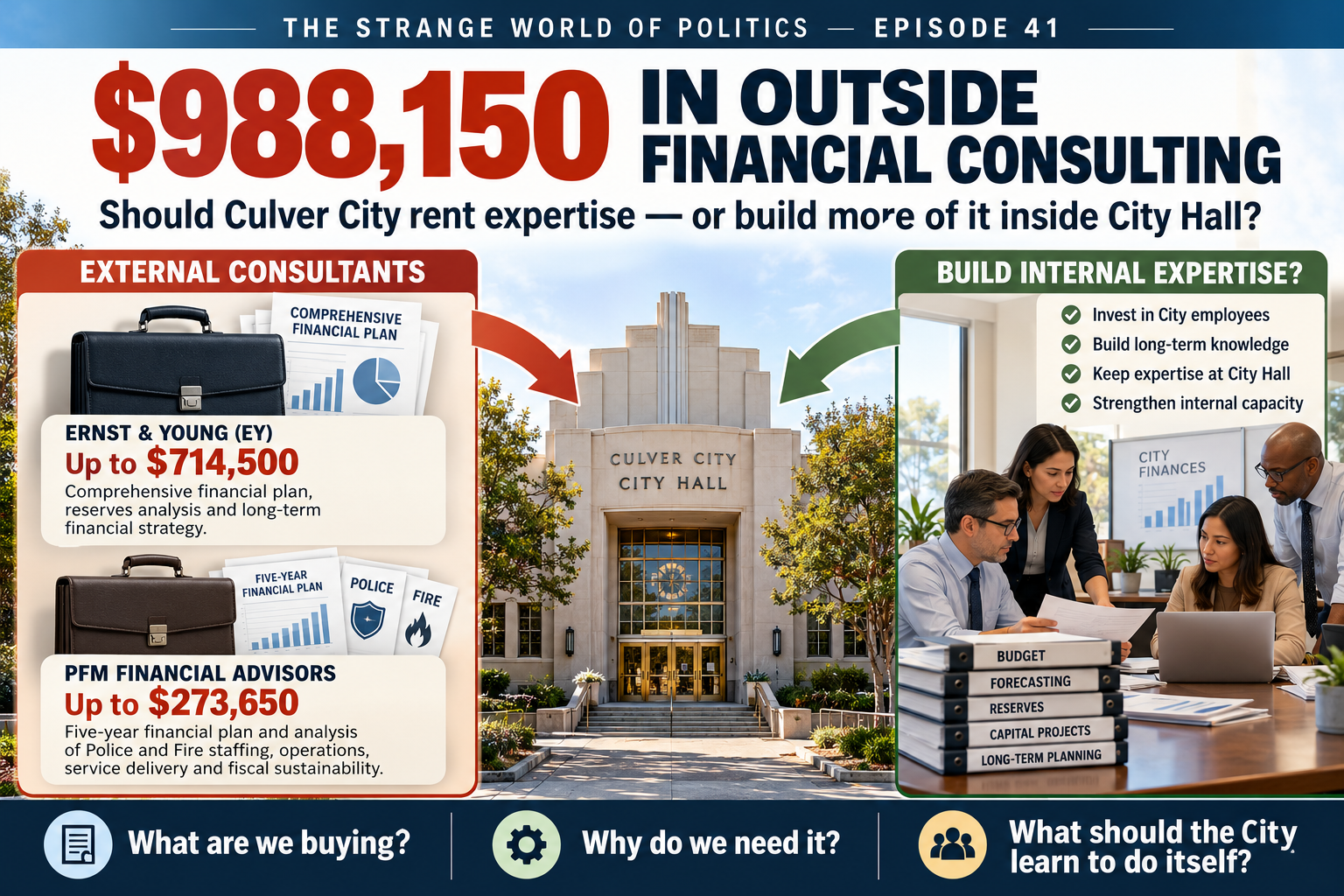
FIRST, THE $714,500 EY CONTRACT
On August 10, 2026, the Culver City Council considered an amendment to its contract with Ernst & Young U.S. LLP, commonly known as EY.
The City had already hired EY earlier in 2026 for up to $49,500 to analyze Culver City's financial condition and outlook.
Then came a much larger assignment.
The City proposed adding as much as:
$665,000
That brought the total potential EY contract to:
$714,500.
So what exactly are taxpayers buying?
The City's description sounds complicated.
Let's translate it into ordinary English.
WHAT IS EY ACTUALLY DOING?
Basically, EY is being paid to take a very deep look at Culver City's finances and answer questions such as:
How much money is the City bringing in?
How much is it spending?
How much should it keep in savings?
Can the City afford its employees and future projects?
What happens to the budget if the economy gets worse?
What happens if the economy does better than expected?
EY is expected to produce updated General Fund projections under three different economic scenarios.
The work also considers staffing, capital improvements, transportation and broader issues that could affect the City's financial future.
In ordinary English:
EY is being paid to give Culver City a major financial checkup and help develop a long-term financial plan.
THEN I FOUND ANOTHER CONTRACT
At the same August 10 City Council meeting, another financial-consulting contract appeared.
This one was with:
PFM Financial Advisors LLC
The Council considered adding as much as:
$223,650
to an existing PFM contract, bringing that contract to as much as:
$273,650.
At first glance, that made me wonder whether Culver City was paying two companies to do the same thing.
But after reading the documents, that's not quite accurate.
PFM's additional assignment is more specific.
The City asked PFM to examine the Culver City Police Department and Culver City Fire Department and make recommendations concerning:
Staffing
Operations
How services are delivered
and
Whether those operations are financially sustainable.
So I don't think it would be fair to say:
“Culver City hired two companies to do the same job.”
The publicly described assignments are different.
But both are connected to the City's broader effort to understand its long-term financial future.
NOW PUT THE TWO CONTRACTS TOGETHER
Maximum EY contract:
$714,500
Maximum PFM contract:
$273,650
Together:
$988,150
That's almost $1 million in potential professional-services contracts.
Again, that does not mean Culver City is paying almost $1 million to have two companies write the same financial plan.
It isn't.
But it does mean residents should understand what we're purchasing and why outside expertise is needed.
AND THEN I FOUND SOMETHING ELSE
This part caught my attention.
For the EY amendment, the City did not seek additional competitive quotations.
The staff report says that because completing the long-term financial plan was important, obtaining additional competitive quotations was determined to be “not practical.”
That doesn't establish that anything improper happened.
There may be legitimate advantages to continuing with a consultant that already understands the City's finances.
EY had already conducted earlier financial work for Culver City.
But consider what happened to the size of the relationship.
It started with work costing up to:
$49,500.
Then another:
$665,000
was proposed.
Potential total:
$714,500.
When a professional-services relationship grows that dramatically, I think residents should be able to understand why obtaining competing prices wasn't practical.
WHERE DOES THE EY MONEY COME FROM?
Here's another interesting detail.
The additional EY work is being funded from taxable bond proceeds received by the Culver City Public Finance Authority.
The City had allocated $1 million of bond proceeds for various administrative expenses, including retaining a consultant to develop the comprehensive financial plan and analyze City reserves.
In other words, some of the money Culver City borrowed is being used for this work.
Borrowing money isn't free.
That doesn't automatically make this a bad use of bond proceeds.
But it makes understanding the cost and benefit particularly important.
BUT ISN'T THIS WHAT THE FINANCE DEPARTMENT DOES?
This brings us back to Karyn's original question.
Culver City already employs financial professionals.
So why are we paying outside companies hundreds of thousands of dollars for financial expertise?
There can be perfectly reasonable explanations.
Sometimes cities need specialists for unusual projects.
Sometimes an independent analysis is useful.
Sometimes existing employees simply don't have enough time to conduct a major study while also preparing budgets, paying bills, producing financial reports and handling the City's normal financial operations.
But this raises another question that I find even more interesting.
WHY AREN'T WE BUILDING MORE OF THIS EXPERTISE INSIDE CITY HALL?
Think about the difference.
When Culver City pays an outside consultant, we are essentially renting expertise.
The consultant performs the assignment.
The City pays the bill.
The assignment ends.
And eventually the consultant leaves.
But when we invest in qualified City employees, something different happens.
We build institutional knowledge.
Those employees learn Culver City's finances.
They learn our departments.
They learn our contracts.
They learn our infrastructure.
They learn what happened five years ago.
They remember which assumptions turned out to be right and which ones turned out to be wrong.
And that knowledge stays inside City Hall.
MAYBE CONSULTANTS ARE STILL CHEAPER
There is another side to this.
Hiring employees isn't free.
A permanent employee means salary, benefits, pension costs, training, management and potentially decades of employment costs.
A highly specialized expert might only be needed occasionally.
If Culver City needs a particular type of expertise for six months every five years, hiring a permanent employee might make absolutely no financial sense.
In that situation:
Renting expertise could be cheaper than owning it.
But what if we're purchasing the same kinds of expertise repeatedly?
Then the calculation changes.
If Culver City is going to spend hundreds of thousands of dollars year after year on outside financial consultants, residents should be able to ask:
Would some of this money be better spent hiring and training our own people?
THE QUESTION I WANT ANSWERED
I'd like to see a very simple comparison.
How much has Culver City spent on outside financial consultants over the past five years?
How much over ten years?
What kinds of work are we repeatedly outsourcing?
How much would it cost to build some of that expertise internally?
Which functions genuinely require an outside specialist?
Which could reasonably be performed by City employees?
And perhaps most importantly:
Are consultants supplementing City staff—or are we becoming dependent upon consultants to perform work the City itself should know how to do?
Those are very different situations.
WHAT EXPERTISE SHOULD CULVER CITY OWN?
I don't think the answer is:
“Stop hiring consultants.”
That wouldn't make sense.
Sometimes you need specialists.
Sometimes you need an independent opinion.
Sometimes a temporary project simply doesn't justify another permanent employee.
But taxpayers should be able to see the calculation.
If an outside consultant costs $700,000, explain why that makes more sense than building additional internal capacity.
If hiring City employees would cost considerably more, show us that too.
If EY possesses specialized knowledge Culver City couldn't reasonably maintain internally, explain what that knowledge is.
And if we're going to need the same expertise again next year—and the year after that—then perhaps we should ask whether we're renting something we should eventually learn to do ourselves.
That leads to what I think is the bigger management question:
What expertise should Culver City own, and what expertise should Culver City rent?
HERE ARE THE QUESTIONS I WOULD ASK
What financial-planning work is currently performed by City employees?
What is EY doing that City employees aren't equipped to do?
What is PFM doing?
Where, if anywhere, do those responsibilities overlap?
What specific products will residents receive from EY for the maximum $714,500 contract?
What will PFM produce for its Police and Fire assessment?
How were these prices determined?
Why was obtaining additional competitive quotations for the EY amendment considered impractical?
How much has Culver City spent on outside financial consulting during the last five and ten years?
Has the City studied whether some of those consulting dollars could instead be used to recruit, train and retain employees with those skills?
And after all this work is completed:
Will residents be able to read the results?
THIS IS WHY I WRITE THIS SERIES
I didn't start researching this because I had decided Culver City was wasting money.
I started because a resident asked a question.
That's how local government should work.
Someone sees a number and asks:
“Why are we spending this money?”
Then we look at the documents.
In this case, those documents tell us that Culver City is undertaking substantial long-term financial planning.
EY has a potential contract of $714,500.
PFM has a potential contract of $273,650.
Together:
$988,150.
Maybe this work ultimately saves Culver City millions of dollars.
Maybe the consultants identify risks that haven't been adequately addressed.
Maybe their recommendations substantially improve City operations.
Those are possible outcomes.
But residents shouldn't have to guess.
When government spends this kind of money, the questions can actually be very simple:
What are we buying?
Why do we need it?
Why does it cost this much?
Why weren't additional competing quotations obtained for the EY amendment?
What should outside experts do?
What should our own employees learn to do?
And eventually, the most important question:
What did Culver City get for the money?
Those aren't questions against consultants.
They're questions about building a government that is financially responsible, knowledgeable and accountable.
And when these reports are finished, we should come back and see whether those questions were answered.
0 Comments
Comments are reviewed before they appear.