
If you follow Culver City politics, you have probably heard of Culver City Neighbors United (CCNU).
I receive their emails myself. They discuss City Council meetings, development, housing, city spending and other local issues. A recent email, for example, raised questions about executive compensation and the proposed Sony Animation Campus transaction.
But there is another part of the CCNU story that voters may not know.
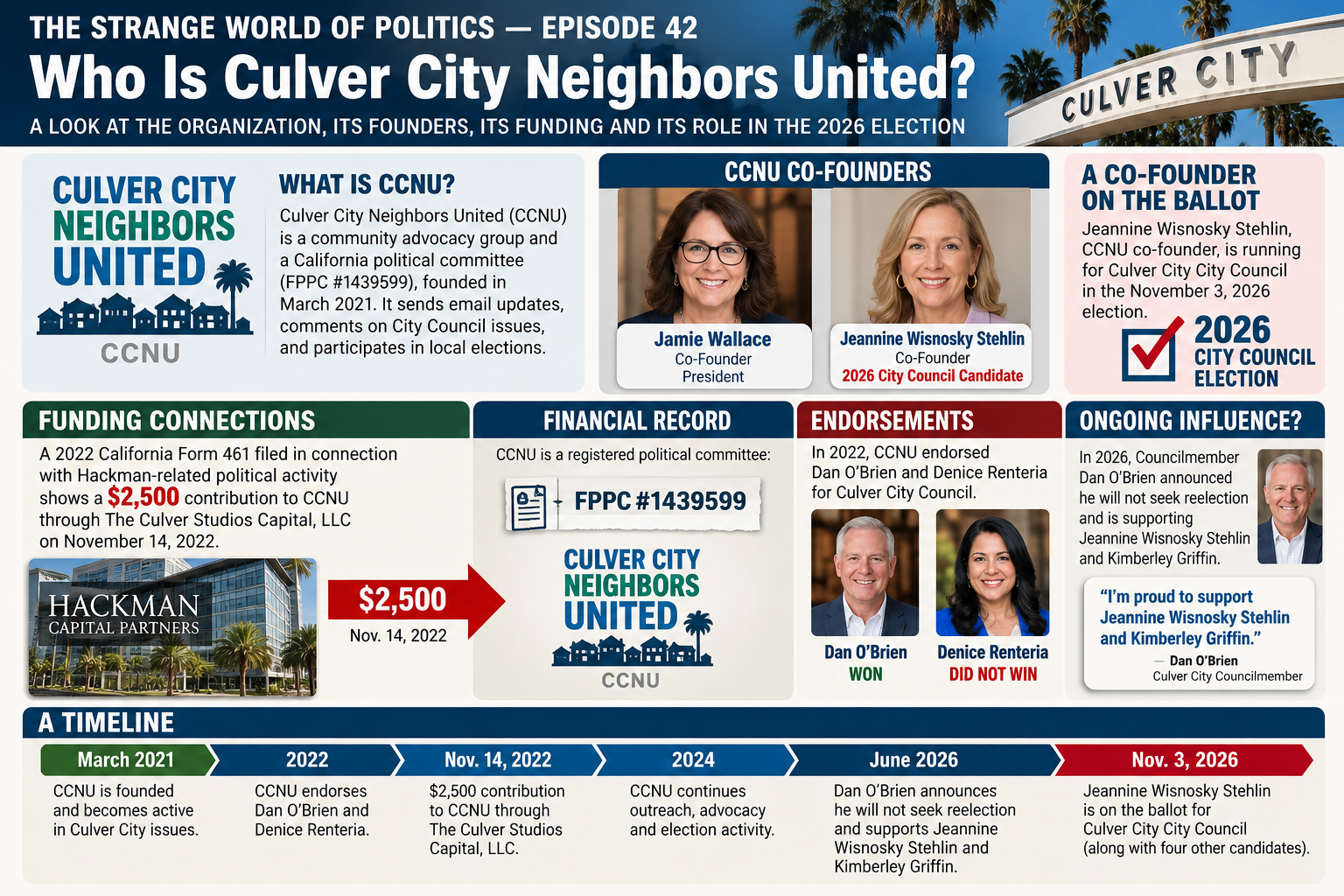
One of CCNU's co-founders, Jeannine Wisnosky Stehlin, is now running for Culver City City Council.
That is not speculation. Stehlin's own campaign website identifies her as a "Culver City Neighbors United co-founder." Her campaign website also confirms that she is running for City Council in the November 3, 2026 election.
The Culver City Observer likewise identifies Stehlin as a CCNU co-founder and reports that she is a candidate for Council.
So I became curious.
What exactly is CCNU? Who has supported it financially? And what candidates has the organization supported?
Those are reasonable questions to ask about any organization actively participating in local politics.
CCNU Is Also a Political Committee
CCNU isn't simply an informal neighborhood email list.
It operates as a California political committee, Culver City Neighbors United, FPPC ID #1439599.
That distinction matters because political committees can raise money and participate in elections, subject to California's campaign-finance disclosure rules.
And CCNU has participated in Culver City elections.
The 2022 Council Election
In 2022, CCNU publicly endorsed Dan O'Brien and Denice Renteria for Culver City Council.
We don't have to rely on somebody else's characterization of that endorsement. CCNU said so itself.
On its website, CCNU wrote that it had endorsed O'Brien and Renteria and encouraged voters to support them.
O'Brien subsequently won a Council seat.
Interestingly, Councilmember O'Brien announced this year that he would not seek reelection in 2026 and said he supports Jeannine Wisnosky Stehlin and Kimberley Griffin for the two Council seats being contested this year.
That doesn't establish anything improper. It does, however, illustrate how organizations, endorsements and political relationships can carry from one election to another.
Where Did Some of CCNU's Money Come From?
This is where campaign-finance disclosure becomes useful.
A California Form 461 filed in connection with Hackman-related political activity documents a $2,500 monetary contribution to Culver City Neighbors United on November 14, 2022.
The filing identifies the contribution as being made through the affiliated entity The Culver Studios Capital, LLC.
That is particularly noteworthy because Hackman Capital Partners and its related entities have substantial business and real-estate interests in Culver City.
Again, a contribution does not by itself demonstrate that a donor controls an organization or that the recipient did anything improper.
Campaign contributions are a normal and lawful part of politics.
But disclosure exists for a reason: voters are entitled to know who finances political organizations attempting to influence their votes.
There Are Larger Claims About Hackman Funding
Other Culver City political organizations have published analyses claiming that Hackman-related money flowing to CCNU was considerably greater than that single $2,500 contribution.
For example, the Culver City Democratic Club has published an analysis stating that Hackman provided $14,500 to CCNU during the 2022 election cycle, which the club calculated as 78% of CCNU's contributions that year.
That is the Democratic Club's analysis and characterization of the campaign-finance records. It should not simply be repeated as an independently established fact without examining the underlying filings transaction by transaction.
The $2,500 contribution, however, appears directly on the Form 461 reviewed for this article.
This distinction is important.
One of the lessons I have learned during this campaign is that political claims often get repeated until people assume they are facts.
I prefer looking at the documents.
And Now a CCNU Co-Founder Is Running for Council
That brings us to 2026.
Jeannine Wisnosky Stehlin is officially a candidate for Culver City Council. The finalized November ballot includes Stehlin, Franklin Carvajal, Freddy Puza, Thomas Aujero Small and Kimberley Griffin.
Stehlin isn't hiding her involvement with CCNU. Her own biography lists her as a CCNU co-founder.
Her campaign also describes extensive civic involvement, including service on the Cultural Affairs Commission, nonprofit work, school activities and political advocacy.
Those are facts voters can consider for themselves.
But her candidacy makes CCNU's history more relevant to the current election.
The Interesting Circle
Consider the sequence:
2021: CCNU is created and becomes involved in Culver City civic and political issues.
2022: CCNU endorses Dan O'Brien and Denice Renteria for City Council.
2022: A campaign-finance filing records $2,500 going to CCNU through The Culver Studios Capital, LLC.
2026: O'Brien decides not to seek another term and publicly supports CCNU co-founder Jeannine Wisnosky Stehlin.
2026: Stehlin is now on the ballot for Culver City Council.
None of those facts, individually or collectively, establishes misconduct.
But together they provide useful context about the relationships among political organizations, contributors, endorsements and candidates in a small city.
Why I'm Writing About This
My purpose isn't to tell anyone whether to support or oppose Jeannine Wisnosky Stehlin.
Voters can make that decision themselves.
What interests me is the machinery behind local politics.
When an organization sends us information about City Hall, endorses candidates, accepts political contributions and has a co-founder who later becomes a candidate herself, I think voters benefit from understanding that history.
The same standard should apply to me.
Look at who contributes to my campaign.
Look at who endorses me.
Look at organizations with which I am associated.
Look at my FPPC filings.
And do the same for every other candidate.
Follow the Documents
This is one reason California requires campaign-finance disclosure.
Instead of relying on rumors, Facebook arguments or campaign accusations, voters can look at the actual records.
Who gave the money?
Who received it?
Which candidates did an organization support or oppose?
How much was spent?
And are the people running political organizations later becoming candidates themselves?
None of those questions tells voters how they should vote.
But the answers tell us something about how politics works in Culver City.
And that is exactly what The Strange World of Politics is supposed to explore.
Follow the money. Follow the endorsements. Follow the filings. Then make up your own mind.
0 Comments
Comments are reviewed before they appear.