
Sometimes government transparency presents an uncomfortable question:
Just because government is legally allowed to do something behind closed doors, does that mean the public is getting enough information? That is, Is it the right thing to do for voters? Or it is better letting voters choose at the ballot?
The proposed purchase of the former Sony Pictures Animation Campus at 9050 Washington Boulevard gives Culver City residents a real-world example.
And because this transaction involves a lot of complicated financial and real-estate terminology, I'm going to try to explain it in ordinary language.
You shouldn't need to be a lawyer, accountant or real-estate developer to understand what your local government is considering doing with more than $100 million.
First: What Is Culver City Actually Considering?
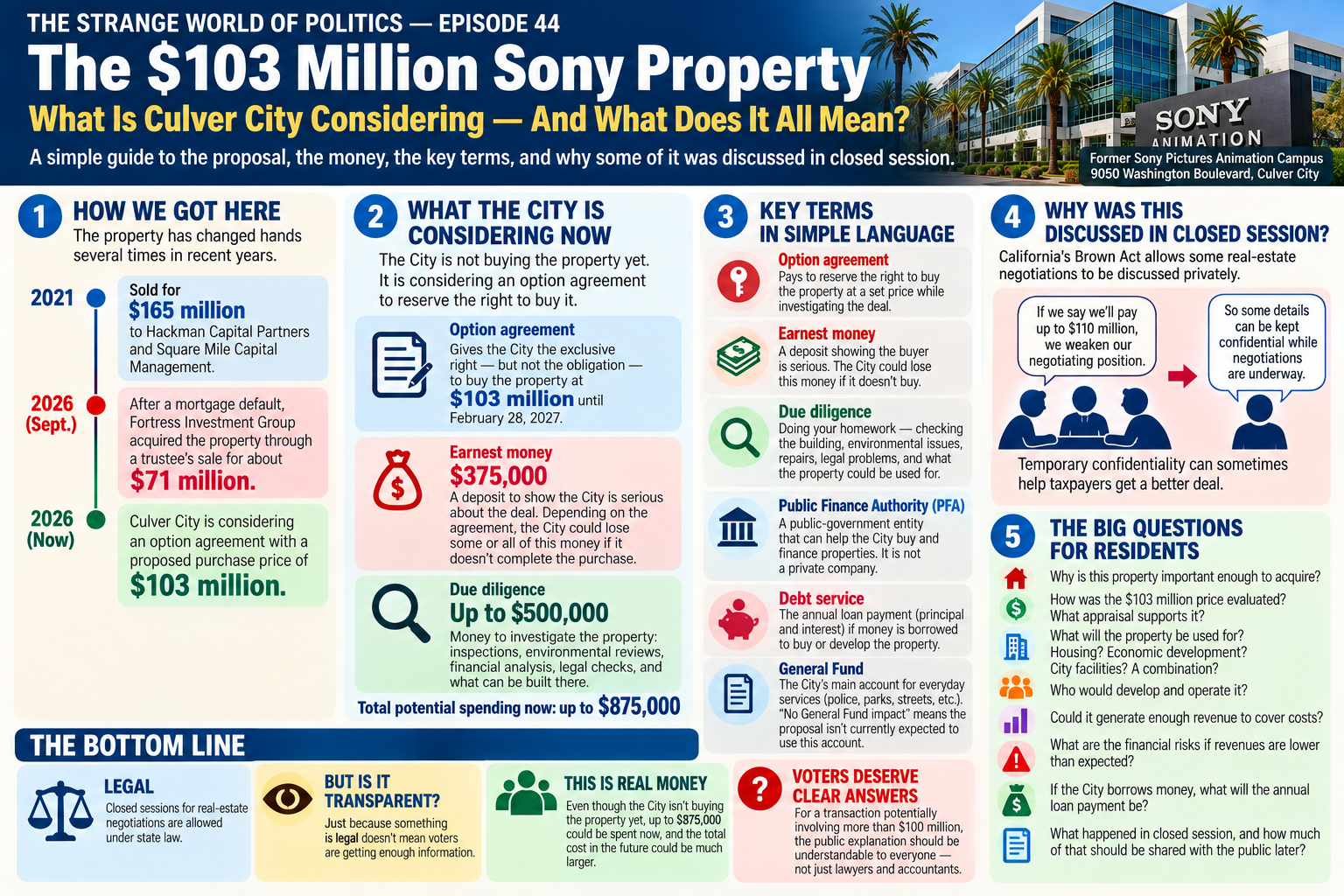
The proposed purchase price is $103 million.
But the City wasn't being asked to write a $103 million check immediately.
Instead, it was considering something called an option agreement.
What is an option agreement?
Think of it as reserving the right to buy the property.
The agreement gives the Culver City Public Finance Authority the exclusive right—but not the obligation—to purchase the property for the agreed price during a certain period.
In ordinary language:
The City is saying, "Hold this property for us at this price while we investigate whether we actually want to buy it."
The option period runs until February 28, 2027.
That's very different from actually purchasing the building.
But reserving that opportunity isn't free.
$375,000 in "Earnest Money" — What Does That Mean?
The agreement calls for $375,000 in earnest money.
That's another real-estate term that sounds more complicated than it is.
Earnest money is basically a deposit showing that a buyer is serious about a transaction.
Think about buying a house.
You agree on a price and put down money while inspections and other work are performed before the final purchase.
This transaction works differently and has its own contractual terms, but the basic concept is similar.
The important question for taxpayers is:
Under what circumstances does Culver City get that $375,000 back, and under what circumstances could it lose the money if the purchase doesn't happen?
That should be explained clearly to residents.
Another $500,000 for "Due Diligence"
Council also considered authorizing as much as $500,000 for due diligence.
What does due diligence mean?
Basically:
Do your homework before buying a $103 million property.
Before spending that kind of money, you want experts investigating things such as:
Is the building structurally sound?
Are there environmental problems?
What repairs will be needed?
What is the property actually worth?
What can legally be built there?
What will it cost to operate?
Are there legal problems?
What could redevelopment cost?
Could the property generate enough money to justify the investment?
That's due diligence.
And the City was prepared to spend up to $500,000 doing that homework.
So before the City even decides whether to complete the $103 million purchase, the amounts being discussed include:
$375,000 — earnest-money deposit
Up to $500,000 — investigation and analysis
That's as much as $875,000 before completing the purchase itself.
What Is the Public Finance Authority?
Here's another term most residents probably don't use in everyday conversation:
Culver City Public Finance Authority, or PFA.
This can sound like some outside financial company.
It isn't.
For purposes of understanding this transaction, think of the PFA as a public-government financing vehicle associated with Culver City that can participate in transactions such as property acquisitions and financing.
So when residents hear that the "Public Finance Authority" may purchase the property, they shouldn't assume this means some unrelated private company is buying it.
This is still a public transaction.
Now the Numbers Get Interesting
The history of this property deserves attention.
According to the information reviewed for this article, the former Sony Animation campus sold in 2021 for approximately:
$165 MILLION
Then there was a mortgage default.
Eventually, Fortress Investment Group reportedly took control of the property through a trustee's sale for approximately:
$71 MILLION
And now Culver City is considering an option agreement with a proposed purchase price of:
$103 MILLION
Those numbers immediately produce an obvious question:
If Fortress took control of the property for approximately $71 million, why would Culver City potentially pay $103 million?
But there's an important warning here.
The $71 million number doesn't automatically mean the property was actually worth $71 million.
Why Isn't $71 Million Necessarily the Property's Value?
This is another place where financial terminology can confuse people.
The Fortress transaction occurred through a trustee's sale following a mortgage default.
In simple terms, the previous ownership had debt secured by the property. After problems with that debt, the lender or creditor could use a legal process to take control of the property.
That's very different from putting a building on the open market and asking buyers:
"What will you pay me for this property?"
So we shouldn't automatically conclude:
Fortress got it for $71 million; therefore it is worth $71 million.
That would be too simplistic.
But the difference between approximately $71 million and $103 million certainly makes another question important:
What independent appraisal or analysis supports the City's $103 million price?
An appraisal is simply an expert estimate of what the property is actually worth.
Residents should be able to understand that analysis.
And What Does "Debt Service" Mean?
Suppose Culver City eventually decides to buy the property but doesn't have $103 million sitting around waiting to be spent.
Money may have to be borrowed.
Borrowing $103 million doesn't mean the cost is simply $103 million.
There is also interest.
The annual payments required to repay borrowed money are commonly called debt service.
Forget the technical terminology.
Think:
THE ANNUAL LOAN PAYMENT.
If the City or Public Finance Authority borrows money for this project, residents should know:
How much is borrowed?
At what interest rate?
For how many years?
What is the annual payment?
And where does the money for those payments come from?
Those questions can be more important than the original purchase price.
What Does "No General Fund Impact" Mean?
You may also encounter statements saying there is no currently contemplated General Fund impact.
What is the General Fund?
Think of it as the City's main checking account for ordinary government services.
It helps pay for the everyday operations residents associate with local government.
So saying there is no currently contemplated General Fund impact doesn't mean:
"This costs taxpayers nothing."
It means the proposal isn't currently expected to draw money from that particular major City funding source.
That raises the next question:
If the General Fund isn't paying for it, what is?
That's the kind of explanation residents deserve in plain English.
Why Does Government Use Closed Sessions?
Now we get to the other complicated part of this story.
Why was any of this discussed privately?
California's Brown Act generally requires local-government business to happen publicly.
But there are exceptions.
Real-estate negotiations can sometimes be discussed in closed session.
A closed session simply means:
The Council discusses certain legally permitted matters privately rather than in front of the public.
There can be a legitimate reason for that.
Imagine you're buying a house.
You tell your real-estate agent:
"I'll offer $95 million, but if necessary I'll go as high as $110 million."
Now imagine your agent announces that publicly.
What do you think the seller will want?
Probably something close to $110 million.
That's why some negotiating information needs to remain confidential while negotiations are underway.
Temporary secrecy can sometimes save taxpayers money.
But Closed Sessions Create Another Problem
Residents aren't in the room.
We don't necessarily know what questions Council members asked.
We don't know what alternatives they discussed.
We don't know what financial risks concerned them.
And we don't necessarily know how much discussion occurred before something finally appeared publicly.
That's the tension:
The City may need privacy to negotiate effectively.
But:
The public needs information to hold government accountable.
Both things can be true.
What Do We Actually Know About the Closed Sessions?
Culver City Neighbors United has questioned whether discussions went beyond real-estate negotiating matters and into possible uses, development, financing and other policy issues.
That's a serious question.
But it is important not to turn a question into a fact.
CCNU's own communication asks:
"What was discussed during the closed sessions?"
If we don't know what was discussed, we shouldn't claim that we do.
There may have been completely appropriate discussions.
There may be questions worth investigating.
But suspicion isn't evidence.
Legal Doesn't Automatically Mean Transparent
And this brings me to the part of this story that interests me most.
Government has rules establishing the minimum amount of information it is legally required to disclose.
But complying with the minimum requirement isn't necessarily the same thing as giving residents the clearest possible understanding of a major financial decision.
Something can therefore be:
LEGAL
while still leaving the public asking:
WHAT ACTUALLY HAPPENED?
The answer doesn't necessarily have to be opening every real-estate negotiation to the public while it is happening.
Doing that could cost taxpayers money by revealing the City's bargaining strategy.
A better question may be:
What should Culver City disclose AFTER secrecy is no longer necessary?
Open the Books After the Negotiation
Once revealing information can no longer damage the City's bargaining position, residents should be able to understand the transaction in ordinary language.
For a deal this large, I would want the public record to answer basic questions such as:
What was the property worth?
Show us the independent appraisal.
Why did the City consider buying it?
Explain the intended public benefit.
What alternatives were considered?
Tell us whether other properties or strategies were evaluated.
What would happen after the purchase?
Would the City operate the property? Lease it? Develop housing? Partner with a private developer?
How much more money might be required?
Buying the building could be only the beginning.
Would money be borrowed?
If yes, explain the loan.
What would the annual payment be?
Don't call it "annual debt service" without explaining it.
Tell residents:
"This is approximately how much we expect to pay every year."
What could go wrong?
Every investment has risks. Tell residents what they are.
Buying the Building Isn't Necessarily the Final Cost
This is another concept that can easily disappear behind financial language.
Suppose the City ultimately pays $103 million.
That doesn't necessarily mean:
TOTAL COST = $103 MILLION
Buildings require maintenance.
Old systems eventually need replacement.
Architects cost money.
Engineers cost money.
Lawyers cost money.
Consultants cost money.
Construction costs money.
Borrowing money costs interest.
Operating a property costs money every year.
And if the City wants to transform the site into housing, offices, public facilities or some combination, redevelopment could require substantial additional investment.
That's why residents need to understand something beyond the purchase price:
WHAT COULD THIS PROPERTY COST CULVER CITY OVER THE NEXT 10, 20 OR 30 YEARS?
That is a much easier question to understand than asking residents to decipher financing documents.
Residents Shouldn't Need an MBA to Understand City Hall
This is ultimately my concern.
For a transaction potentially involving more than $100 million, the public explanation should be understandable to someone who knows absolutely nothing about municipal finance.
Don't just say:
Earnest money.
Explain:
This is the deposit, and here is when we could lose it.
Don't just say:
Due diligence.
Explain:
We're spending up to $500,000 investigating whether this is a good purchase.
Don't just say:
Debt service.
Explain:
This is what the loan could cost us every year.
Don't just say:
No General Fund impact.
Explain:
This particular City account isn't expected to pay for it. Here is where the money would come from instead.
Don't just say:
Public Finance Authority.
Explain what that organization is and why it is being used.
And don't just say:
Closed session.
Explain:
Here is what was kept private, why it was kept private, and—when doing so no longer harms the City's negotiating position—what happened behind those doors.
The $103 Million Question
Maybe purchasing the Sony property ultimately makes financial sense.
Maybe it doesn't.
The information in this article alone doesn't answer that question.
But residents shouldn't have to understand municipal bonds, foreclosure law, real-estate finance or government accounting before they can understand what their City is considering.
With a transaction this large, perhaps the simplest standard is also the best:
Explain it as though you're explaining it to the person whose money is being spent.
Because ultimately, that's exactly what government is supposed to do.
0 Comments
Comments are reviewed before they appear.