
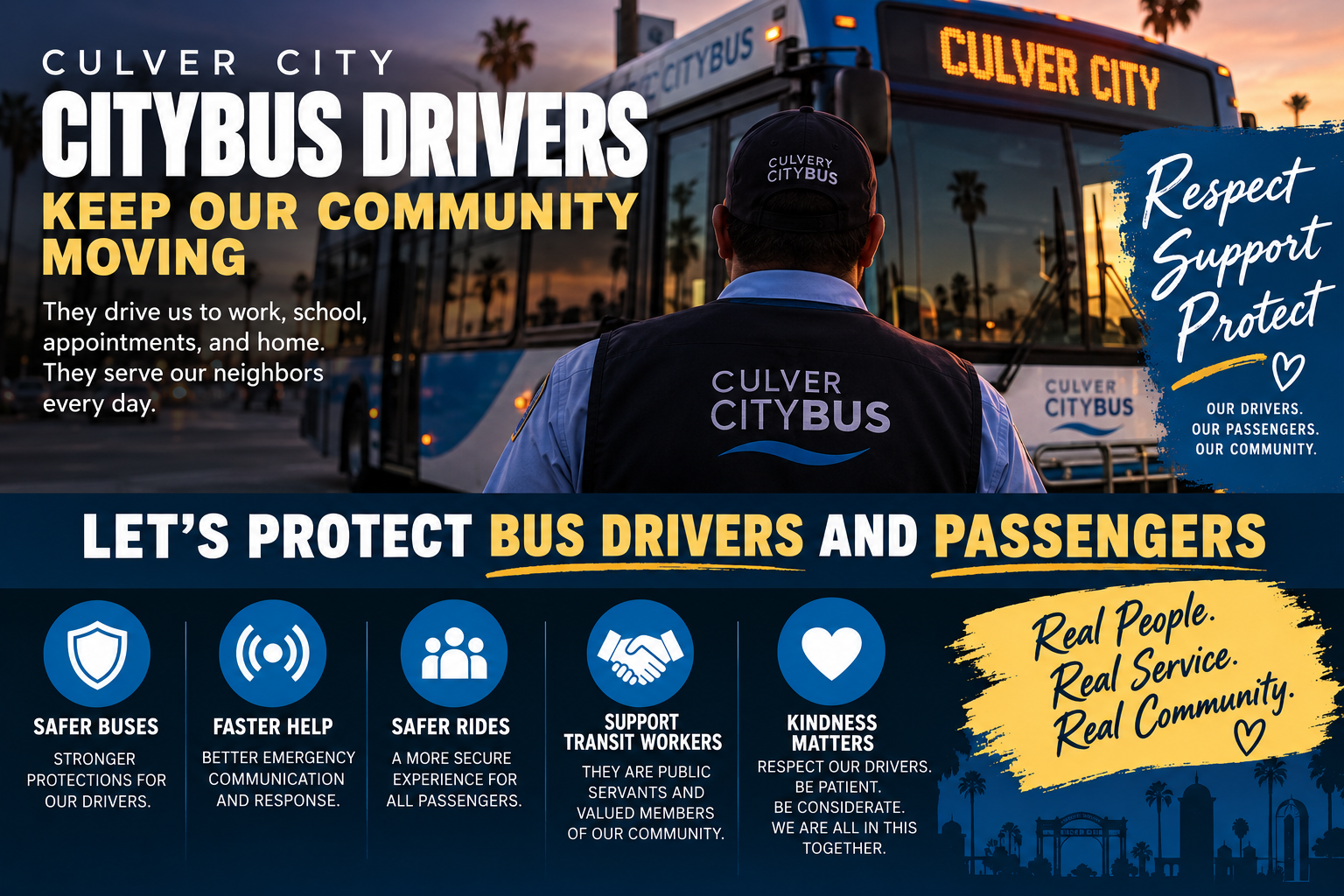
Yesterday, something terrible happened to a member of the Culver City family.
A Culver CityBus operator was shot and killed while doing his job.
The shooting occurred at approximately 5:15 p.m. on October 1 near Centinela and Mitchell avenues in Mar Vista. According to the Los Angeles Police Department, an altercation occurred between the driver and a passenger. Police say the passenger pulled out a gun and shot the driver. The driver, a man in his 40s whose identity had not yet been publicly released, was transported to a hospital, where he died. The suspect fled on a bicycle. The investigation is continuing.
Culver City subsequently suspended CityBus service for the weekend to give employees time to grieve and announced that crisis-support services would be available to staff.
Before discussing policy, we should remember the human being at the center of this tragedy.
A bus operator went to work expecting to drive people to their jobs, schools, stores, medical appointments and homes.
He did not come home.
His family lost someone they loved. His coworkers lost a colleague. And the entire Culver CityBus workforce has been reminded, in the most horrible way possible, that a routine interaction with a passenger can become dangerous.
Bus Drivers Are Public Servants on the Front Line
We often think about public safety in terms of police officers and firefighters. But there are other City employees who spend their entire workday interacting directly with the public.
Bus operators are among them.
They work alone at the front of a vehicle. They interact with hundreds of strangers. They handle disputes involving fares, stops, behavior and other passengers. At the same time, they are responsible for safely operating a large vehicle carrying members of the public.
And when something goes wrong inside that bus, the operator cannot simply walk away.
Passengers are vulnerable too. They are inside an enclosed vehicle and depend upon the operator to get them safely to their destination.
That means transit safety has two inseparable parts:
protecting the person driving the bus and protecting the people riding it.
What Should Culver City Examine?
The investigation into this killing is still underway, so we should not pretend that any particular security measure would necessarily have prevented it.
But an event this serious warrants a careful review of Culver CityBus safety procedures.
That review could examine practical questions such as:
Driver protection: What physical barriers or protective compartments are currently installed on Culver City buses, and are they sufficient?
Emergency communication: How quickly can a driver silently alert dispatchers and law enforcement when a situation begins escalating?
Real-time location: Can dispatch immediately identify the exact location of a bus during an emergency?
Cameras: What camera coverage exists inside and outside buses, how quickly can that video be accessed during an emergency, and can technology provide dispatchers with better real-time information?
Police coordination: What procedures exist between Culver CityBus, Culver City Police, LAPD and other agencies when buses travel outside Culver City's boundaries?
Dangerous-passenger protocols: What are drivers trained to do when a passenger becomes threatening or violent? More importantly, are our policies placing too much responsibility on the driver to personally manage a dangerous confrontation?
Passenger protection: What should passengers do during a violent incident, and are emergency instructions readily available?
Employee support: After witnessing or experiencing violence, what counseling, leave and trauma services are available to operators and other transit employees?
These are questions that can be answered with evidence rather than assumptions.
Drivers Should Not Have to Be Police Officers
There is also a larger issue worth discussing.
A bus driver's primary responsibility is to operate a bus safely.
We should be very careful about creating a system in which the driver simultaneously becomes the fare enforcer, security officer, behavioral-health responder and person responsible for physically confronting someone who may be dangerous.
When someone becomes threatening, the system should give the operator a way to obtain help quickly while reducing the need for direct confrontation.
That protects the driver.
It also protects every passenger sitting behind that driver.
Safety Does Not Have to Mean Turning a Bus Into a Fortress
There is an important balance here.
Public transportation should remain welcoming and accessible. The overwhelming majority of passengers simply want to get where they are going.
Security measures therefore should be evaluated based on evidence: what risks they address, how effective they are, what they cost and whether they create unintended problems for operators or passengers.
Some improvements may involve technology. Others may involve training, physical modifications to buses, staffing, communication with law enforcement or changes in procedures.
The City should determine what works rather than simply reacting emotionally to one horrific event.
And We Should Listen to the Drivers
Perhaps the most important people to ask are the people sitting behind the wheel every day.
What situations frighten them?
Where do they feel vulnerable?
What happens when they call for assistance?
What changes would actually make them safer?
Management can provide statistics. Consultants can prepare reports. Technology companies can sell equipment.
But the operators know what happens on these buses.
Their experience should be part of any serious safety review.
A Community Owes Something to the People Who Serve It
There will be time to examine exactly what happened, what procedures were followed and whether changes are necessary.
Today, however, a family is grieving.
So are the men and women of Culver CityBus.
When service resumes, the person sitting behind the wheel may be someone who knew the driver who was killed. It may be someone who is wondering whether the same thing could happen to them.
Culver City has asked the public to show kindness to its operators as they return to work.
We should.
And beyond our condolences, the City can undertake a transparent review of what protections already exist, what transit workers themselves say they need, what additional measures are available, and what those measures would accomplish.
Because protecting a bus operator is not separate from protecting passengers.
The person sitting behind that wheel is responsible for everyone on that bus. Their safety and the passengers' safety are connected.
0 Comments
Comments are reviewed before they appear.