
A Culver City resident recently sent me an email.
She complimented my website, but then said something much more important:
She knew I cared about sidewalks, but she wasn't really sure what I thought Culver City's biggest problems were—or what I would actually do about them if elected.
That was useful criticism.
Because if someone visits my website, reads my material, and still doesn't know what I would actually try to accomplish on the City Council, then I need to communicate more clearly.
So here it is.
Why Am I Running?
I did not begin this journey as a politician.
I began as a Culver City resident, property owner, taxpayer, and voter who became frustrated trying to understand what my own city government was doing.
I would ask questions.
Sometimes I received answers. Sometimes I received partial answers. Sometimes I had to keep asking.
And sometimes understanding a relatively simple issue required reading lengthy staff reports, budgets, consultant studies, meeting agendas, contracts, and financial documents.
That experience eventually led me to a very simple idea:
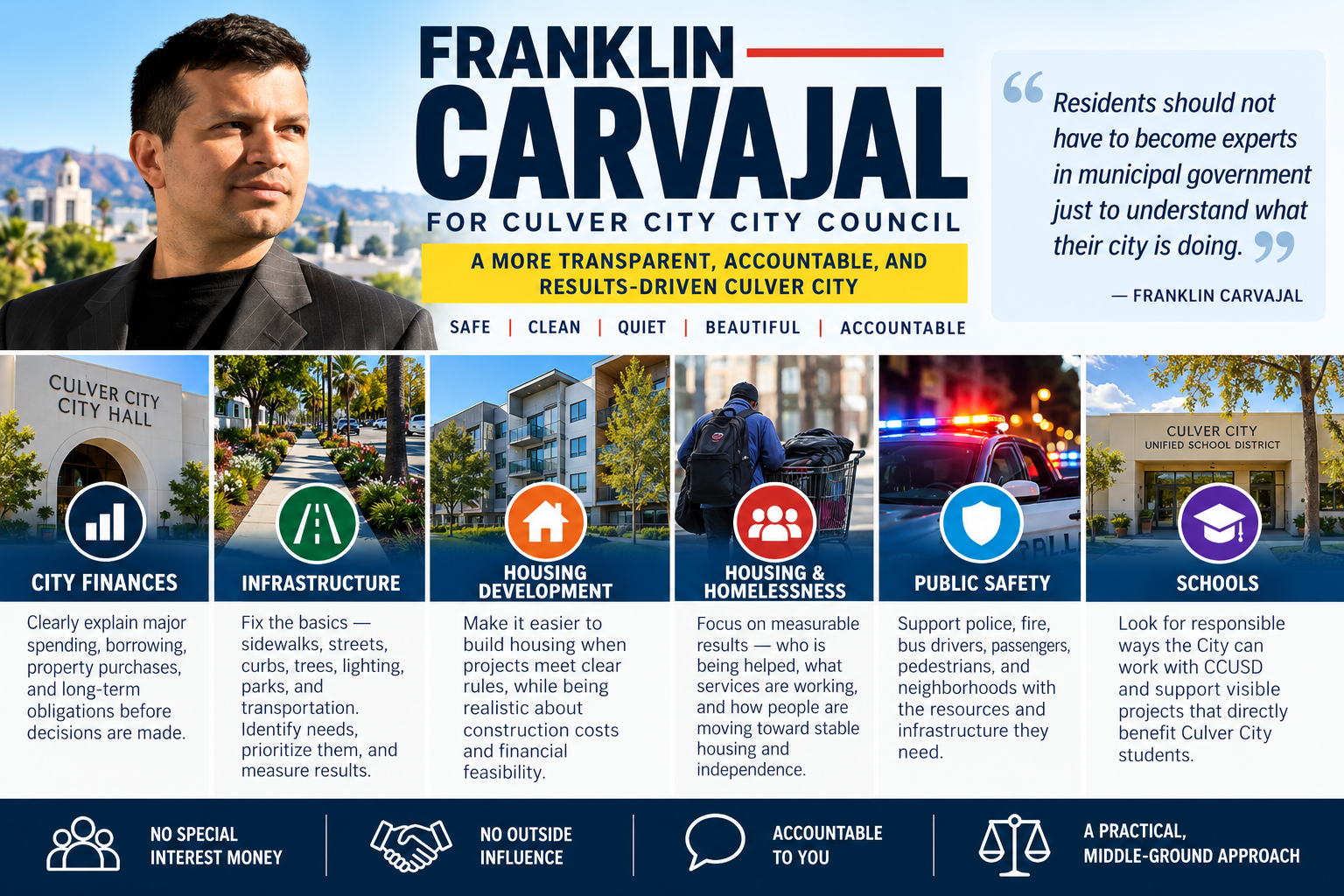
Residents should not have to become experts in municipal government just to understand what their city is doing.
That is at the center of my campaign.
1. Make City Finances Understandable
Think about your credit card statement or mortgage.
You can see what you owe. You can see what you paid. You can see your interest rate. You can see where your money went.
Why shouldn't residents be able to understand City finances just as easily?
When Culver City considers a major property purchase, borrowing money, issuing debt, hiring consultants, or committing taxpayers to years of payments, residents should be able to quickly understand:
What are we buying?
How much does it cost?
How are we paying for it?
How much will we owe each year?
How long will we be paying for it?
What are the risks?
What will it cost to operate and maintain?
And what measurable benefit are residents getting in return?
The information may technically be public. That doesn't necessarily make it understandable.
I want to change that.
2. Fix the Basics
Yes, I talk about sidewalks.
And I will continue talking about them.
Sidewalks may not sound exciting compared with enormous development projects or ambitious new programs, but they illustrate something important about government.
Residents interact with sidewalks, streets, curbs, trees, lighting, parks, buses, and public spaces every day.
Government should be able to take care of the basics.
I want Culver City to identify these basic infrastructure needs, prioritize them, establish realistic schedules, and show residents what is being completed.
Not simply announce plans.
Measure results.
3. Housing: Move Beyond the Slogans
We need housing.
But saying "build more housing" is much easier than actually building it.
I have learned this personally while exploring what can realistically be built on my own narrow Culver City property.
State housing laws can allow more density on paper. That does not automatically mean a project is financially or physically feasible.
Construction costs, financing, lot dimensions, rents, parking, utility requirements, affordability requirements, and development standards all matter.
I want Culver City to become a place where someone who wants to build housing can understand the rules, receive answers quickly, and determine whether a project can actually work.
Housing policy should ultimately produce housing, not simply paperwork.
4. Homelessness: Measure Outcomes, Not Just Spending
Culver City has devoted substantial attention and resources to homelessness.
Residents deserve to understand what those programs accomplish.
How many people entered a program?
What services did they receive?
How many moved into permanent housing?
How many became capable of living independently?
How long did that process take?
Where are the gaps?
Protecting people's privacy does not prevent government from providing residents with useful aggregate information.
Compassion and accountability are not opposites.
We should have both.
5. Public Safety Means Everyday Safety
Public safety is more than one department.
It means protecting residents, police officers, firefighters, bus drivers, passengers, pedestrians, cyclists, seniors, children, businesses, and people simply walking through their neighborhoods.
It also means looking at intersections, traffic speeds, lighting, transportation infrastructure, emergency preparedness, and technology that may improve safety while establishing appropriate safeguards.
Again, the question should be:
What problem are we trying to solve, what are we doing about it, and is it working?
6. Support Our Schools
Culver City benefits enormously from its public schools.
I believe the City should look seriously at appropriate opportunities to work with CCUSD on projects that visibly benefit students and families.
Education may have its own governmental structure, but the children attending Culver City schools are part of the same community the City Council represents.
City government and our schools should not operate as though they exist on different islands.
There Isn't One "Biggest Problem"
The voter who wrote to me asked what I thought Culver City's biggest problem was.
I thought about that question.
I don't believe there is one answer.
Ask ten Culver City residents and you may hear ten different priorities.
Housing.
Homelessness.
Traffic.
Public safety.
Taxes.
Schools.
Development.
Bicycles.
Business.
Sidewalks.
City spending.
And that is exactly why local government is difficult.
My job as a councilmember would not be to pretend everyone agrees with me.
It would be to listen, examine the evidence, explain the choices, make a decision, and then be accountable for the result.
I Want to Be the Person in the Middle
Culver City politics can sometimes make it feel as though you have to choose a team before the conversation even begins.
I don't think that is healthy for local government.
Someone can support more housing and still ask whether a particular housing proposal makes financial sense.
Someone can strongly support helping homeless residents and still ask whether millions of dollars in programs are producing results.
Someone can support bicycle infrastructure and still ask whether streets and sidewalks are being maintained.
Someone can support public safety and still insist on transparency and safeguards.
These positions do not have to contradict each other.
I want to approach City Hall as I approach problems in the rest of my life:
Listen. Ask questions. Look at the evidence. Make a plan. Spend carefully. Measure the results. Explain what happened.
Maybe I Needed That Email
Campaigns involve a lot of talking.
Websites.
Forums.
Mailers.
Endorsements.
Social media.
Candidate statements.
Signs.
But none of those things matter very much if residents still don't know what you would actually do.
So I am grateful that one voter told me exactly that.
It reminded me why I started writing The Strange World of Politics in the first place.
Government shouldn't be something happening somewhere behind the doors of City Hall while the rest of us try to figure it out afterward.
Residents should understand what their government is doing, why it is doing it, what it costs, and whether it worked.
That may not fit neatly into a political slogan.
But it is the kind of City government I want to help build.
Safe. Clean. Quiet. Beautiful. Accountable.
— Franklin Carvajal
Candidate for Culver City City Council
0 Comments
Comments are reviewed before they appear.