
A voter recently asked me a very good question:
What exactly makes you different from the other candidates?
That question made me think about Culver City politics in a way that may sound strange at first.
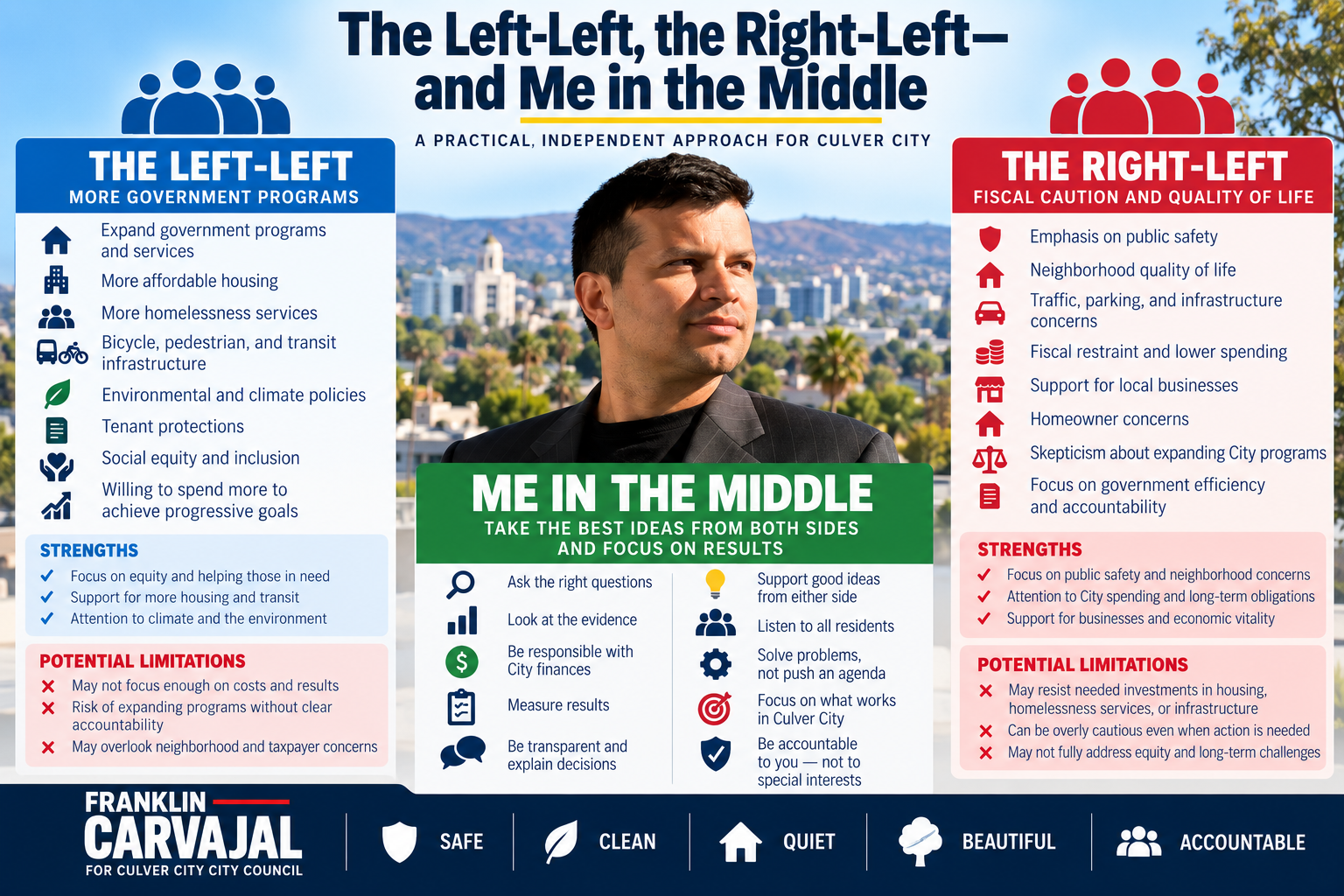
I don't see our local political debate as traditional left versus right. Culver City is overwhelmingly a progressive community. Instead, I often see two different versions of the left.
I call them the Left-Left and the Right-Left.
And then there is where I tend to stand: somewhere in the middle.
What Do I Mean by the “Left-Left”?
When I use the term Left-Left, I am not criticizing people or questioning their motives. I am describing one approach to local government.
This side generally places greater emphasis on expanding government programs, affordable housing, tenant protections, homelessness services, bicycle and pedestrian infrastructure, environmental policies, and other progressive initiatives.
There are important ideas here that I support.
We need more housing. We need to help people experiencing homelessness. We need safer streets. We need alternatives to driving. We need to protect renters. We need to address climate change.
Where I sometimes differ is on the next question:
How much will it cost, how will we pay for it, and how will we know whether it worked?
Supporting the goal does not mean that every program designed to achieve that goal is necessarily the best program.
What Do I Mean by the “Right-Left”?
The other major group in Culver City is what I call the Right-Left.
Again, I am not talking about the traditional national political right.
These residents may also support Democratic and progressive values, but they tend to place greater emphasis on public safety, neighborhood quality of life, fiscal restraint, traffic, parking, homeowners, businesses, and skepticism about expanding City programs too quickly.
I understand many of those concerns too.
Government cannot spend without limits. Neighborhoods matter. Businesses matter. Public safety matters. Residents should be able to question a government program without being accused of opposing the people that program is intended to help.
But fiscal caution should not become an excuse for doing nothing.
Sometimes government should spend money.
The question is whether we are spending it intelligently.
So Where Does That Leave Me?
In the middle.
But being in the middle does not mean splitting every issue 50/50.
It means I am willing to take an idea from either side and ask the same questions:
What problem are we trying to solve?
What does the evidence tell us?
What will the solution cost?
Where will the money come from?
What are the unintended consequences?
How will we measure whether it worked?
And perhaps most importantly:
Can we explain all of this clearly to the residents paying for it?
That is the kind of government I want.
Housing Is a Good Example
The Left-Left might say: We need more housing.
I agree.
The Right-Left might say: Development can affect neighborhoods, traffic, parking, and infrastructure.
I agree with that too.
My question is: How do we actually get housing built while dealing realistically with those consequences?
My own experience exploring development possibilities on a narrow Culver City lot has taught me something important.
A law can say that more housing is allowed.
That doesn't mean anyone can afford to build it.
Construction costs, financing, rents, utilities, lot dimensions and development requirements can determine whether a project ever leaves the drawing board.
I am interested in the point where housing policy meets economic reality.
Homelessness Is Another Example
One side may emphasize compassion and services.
Another may emphasize public order, spending and accountability.
Why should we have to choose?
We can treat people experiencing homelessness humanely and ask whether our programs are working.
How many people entered a program?
How many obtained permanent housing?
How many became independent?
How long did it take?
How much did it cost?
What happened to people who were unsuccessful?
Those are not anti-homeless questions.
They are questions government should be able to answer.
Transportation Doesn't Have to Be a Culture War
The same applies to transportation.
I support walking, bicycles and public transportation.
I also recognize that many Culver City residents depend on cars.
Those facts can coexist.
Instead of arguing endlessly about whether cars or bicycles are good or bad, I would rather ask:
Can children walk safely to school?
Can someone in a wheelchair use the sidewalk?
Can residents cross dangerous intersections safely?
Does the bus come frequently enough that people will actually use it?
Can businesses receive customers and deliveries?
Can residents reasonably get where they need to go?
Transportation policy should solve transportation problems.
And Then There Is Money
This may be where I differ most in emphasis.
Whenever the City proposes something ambitious, I want residents to see the financial consequences in plain English.
Imagine if every major City proposal came with something resembling a household financial statement:
Purchase price.
Amount borrowed.
Interest and financing costs.
Annual payments.
Operating costs.
Expected revenue.
Effect on reserves.
Expected benefit.
How success will be measured.
Then residents could decide for themselves whether they think it is a good investment.
That is transparency.
I Don't Want Culver City Governed by Teams
National politics increasingly asks us to pick a team and defend everything our team does.
Local government doesn't have to work that way.
A pothole isn't progressive or conservative.
A broken sidewalk doesn't have a political affiliation.
A dangerous intersection doesn't care who you endorsed.
And a dollar spent by City Hall is still a dollar regardless of which political group proposed spending it.
I want to be able to say yes to someone I usually disagree with when they have a good idea.
And I want to be able to say no to someone I usually agree with when I believe they have a bad one.
That independence matters to me.
My Politics Are Actually Pretty Simple
I can summarize my approach in seven words:
Listen. Question. Plan. Spend carefully. Measure. Explain.
And I can summarize the kind of Culver City I want in five:
Safe. Clean. Quiet. Beautiful. Accountable.
I don't expect everyone on the Left-Left to agree with me.
I don't expect everyone on the Right-Left to agree with me either.
In fact, if I am genuinely independent, there will probably be times when both sides disagree with me.
That's okay.
Because I am not running to represent a political faction.
I am running to represent Culver City.
0 Comments
Comments are reviewed before they appear.