
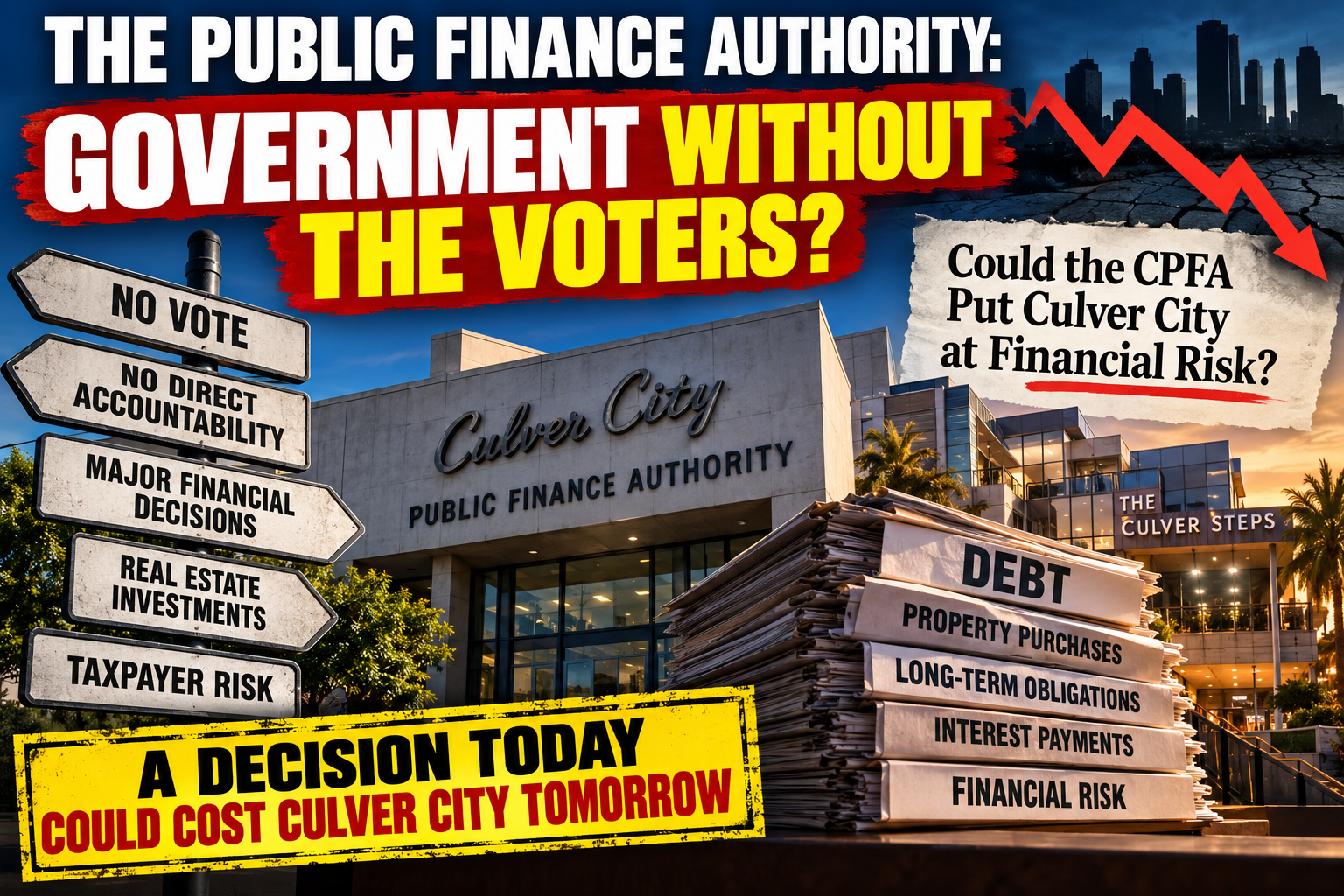
Culver City residents should pay close attention to a recent statement from City Manager Odis Jones concerning the proposed acquisition of The Culver Steps.
The City ultimately decided not to purchase the property. That may have been the correct financial decision.
But there is a much bigger issue hiding inside the announcement.
The City Manager explained that the City spent months evaluating the possible acquisition of The Culver Steps through the Culver City Public Finance Authority (CPFA).
That raises a fundamental question:
What exactly has the Public Finance Authority become?
Most Culver City residents never voted to create a separate investment arm of City government. They do not elect a separate Public Finance Authority board. Yet increasingly, major financial decisions can be discussed and structured through an entity that most residents probably know very little about.
The members of the City Council also serve as the governing board of the Public Finance Authority.
In other words, the same five elected officials can finish acting as the City Council and then act as the Public Finance Authority Board.
That may be legally permissible.
But legal authority and democratic accountability are not the same thing.
Look at the language in the City's own announcement
City Manager Odis Jones wrote:
“Beginning in the spring, this work included evaluating the potential acquisition of The Culver Steps through the Culver City Public Finance Authority (CPFA).”
He further explained that staff conducted due diligence and financial analysis and, after discussions with the CPFA Board, determined that purchasing The Culver Steps would not be in the CPFA's best interest.
I am glad they ultimately decided against the acquisition.
But think about what residents are being told.
For months, City staff and the Public Finance Authority were analyzing a potentially enormous real-estate transaction involving one of downtown Culver City's most important properties.
How many residents knew this was happening?
How much meaningful public discussion occurred before substantial City resources were devoted to evaluating the transaction?
And, most importantly, what rules determine what the Public Finance Authority may pursue next?
The CPFA appears to be evolving beyond a financing mechanism
Public finance authorities can serve legitimate purposes. Cities use these entities to issue debt, structure lease-revenue financing, and finance public projects.
But Culver City's CPFA now appears to be taking on a potentially broader role.
The City's own statement describes the CPFA as evaluating investments that could strengthen commercial districts, support businesses, create jobs, generate new revenue, and advance economic development.
Those are extraordinarily broad objectives.
If the CPFA is going to become a vehicle through which Culver City buys property, borrows money, makes investments, or pursues economic-development projects, residents deserve a serious public conversation about exactly what its powers should be.
Who gave the CPFA this investment mandate?
That is the question I want answered.
When did Culver City residents decide that the Public Finance Authority should become an economic-development and investment agency?
There was no citywide election asking voters:
Should Culver City's Public Finance Authority purchase major commercial properties?
There was no ballot question asking:
Should the Authority borrow tens of millions of dollars for economic-development investments?
There was no public referendum establishing how much financial risk taxpayers should accept.
Instead, the institution can grow decision by decision, transaction by transaction.
That is precisely why oversight matters.
“We decided not to buy it” is not enough
The City Manager's statement emphasizes that the decision not to purchase The Culver Steps demonstrates financial discipline.
Perhaps it does.
But accountability cannot depend solely upon City officials telling residents afterward that they exercised good judgment.
The public deserves to know before major commitments are made:
What property is being considered?
Why is the City considering buying it?
What is the purchase price?
What is the independent appraisal?
How much would the City borrow?
What interest rate would it pay?
What would the annual debt payments be?
What revenue is realistically expected?
What happens if those revenues fall short?
What City funds or assets ultimately support the financing?
What alternatives were considered?
And what happens to police, fire, streets, sidewalks, parks, homelessness programs and other essential services if the financial projections are wrong?
Those questions should not be afterthoughts.
They should be prerequisites.
Could the Public Finance Authority become a threat to the City's financial stability?
This is the question that concerns me most.
A Public Finance Authority can help a city finance useful projects. But financing also creates obligations. If an authority repeatedly borrows money, purchases expensive properties, or enters long-term financial commitments, those obligations do not simply disappear when an investment performs poorly.
Imagine a series of projects based on optimistic assumptions about property values, rents, interest rates, operating costs or future revenues.
One project underperforming may be manageable.
Several major projects underperforming at the same time could be much more serious.
Debt payments continue.
Buildings require maintenance.
Employees and contractors must be paid.
Unexpected repairs occur.
Interest costs can rise.
Revenues can fall.
Eventually, the question becomes: Who makes up the difference?
That is why residents should care about the relationship between the CPFA and Culver City's broader finances.
I am not saying Culver City is going bankrupt.
I am saying that poorly controlled borrowing and investment through a public financing authority could contribute to the kind of long-term financial stress that can threaten a city's fiscal stability.
In an extreme situation, excessive obligations combined with inadequate revenues can contribute to municipal insolvency.
That is not a prediction.
It is precisely the kind of risk responsible government should design safeguards to prevent.
And residents should not discover those risks only after the obligations have already been incurred.
Five Councilmembers should not equal unlimited financial authority
We elect five people to the City Council.
That does not mean residents surrender their right to understand how major long-term financial decisions are being made.
When those same five people sit as another governing board with the ability to participate in complicated financing structures, the distinction between the City and the Public Finance Authority can become almost invisible to the ordinary voter.
That makes transparency even more important—not less.
Residents should not have to understand municipal bond law, lease-revenue financing, joint-powers authorities, or complicated organizational charts to figure out who is borrowing money and who ultimately bears the risk.
My proposal: CPFA Accountability Rules
If I am elected to the Culver City Council, I will push for clear accountability requirements for major Public Finance Authority transactions.
Before the CPFA approves a significant property acquisition, financing or investment, the public should receive a plain-English financial disclosure showing:
Purchase price. Independent appraisal. Amount borrowed. Interest rate. Financing term. Annual payments. Total projected financing cost. Expected revenues. Operating expenses. Best-case and worst-case projections. Impact on City reserves. Impact on the General Fund. Intended public use. Exit strategy.
I would add another requirement:
A Financial Stress Test
Before a major CPFA transaction is approved, residents should be shown what happens if the assumptions are wrong.
What happens if revenues are 10%, 20% or 30% below projections?
What happens if operating expenses are substantially higher?
What happens during a recession?
What happens if refinancing becomes more expensive?
Most importantly:
Could the City still pay for essential services while meeting these obligations?
For especially large transactions, I also believe the City should consider requiring an independent financial review and a clearly defined period for public examination before final approval.
And if a transaction exposes taxpayers to extraordinary long-term financial obligations, we should have a serious discussion about whether direct voter approval should be required.
This is bigger than The Culver Steps
The Culver Steps transaction did not happen.
The next transaction might.
And the next one could be larger.
That is why this discussion needs to happen now, not after the City has already signed documents or borrowed millions of dollars.
I am not opposed to investment.
I am not opposed to economic development.
I am not opposed to using financing when financing makes sense.
I am opposed to major public financial decisions becoming so complicated and institutionally removed that ordinary residents cannot understand what their government is doing—or how much financial risk it is assuming.
The Public Finance Authority should never be allowed to become a government within our government or a financial vehicle capable of accumulating obligations without meaningful public scrutiny.
Could decisions made through the CPFA someday contribute to a financial crisis for Culver City?
That is exactly why we need safeguards before the answer to that question is tested in the real world.
Public money requires public accountability.
Public debt requires public transparency.
And when financial decisions could affect Culver City for decades, residents deserve a meaningful voice before the risk is taken—not after the bill comes due.
0 Comments
Comments are reviewed before they appear.