
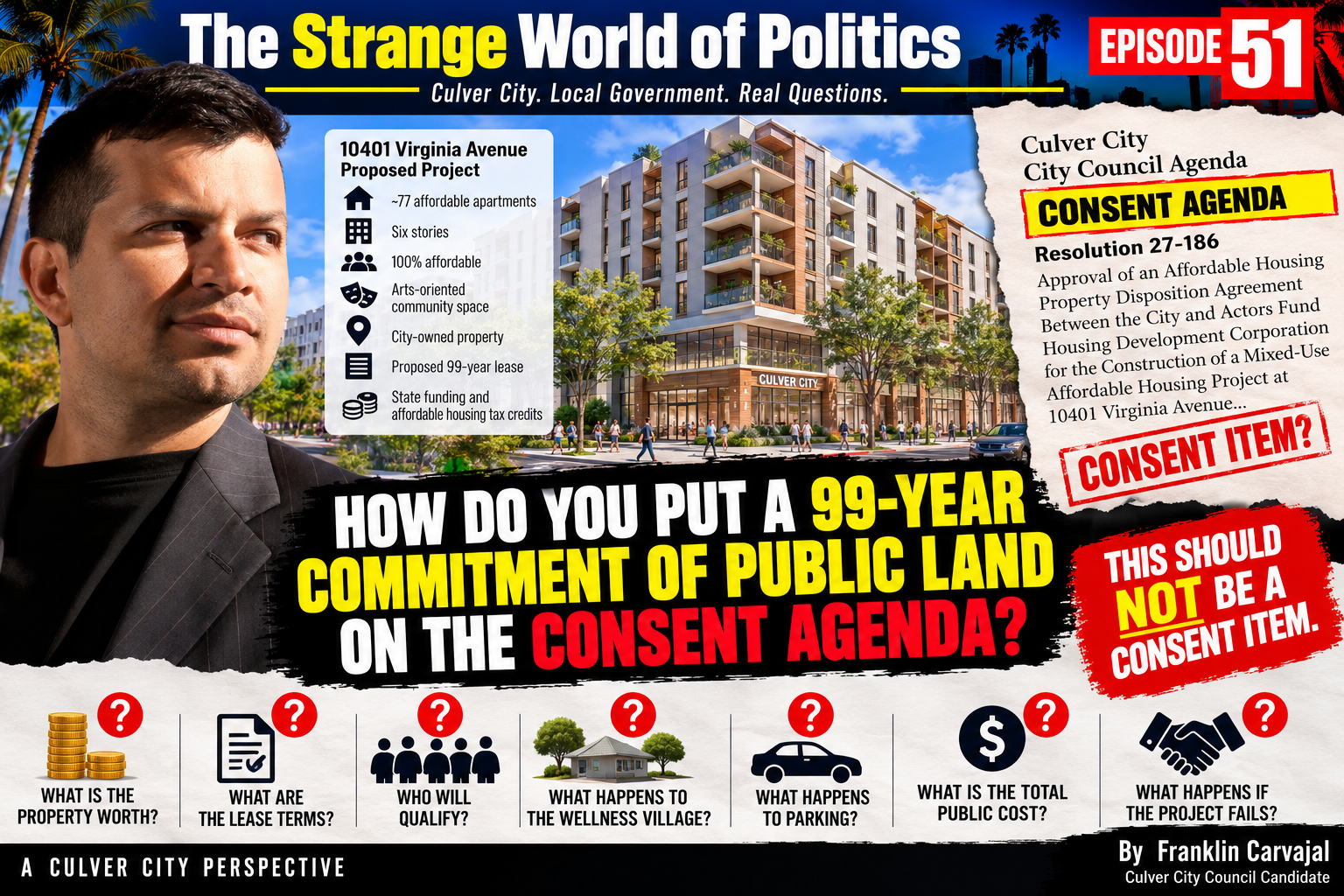
Culver City, Affordable Housing, and the Politics of Avoiding Public Discussion
By Franklin Carvajal | Culver City Council Candidate
There is something very strange about how government operates in Culver City.
We are constantly told that transparency, public participation, and accountability are among the City's highest priorities. Yet some of the most consequential decisions involving public property, taxpayer resources, and the future of our community are placed on the City Council's consent agenda.
For those unfamiliar with the process, a consent agenda is supposed to streamline government operations. It allows the City Council to approve routine, noncontroversial items together, often without individual discussion.
That makes sense when approving ordinary administrative matters.
But should a decision potentially committing valuable City-owned land for 99 years be treated as routine?
I don't think so.
And Resolution 27-186 is a perfect example of why Culver City needs to rethink what belongs on its consent agenda.
1. What Is Resolution 27-186?
The resolution concerns a proposed affordable housing development at 10401 Virginia Avenue, involving five parcels of land.
The City Council item calls for two actions:
Approval of an Affordable Housing Property Disposition Agreement between Culver City and Actors Fund Housing Development Corporation for a mixed-use affordable housing project.
Adoption of a resolution approving the developer's application for housing development financing.
The project has been described as potentially providing approximately 77 affordable apartments, along with community-oriented space.
I support the creation of affordable housing. In fact, I have been personally trying to develop housing in Culver City and have written extensively about the obstacles facing small developers.
But supporting affordable housing does not mean abandoning financial scrutiny.
And it certainly does not mean that major decisions about public property should be buried among routine agenda items.
2. Ninety-Nine Years Is Not Routine
Think about what 99 years means.
A child born today could live an entire lifetime before the proposed lease expires.
City Council members will come and go. City managers will come and go. Entire generations of Culver City residents will come and go.
Yet a decision made by today's Council could affect the use of this property for nearly a century.
That deserves a public discussion.
Residents should know:
What is the current market value of the five parcels?
How much will the developer pay the City for the land?
Is the City leasing the property below market value?
What is the total estimated cost of the development?
What financial commitments, if any, will the City make?
What happens if the developer cannot secure financing or complete construction?
Who will qualify for the affordable apartments?
What happens to existing uses of the property, including the Wellness Village and parking?
These are not unreasonable questions.
They are precisely the questions elected officials should ask before approving a long-term agreement involving public assets.
3. The Consent Agenda: Where Important Decisions Can Escape Attention
Here is what residents need to understand.
When an item is placed on the consent agenda, it can be approved together with numerous other items through a single vote.
Unless a Council member requests separate consideration, there may be no individual presentation, no detailed questions from Council members, and no substantive public debate about the item.
To be clear, consent items are publicly noticed, and residents generally have opportunities to comment under the applicable meeting procedures.
But having an opportunity to comment is not the same as having a meaningful public discussion.
Transparency should mean more than placing a document online and expecting residents to discover it.
Consider the contradiction.
The City can spend substantial time debating relatively minor policy issues while a proposed 99-year arrangement involving publicly owned land is placed on an agenda designed for routine approvals.
What message does that send?
That the City considers this decision ordinary?
That the financial implications are too insignificant to discuss?
Or simply that the Council believes the matter has already received enough attention elsewhere?
If the project has been thoroughly evaluated, why not present that evaluation publicly?
A good project should be able to withstand public scrutiny.
4. Public Land Has Value, Even When the City Says There Is No General Fund Impact
One of the most important distinctions residents need to understand is the difference between spending money and committing a public asset.
A staff report may indicate that a transaction has no anticipated General Fund impact.
That is an important piece of information.
But it does not necessarily mean the transaction has no economic cost.
Imagine owning a valuable piece of property.
You agree to let someone use it for 99 years.
Even if you do not write that person a check, you have committed an asset that might otherwise have generated revenue, supported another public use, or remained available for future decisions.
That is an economic consideration.
I am not claiming that the proposed agreement is financially irresponsible. I am saying residents deserve enough information to determine whether it is responsible.
What is the property worth, what is Culver City contributing, and what is Culver City receiving in return?
Those questions should be answered before the Council votes, not after residents discover what was approved.
5. The Affordable Housing Contradiction
This issue is especially interesting to me because I have been trying to develop affordable housing myself.
I have written about my efforts to build approximately 11 to 20 residential units under California's SB 79 and density bonus laws.
As a small property owner and prospective developer, I have encountered a complicated process involving architects, engineers, consultants, planning requirements, financing uncertainties, and substantial upfront expenses.
I have repeatedly asked how the City can help smaller developers who want to contribute to its housing goals.
The assistance available to someone in my position appears extremely limited.
Meanwhile, the City is considering an agreement making publicly owned land available for a much larger affordable housing development.
I understand that nonprofit affordable housing projects often rely on financing structures and subsidies that are different from those available to private developers.
But that distinction raises an important policy question.
Why doesn't Culver City have a more transparent and accessible strategy for helping smaller property owners produce affordable housing too?
If affordable housing is truly a priority, shouldn't the City explore every reasonable opportunity to produce it?
Why should affordable housing development depend so heavily on large institutional arrangements?
Why not create pathways for smaller developments that could collectively add meaningful housing supply throughout Culver City?
I am not asking the City to stop helping nonprofit developers.
I am asking it to explain why its housing strategy does not appear to provide comparable practical assistance to smaller developers willing to build housing.
6. What About the Wellness Village?
Another issue deserves public attention.
The Virginia Avenue property has been associated with the City's Wellness Village interim housing program, and portions have also served parking needs.
If the site is redeveloped, what happens to those existing uses?
Will the Wellness Village need to move?
If so, where will it go, what will relocation cost, and how will services be maintained?
What happens to the parking?
These questions may have answers in project planning documents. But residents should not have to conduct their own investigation to understand the consequences of a major public-property decision.
The City Council should explain the transition clearly and publicly.
7. A Simple Reform: Keep Major Public-Property Decisions Off the Consent Agenda
I believe Culver City should adopt a straightforward policy.
Any proposed transaction involving a substantial public asset, a long-term land commitment, or significant financial exposure should automatically receive separate City Council consideration.
That means a staff presentation, an opportunity for Council members to ask questions, a clear explanation of the financial terms, and an individually recorded vote.
The City could establish reasonable thresholds for these requirements.
A 99-year lease of publicly owned land would certainly qualify.
This reform would not prevent the City from approving affordable housing.
It would not require the City to reject agreements with nonprofit developers.
It would simply ensure that major public decisions receive the attention they deserve.
If a project is financially sound and serves the public interest, a public discussion should strengthen confidence in it.
8. Why This Matters Beyond One Housing Project
This is not just about 10401 Virginia Avenue.
It is about how Culver City governs.
I have raised similar concerns about the Culver City Public Finance Authority and the extent to which major financial decisions can occur without sufficient public understanding.
The underlying problem is the same.
Government develops complicated financial and administrative mechanisms. Staff members prepare extensive reports. Elected officials receive recommendations. Residents are left trying to understand what happened.
And too often, the public conversation comes after the important decisions have already been made.
That is not how I believe local government should function.
Culver City residents own the public assets being discussed.
Their elected representatives are supposed to act as stewards of those assets.
That responsibility should include explaining important decisions openly, even when the proposals are well-intentioned.
9. My Position as a City Council Candidate
I support increasing Culver City's housing supply.
I support affordable housing.
I support using public resources when there is a clear, demonstrable public benefit.
But I also support financial accountability, transparency, and meaningful public participation.
These principles should not conflict.
A Council member should be able to support affordable housing while questioning the terms of a 99-year land agreement.
A resident should be able to ask about the market value of public property without being accused of opposing affordable housing.
And a City Council should be willing to discuss major transactions individually rather than relying on the consent agenda.
Good government is not measured only by what it approves. It is also measured by how it makes those decisions.
10. The Strange World of Politics
Here is the irony.
Culver City regularly speaks about community engagement, transparency, and public accountability.
Yet a proposed agreement involving five parcels of public land and a possible 99-year commitment was presented as a consent item.
Think about that.
Ninety-nine years.
Five parcels.
A major affordable housing development.
Publicly owned property.
And the procedural classification is: Consent.
That is the strange world of politics.
I am not arguing that the project should be rejected.
I am arguing that the public deserves a government willing to explain exactly what it is approving.
A 99-year agreement deserves more than a routine vote. It deserves a conversation.
And if I am elected to the Culver City Council, that is the kind of transparency and accountability I intend to advocate.
Franklin Carvajal is a candidate for Culver City Council and author of The Strange World of Politics, a series examining local government, public spending, housing, accountability, and the contradictions of municipal politics.
Episode 51 — The Strange World of Politics
Reference: Culver City Council Resolution 27-186, Affordable Housing Property Disposition Agreement for 10401 Virginia Avenue.
0 Comments
Comments are reviewed before they appear.