
By Dr. Franklin Carvajal — Candidate for Culver City Council 2026
October 17, 2026
1. Who Is Behind Protect Culver City?
As I continue my campaign for Culver City Council, I have become increasingly interested in the organizations that influence our local elections.
One of these organizations is Protect Culver City, a political action committee that has been involved in local politics since 2019.
The organization advocates for public safety, government accountability, and policies concerning housing, homelessness, policing, and transportation.
In the November 2026 election, Protect Culver City is supporting Kimberly Griffin and Jeannine Wisnosky Stehlin for City Council.
Interestingly, these are also the candidates supported by the Culver City Coalition and several other local organizations.
But who founded Protect Culver City? What is its political history? And what do we know about the people behind it?
I decided to investigate.
2. The Beginning: Rent Control and the 2019 City Council
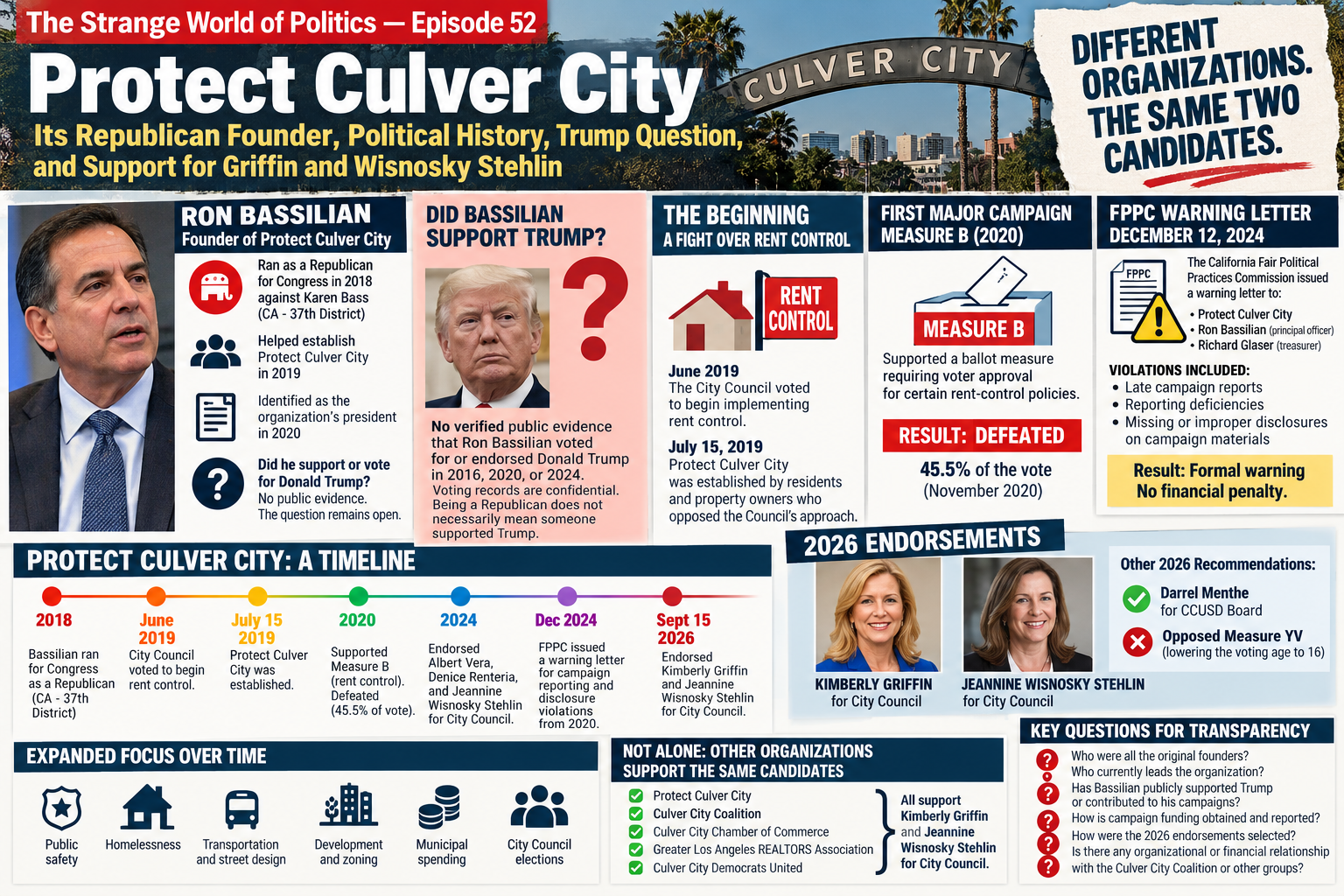
Protect Culver City was established on July 15, 2019.
According to the organization's own account, its formation followed the City Council's June 2019 decisions concerning rent control.
Some residents and property owners believed the Council had moved too quickly and had not adequately consulted the public before making significant housing-policy changes.
Protect Culver City emerged from those concerns.
Its initial mission focused on opposing the Council's approach to rent control and advocating for greater public involvement in government decisions.
Over time, however, the organization expanded its interests to include public safety, homelessness, transportation, development, and City Council elections.
What began as an organization focused on one controversial policy became a broader political force in Culver City.
3. Who Founded Protect Culver City?
One of the principal figures behind Protect Culver City was Ron Bassilian.
Bassilian was identified in contemporary news coverage as the organization's founder and president.
Before becoming involved in Protect Culver City, Bassilian had already participated in national politics.
In 2018, he ran as a Republican candidate for the United States House of Representatives, challenging Democrat Karen Bass in California's 37th Congressional District.
He lost that election but subsequently became active in Culver City politics.
His Republican political background is an important part of the organization's history.
There is nothing unusual or improper about a Republican establishing a local political organization, particularly one concerned with housing policy and public safety.
However, understanding the political backgrounds of an organization's founders can help residents evaluate its history and policy priorities.
The available information identifies Bassilian as a founding leader. A complete, independently verified list of the organization's original founders has not been established.
4. Did Ron Bassilian Support Donald Trump?
This brings me to another question.
Did Ron Bassilian vote for Donald Trump?
Bassilian ran for Congress as a Republican in 2018, during Trump's first presidency.
But being a Republican does not necessarily mean someone voted for Trump.
I have not established whether Bassilian voted for Trump in 2016, 2020, or 2024.
Because individual votes are confidential, there is no public voting record that can answer that question.
However, other questions may be answerable through public records:
Did Bassilian publicly endorse Donald Trump?
Did he contribute money to Trump's presidential campaigns?
Did he participate in organizations supporting Trump's political agenda?
Has he publicly expressed support for or opposition to Trump's policies?
I believe these are reasonable questions when examining the political background of someone who founded an organization involved in local elections.
At the same time, it would be incorrect to assume that Bassilian supported Trump simply because he ran as a Republican.
It would also be incorrect to assume that Protect Culver City's endorsed candidates share Bassilian's national political views.
Those are separate questions requiring separate evidence.
5. Protect Culver City's First Major Campaign: Measure B
In 2020, Protect Culver City became involved in one of Culver City's major political disputes: rent control.
The organization supported Measure B, a ballot measure concerning voter approval of rent-control policies.
Supporters argued that residents should have a direct vote on significant rent-control decisions.
Opponents argued that the measure would make it more difficult to protect tenants and maintain housing stability.
Measure B was defeated in November 2020, receiving approximately 45.5% of the vote.
Although the measure failed, the campaign helped establish Protect Culver City as an organized political participant.
The organization had demonstrated its willingness to engage in fundraising, campaign advertising, and ballot-measure advocacy.
6. The 2024 FPPC Warning Letter
Another part of Protect Culver City's history deserves attention.
On December 12, 2024, the California Fair Political Practices Commission issued a warning letter concerning the organization's campaign activities during the 2020 election.
The letter identified:
Protect Culver City, Ron Bassilian, and Richard Glaser, who was identified as the organization's treasurer.
The FPPC documented violations involving campaign reporting and advertising disclosures.
These included late filings, reporting deficiencies, and problems with required disclosures on campaign materials.
The Commission resolved the matter with a formal warning rather than imposing a financial penalty.
It considered mitigating circumstances, including the absence of previous enforcement history and efforts to obtain compliance guidance.
That distinction is important.
The FPPC found violations, but the case did not result in an administrative fine.
Still, this history is relevant because Protect Culver City has repeatedly emphasized transparency and accountability in government.
Political organizations advocating those principles should also be prepared to explain their own campaign reporting and compliance practices.
7. Protect Culver City Expands Beyond Rent Control
After the 2020 election, Protect Culver City continued participating in local political debates.
Its areas of interest expanded to include police staffing and funding, homelessness, street design, bicycle lanes, development, and municipal spending.
In 2024, the organization supported three City Council candidates:
Albert Vera, Denice Renteria, and Jeannine Wisnosky Stehlin.
The endorsements reflected the organization's stated priorities concerning public safety, homelessness, and transportation.
Protect Culver City was no longer simply an organization responding to the 2019 rent-control debate.
It had become a political action committee participating in successive municipal elections.
8. The 2026 Election: Kimberly Griffin and Jeannine Wisnosky Stehlin
On September 15, 2026, Protect Culver City published its recommendations for the November election.
Its choices for City Council were:
Kimberly Griffin and Jeannine Wisnosky Stehlin.
The organization cited concerns about the direction of City government and expressed support for the candidates' positions on public safety and accountability.
It also recommended Darrel Menthe for the Culver City Unified School District Board and opposed Measure YV, which would allow eligible 16- and 17-year-olds to vote in municipal elections.
These recommendations provide insight into the organization's current policy priorities.
They also raise an interesting question about the broader network of political endorsements in Culver City.
9. Protect Culver City and the Culver City Coalition: Why the Same Candidates?
In an earlier episode, I examined the Culver City Coalition, another organization involved in local political advocacy.
The Coalition also supports Kimberly Griffin and Jeannine Wisnosky Stehlin.
Other organizations, including the Culver City Chamber of Commerce and Greater Los Angeles REALTORS Association, have also supported these candidates.
The organizations have different histories and constituencies.
Protect Culver City emerged from opposition to rent-control decisions.
The Chamber of Commerce represents business interests.
The REALTORS association advocates on issues affecting real estate and property ownership.
The Culver City Coalition has emphasized common-sense government, public safety, and accountability.
These groups may share some priorities while disagreeing on others.
Supporting the same candidates does not prove that the organizations coordinate their activities, share leadership, or have common funding.
Nevertheless, it is reasonable to ask why they arrived at the same endorsements and what policy positions they expect their preferred candidates to pursue.
10. What Does Moderate Mean in Culver City?
One of the more interesting aspects of Culver City politics is how frequently organizations and candidates describe themselves as moderate, reasonable, or committed to common-sense government.
But those descriptions can mean different things.
For one organization, moderation may mean maintaining police funding.
For another, it may mean limiting government spending.
For another, it may mean balancing housing development with neighborhood concerns.
I also describe myself as a middle candidate.
My approach is to consider the interests of renters, homeowners, businesses, workers, and taxpayers rather than automatically supporting one political faction.
During this campaign, I have raised questions about long-term municipal financial obligations, affordable housing financing, infrastructure, school funding, and public safety.
I have also criticized decisions made by Council members across the political spectrum.
For me, being in the middle means evaluating individual proposals rather than automatically accepting the position of any political organization.
Other candidates and organizations may define moderation differently.
That is why specific policy positions and voting records matter more than political labels.
11. Questions I Would Like Protect Culver City to Answer
After reviewing the organization's history, I believe several questions deserve public answers.
About its founders and leadership
Who were all the original founders of Protect Culver City in 2019? Who currently serves as its principal officer and treasurer? Is Ron Bassilian still involved in its leadership or endorsement decisions?
About political affiliations
Has Bassilian publicly supported Donald Trump or contributed to his campaigns? How does the organization distinguish its local political activities from the national political affiliations of its leaders?
About campaign finances
Who has financed Protect Culver City's political activities? What contributions and independent expenditures has it reported during the 2026 election?
About its endorsements
How did Protect Culver City select Kimberly Griffin and Jeannine Wisnosky Stehlin? Were other candidates considered or interviewed? What specific policy commitments influenced its decision?
About its relationship with other organizations
Does Protect Culver City have any formal organizational or financial relationship with the Culver City Coalition or other groups supporting the same candidates?
These are questions, not allegations of wrongdoing.
Political action committees have a legitimate role in elections. The public also has a legitimate interest in their funding, leadership, and decision-making processes.
12. My Experience Running Without These Endorsements
One of the lessons I have learned during this campaign is that local elections involve much more than individual candidates.
Political action committees, business associations, community organizations, and advocacy groups all participate in shaping the public debate.
Some organizations have established relationships, volunteers, fundraising networks, and experience participating in multiple election cycles.
I entered this race without the organizational support enjoyed by some candidates.
I have financed my campaign primarily with my own resources, written extensively about local government, and tried to communicate directly with residents.
My campaign has focused on public safety, infrastructure, financial accountability, affordable housing, and better cooperation between the City and our schools.
I do not expect every political organization to agree with my proposals.
But I believe residents benefit when candidates and organizations explain their positions in detail and make the reasoning behind their endorsements available to the public.
13. Conclusion: Understanding Who Influences Culver City Politics
Protect Culver City's history is worth understanding.
It began in 2019 in response to rent-control decisions.
Its founding leader, Ron Bassilian, previously ran for Congress as a Republican.
The organization participated in the 2020 Measure B campaign, received an FPPC warning concerning campaign reporting and disclosure violations, and subsequently became involved in additional City Council elections.
In 2026, it is supporting Kimberly Griffin and Jeannine Wisnosky Stehlin, the same candidates supported by the Culver City Coalition and several other organizations.
Questions remain about its complete founding membership, current leadership, campaign funding, and endorsement process.
There is also the unanswered question of whether Bassilian ever supported Donald Trump. His Republican candidacy is documented; his presidential voting choices are not.
None of these facts alone establishes anything improper about Protect Culver City or the candidates it supports.
They do, however, illustrate why understanding political organizations requires looking beyond their names and slogans.
Who founded them? Who finances them? What policies do they advocate? And how do they decide which candidates deserve their support?
These are questions worth asking about every political organization, regardless of ideology.
Because in the strange world of politics, understanding the organizations behind an endorsement can be just as informative as the endorsement itself.
Dr. Franklin Carvajal
Candidate for Culver City Council 2026
Safe. Clean. Quiet. Beautiful. Accountable.
0 Comments
Comments are reviewed before they appear.