
By Dr. Franklin Carvajal, Candidate for Culver City Council 2026
When the Right-Left and Left-Left Finally Agree
In Culver City politics, we have become accustomed to watching two political camps disagree about almost everything.
On one side, we have what I call the Left-Left, the more progressive members of the City Council, who frequently emphasize labor rights, social justice, affordable housing, and government intervention.
On the other side, we have the Right-Left, the more moderate members of our overwhelmingly Democratic political landscape, who often emphasize fiscal responsibility, public safety, and a more business-friendly approach.
These groups regularly disagree about the direction of our city.
But something interesting happened on October 13, 2026.
The Right-Left finally came over to the side of the Left-Left.
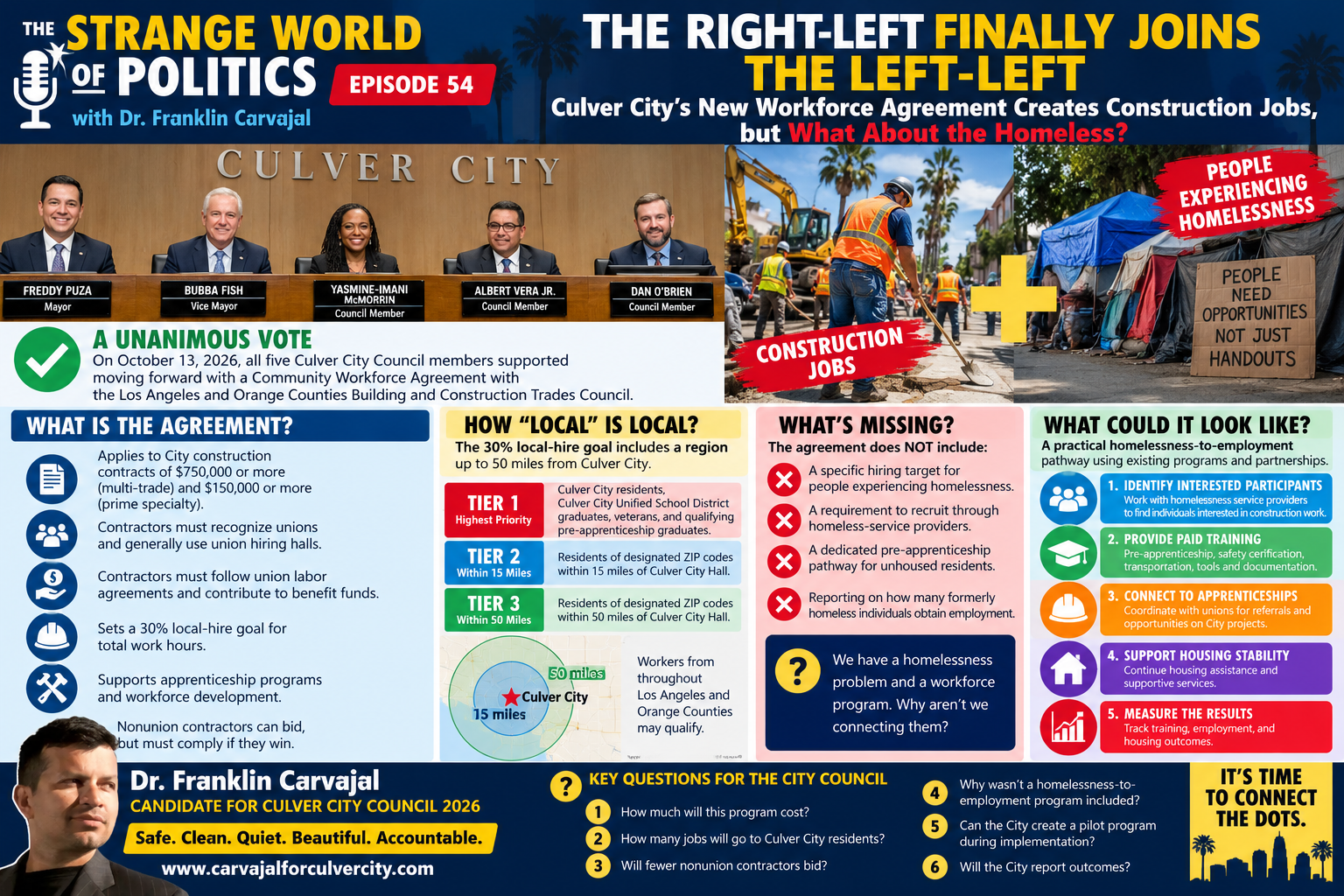
All five Culver City Council members unanimously supported moving forward with a Community Workforce Agreement with the Los Angeles and Orange Counties Building and Construction Trades Council.
Mayor Freddy Puza, Vice Mayor Bubba Fish, and Council Members Yasmine-Imani McMorrin, Albert Vera Jr., and Dan O'Brien all supported the agreement.
For once, there was no apparent ideological divide in the final vote.
The progressive members supported it.
The more moderate members supported it.
Everyone agreed.
And yet, after reading the 44-page agreement, I found myself asking a question that apparently did not prevent any of them from voting yes:
If we are creating employment opportunities through taxpayer-funded construction projects, why didn't we explicitly connect this program to Culver City's homelessness problem?
That is where the strange world of politics begins.
What Exactly Did All Five Council Members Approve?
The Community Workforce Agreement establishes special labor requirements for certain construction projects funded by the City.
It applies to:
Multi-trade construction contracts of $750,000 or more.
Prime specialty construction contracts of $150,000 or more.
Under the agreement, contractors must comply with labor arrangements negotiated with the construction trades unions.
These requirements include recognizing participating unions as exclusive bargaining representatives for covered workers, generally obtaining workers through union hiring halls, following applicable labor agreements, and contributing to designated employee benefit funds.
Nonunion contractors can still compete for City contracts.
However, if they win a covered contract, they must comply with the agreement.
The agreement also restricts how many existing employees a nonunion contractor can bring onto a covered project through its core-worker exception.
Workers are not required to become union members, but contractors must comply with the applicable referral and labor procedures.
These are substantial changes to how some construction companies will operate when performing work for Culver City.
The City says the agreement will promote workforce development, apprenticeships, local hiring, and labor stability.
Those are worthwhile objectives.
But what will they cost?
Will fewer nonunion contractors bid on City projects?
Will the new requirements increase the cost of repairing our sidewalks and streets?
Will Culver City residents actually receive more employment opportunities?
And why was there no specific program connecting these opportunities to people experiencing homelessness?
The Right-Left Suddenly Embraces the Left-Left's Labor Agenda
What makes this decision particularly interesting is the political alignment.
The Left-Left has traditionally favored policies that strengthen organized labor and expand government's role in establishing employment conditions.
A Community Workforce Agreement fits comfortably within that philosophy.
But what about the Right-Left?
Council Members Albert Vera Jr. and Dan O'Brien, whom I place on the more moderate side of Culver City's political spectrum, also supported the agreement.
I am not suggesting that supporting unions is inherently wrong.
Unions have played an important role in improving working conditions, wages, training, and workplace safety.
Nor am I suggesting that moderate Democrats should automatically oppose agreements supported by progressive Democrats.
Good policies can and should attract support across political differences.
But when the Right-Left and Left-Left unanimously support a major labor agreement, residents deserve to understand the reasoning.
Did the Council carefully evaluate the potential financial consequences for taxpayers and small contractors?
Did members examine whether the agreement might discourage nonunion businesses from bidding?
Did they compare the anticipated workforce benefits against potential increases in construction costs?
And did anyone ask whether the agreement could be designed to help address homelessness?
A unanimous vote does not necessarily mean a decision is wrong.
But unanimity should not replace scrutiny.
The public deserves more than five votes in favor.
It deserves a clear explanation of the costs, benefits, and alternatives.
Local Jobs — But How Local?
One of the agreement's central provisions is a goal that 30% of construction work hours be performed by qualifying local hires.
That sounds excellent.
Until you examine how the agreement defines local.
The agreement establishes three geographic priority tiers.
Tier 1: Culver City residents, Culver City Unified School District graduates, veterans, and qualifying pre-apprenticeship graduates. Some individuals qualify regardless of where they reside.
Tier 2: Residents of designated ZIP codes within 15 miles of Culver City Hall.
Tier 3: Residents of designated ZIP codes within 50 miles of Culver City Hall.
Fifty miles!
Imagine telling Culver City residents that we have established a local employment program, only to discover that workers living dozens of miles away can count toward the local-hiring goal.
There may be legitimate reasons to use a regional workforce. Construction requires specialized skills, and Culver City alone may not have enough qualified workers for every project.
But that does not eliminate the need for accountability.
How many of the jobs will actually go to Culver City residents?
How many will go to workers from neighboring cities?
How many will go to individuals who face significant barriers to employment?
And how many will go to people currently experiencing homelessness?
The agreement does not establish a specific homelessness hiring target.
That omission deserves attention.
We Have a Homelessness Problem and a Workforce Program. Why Aren't They Connected?
Culver City has invested substantial public resources in addressing homelessness.
We fund outreach, supportive services, housing initiatives, and other efforts intended to help people achieve stability.
Meanwhile, we also spend public money on construction projects.
We need sidewalks repaired.
We need streets maintained.
We need infrastructure improvements.
We need trained workers to perform these jobs.
Now we have a Community Workforce Agreement intended to promote employment and apprenticeship opportunities.
Yet there is no explicit program in the agreement connecting people experiencing homelessness to those opportunities.
Think about that.
We have one set of City programs helping people experiencing homelessness.
We have another City program intended to develop construction workers.
But we have not established a specific pathway connecting the two.
Why not?
This is exactly the kind of problem that government should be capable of solving through coordination.
Not Everyone Experiencing Homelessness Is Unable to Work
As a psychologist who has spent much of my professional career working with people facing psychiatric, social, and institutional challenges, I understand that homelessness is not a single condition with a single solution.
Some people experience severe psychiatric disorders.
Some struggle with substance use disorders.
Some have physical disabilities or chronic medical conditions.
Others have lost employment, experienced financial hardship, or faced circumstances that made maintaining housing impossible.
Not everyone will be able to enter a physically demanding construction apprenticeship.
But some individuals may be interested, capable, and ready to work if provided with appropriate training and support.
For those individuals, employment can be part of a pathway toward greater stability.
Why would we create a workforce development agreement without specifically considering this population?
What Could Culver City Have Done Differently?
Imagine if the City had included a voluntary homelessness-to-employment initiative as part of implementing the Community Workforce Agreement.
It could work like this.
First: Identify interested participants.
City-supported homelessness service providers could identify individuals interested in construction employment.
Participation would be voluntary and based on each person's interests, capabilities, and circumstances.
Second: Provide paid pre-apprenticeship opportunities.
Participants could receive basic construction training, safety instruction, and assistance obtaining necessary documentation, transportation, tools, and equipment.
Third: Connect participants with union apprenticeship programs.
The City could coordinate with the construction trades to help qualified individuals enter registered apprenticeship programs and union referral systems.
Fourth: Continue housing and supportive services.
Participants could receive assistance maintaining housing stability as they begin employment.
Fifth: Measure outcomes.
The City could track how many participants begin training, complete it, obtain jobs, and remain employed.
This would not solve homelessness by itself.
But it could create a meaningful opportunity for some individuals to move toward economic independence.
And it would connect two public policy objectives that currently appear disconnected in the agreement.
The Agreement Already Contains an Opportunity
Interestingly, the Community Workforce Agreement already includes language that could support such an initiative.
Section 3.5.3 calls for collaboration with local nonprofit organizations and schools to expand employment opportunities.
It also provides a mechanism for qualified referrals through designated City organizations.
Why not use this provision to work with homelessness service providers?
Why not establish a pilot program?
Why not ask the unions to participate?
Why not create a measurable objective and report the results?
The City may not even need to renegotiate the entire agreement to explore this approach.
What it needs is an implementation plan, willing partners, and a commitment to measurable outcomes.
What About the Financial Consequences?
There is another issue that should concern both the Right-Left and Left-Left.
Construction costs.
Culver City already faces significant infrastructure needs.
Residents complain about deteriorating sidewalks, damaged streets, and delayed repairs.
The Community Workforce Agreement introduces additional labor requirements that may affect contractor participation and project costs.
That does not automatically mean every project will become more expensive.
Some agreements of this type may improve labor stability, training, and project delivery.
But those potential benefits should be measured against the costs.
I would like the City to publicly explain:
How much will the agreement cost to administer?
How many nonunion contractors currently compete for City projects?
How might the agreement affect the number of bidders?
What financial analysis was conducted before the unanimous vote?
How many jobs are expected to go specifically to Culver City residents?
Why wasn't a dedicated homelessness-to-employment initiative included?
Could the City establish such a program during implementation?
These are reasonable questions for a City Council that frequently discusses fiscal responsibility, equity, and accountability.
When Everyone Agrees, Who Asks the Difficult Questions?
This is what makes the October 13 vote so interesting.
The Left-Left supported the agreement.
The Right-Left supported the agreement.
The Council unanimously moved forward with a major labor policy affecting City construction projects.
Yet the agreement does not explicitly connect workforce development with one of Culver City's most persistent challenges.
I would have expected the progressive members to ask how the agreement could help people experiencing homelessness.
I would have expected the more moderate members to ask about costs, competition, and measurable returns on public spending.
Ideally, every council member would ask both sets of questions.
Perhaps those issues were discussed during negotiations. If so, the City should explain what was considered and why particular provisions were or were not included.
But the agreement itself does not provide a dedicated homelessness employment pathway.
And that is a missed opportunity worth addressing.
The Strange World of Politics
Culver City's Right-Left and Left-Left finally found something they could all support.
A Community Workforce Agreement.
Five council members.
Five votes in favor.
A new framework for labor relations, hiring, and apprenticeships on covered City construction projects.
A local-hiring goal that can include workers living as far as 50 miles from Culver City Hall.
But no explicit hiring or training pathway for people experiencing homelessness.
I find that contradiction remarkable.
The City wants to help people experiencing homelessness.
The City wants to create construction employment opportunities.
The City wants to develop a skilled workforce.
The City wants to improve its infrastructure.
These goals are not mutually exclusive.
They could reinforce one another.
Yet government too often approaches them as separate programs, each with its own budget, department, consultants, and administrative procedures.
Why aren't we connecting the dots?
I am running for Culver City Council because I believe government should do more than approve programs.
It should coordinate them, measure them, and explain their results to residents.
I do not believe the answer is automatically more spending.
Sometimes the answer is making existing spending work more effectively.
And sometimes the most important question is the one nobody appears to have answered.
If the Right-Left and Left-Left can come together to support a workforce agreement, why can't they come together to connect that agreement to a practical employment pathway for people experiencing homelessness?
That would be an agreement worth celebrating.
And that is the strange world of Culver City politics.
Dr. Franklin Carvajal
Candidate for Culver City Council 2026
Safe. Clean. Quiet. Beautiful. Accountable.
Source: City of Culver City, Community Workforce Agreement with the Los Angeles and Orange Counties Building and Construction Trades Council, October 2026. See particularly Sections 3.1, 3.3, 3.5, 3.8, and 5.2.
Political classifications such as “Right-Left” and “Left-Left” are the author's characterizations of the Council's political tendencies, not official affiliations.
0 Comments
Comments are reviewed before they appear.