
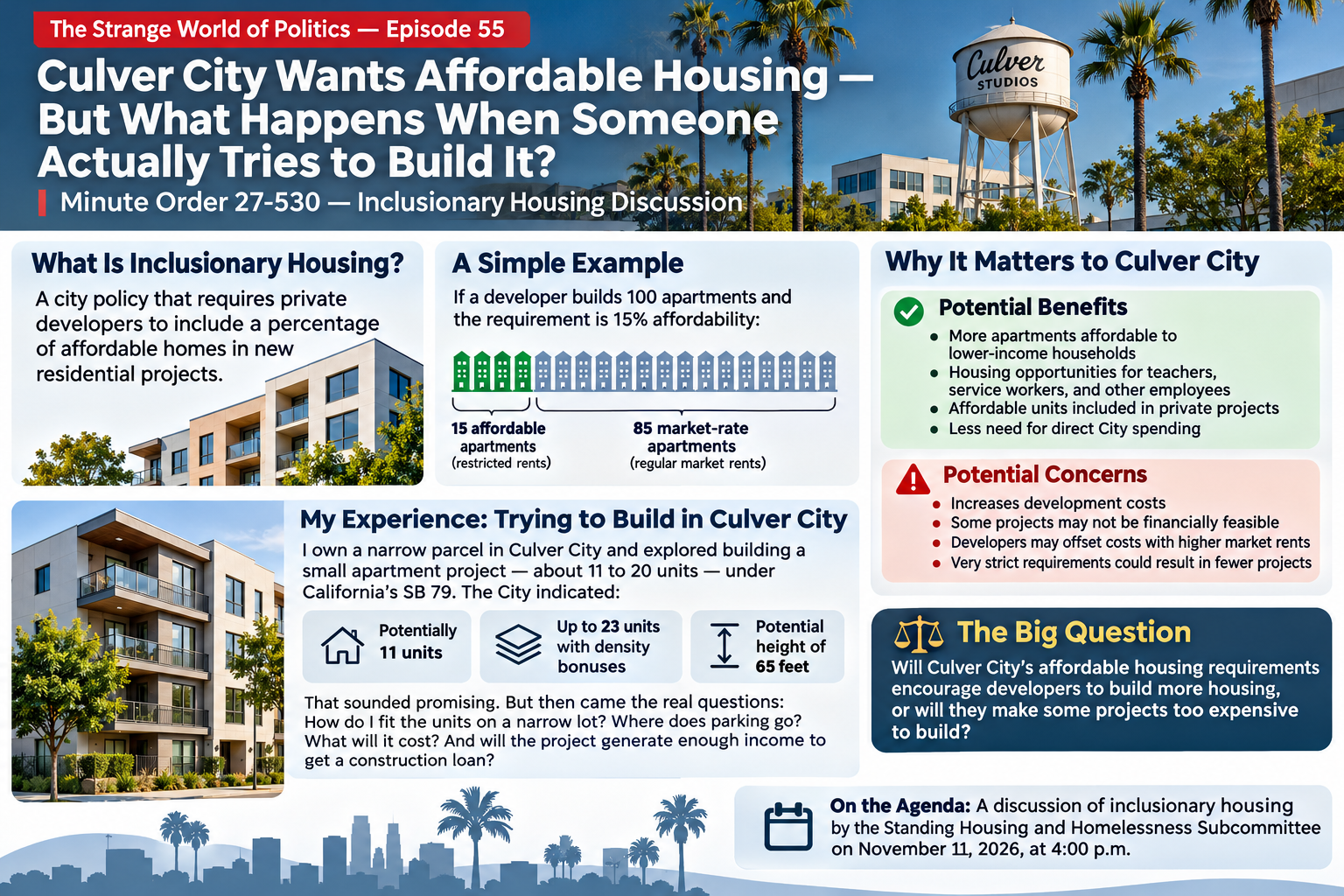
Minute Order 27-530 — Inclusionary Housing Discussion
Culver City wants more affordable housing. Our elected officials regularly discuss the housing crisis, the need for additional apartments, and the importance of making our community accessible to people with different income levels.
These are worthwhile goals.
But there is an important question that rarely receives enough attention:
What happens when a small property owner actually wants to build housing in Culver City?
I can answer that question from personal experience.
My Experience Trying to Build Housing
I own a relatively narrow parcel of land in Culver City. With California's Senate Bill 79 (SB 79), I began exploring whether I could develop the property into a small apartment building.
I was not proposing a massive development. I was exploring a project of approximately 11 to 20 apartments, depending on what the law, property dimensions, and financial feasibility would allow.
After communicating with the City's Planning Division, I received some encouraging information.
Under SB 79, the property could potentially accommodate 11 units. With applicable density bonuses and affordable housing provisions, that number might increase to as many as 23 units.
The City also indicated a potential height allowance of 65 feet.
That sounded promising.
But then came the reality.
How do I fit those apartments on a narrow parcel? Where do cars enter? How much parking is possible? What will architects, engineers, consultants, and attorneys cost? Will a bank finance the project?
And perhaps most importantly, will the finished building generate enough rental income to pay for its construction?
These are not theoretical questions.
They are the questions that determine whether housing actually gets built.
Now the City Is Discussing Inclusionary Housing
On November 11, 2026, Culver City's Standing Housing and Homelessness Subcommittee scheduled a discussion of inclusionary housing under Minute Order 27-530.
Inclusionary housing generally means requiring developers to make a portion of the apartments they build affordable to households meeting certain income limits.
For example, if a developer builds 20 apartments and the applicable requirement is 20%, four apartments might need to be offered at restricted rents.
The intention is understandable: create more affordable housing without requiring the City to construct every apartment itself.
But there is another side to this policy.
What if the developer cannot afford to build the project under those requirements?
Let's Look at a Simple Example
Imagine that I am able to build 11 apartments on my property.
Suppose the applicable inclusionary housing requirement is 20%, which I am using only as an illustration.
Depending on the City's rules, approximately two or three apartments might need to be rented at restricted affordable rates.
That means those apartments would generate less income than comparable market-rate units.
However, the developer still needs to pay for the land, construction, architects, engineers, financing, insurance, maintenance, and property taxes.
Banks also examine whether the anticipated rental income will support the construction loan and the completed building.
If the numbers do not work, the bank may decline to finance the project.
And if the bank declines, the project may never be built.
The result?
Instead of getting 11 apartments, including affordable apartments, Culver City might get zero.
Of course, some projects may qualify for density bonuses, waivers, incentives, or other benefits that improve their financial feasibility. Those possibilities must be evaluated before concluding that an affordable housing requirement makes a project impossible.
The Strange Part of Culver City Politics
Here is what I find particularly interesting.
Our City discusses affordable housing repeatedly. We have committees, consultants, studies, policies, and lengthy public meetings.
Yet when I began exploring a relatively small housing development, I discovered how much responsibility falls on the individual property owner.
I needed to determine what could legally be built, investigate parking and access, consult professionals, estimate costs, and explore financing.
The City provided planning information, which I appreciated. But information about what is legally permissible is not the same as practical assistance in making a project financially feasible.
And the preliminary work can cost thousands of dollars before a developer even knows whether construction financing will be available.
I am not asking the City to guarantee a private investment or finance my project.
I am asking a more fundamental question:
If Culver City genuinely wants additional housing, shouldn't it make the process easier for people who are willing to build it?
Large Developers and Small Developers Are Not the Same
A large developer building 200 apartments may have substantial financial resources, experienced architects, attorneys, and established relationships with banks.
A small developer building 11 apartments does not necessarily have those advantages.
Yet both may face complicated regulations, expensive professional services, lengthy reviews, and uncertain financing.
Policies that work for a 200-unit project may not work for an 11-unit project.
That distinction matters.
If Culver City wants more housing, it should not design its policies exclusively around large developers.
Small property owners can also contribute to the housing supply.
What Should the City Be Discussing?
Rather than simply debating how many affordable apartments developers should be required to provide, I would like the City to answer several practical questions:
How many small housing projects have actually been completed in Culver City during the past five years?
How many proposed projects were abandoned because construction costs, financing, or regulatory requirements made them financially infeasible?
Has the City conducted a financial feasibility analysis specifically for small developments of approximately 10 to 20 apartments?
What assistance can the City provide to small property owners trying to understand density bonuses, affordable housing requirements, parking rules, and financing opportunities?
Could the City establish a coordinated process to help small developers obtain reliable information before spending thousands of dollars on consultants?
Are the City's inclusionary housing requirements calibrated to encourage construction, or could they discourage some projects from proceeding?
These are questions about results, not political ideology.
Affordable Housing Should Be Measured by What Gets Built
There is a difference between announcing an affordable housing policy and actually producing affordable apartments.
A requirement that looks impressive on paper may accomplish little if developers cannot obtain financing.
On the other hand, requirements that are too weak may allow substantial development without producing enough affordable homes.
The challenge is finding a workable balance.
That requires financial analysis, transparency, and an understanding of the practical obstacles faced by both large and small developers.
It also requires listening to property owners who are actually trying to build housing.
My Suggestion to Culver City
I would like the City to consider creating a Small Housing Development Assistance Program focused on projects of approximately 10 to 20 apartments.
Such a program would not need to subsidize private profits.
Instead, it could provide coordinated planning guidance, preliminary feasibility information, explanations of affordable housing incentives, and referrals to available state and federal financing programs.
It could also help developers identify major regulatory obstacles early, before they spend substantial sums on plans that may never become financially viable.
The City could begin by examining whether existing staff and resources could provide these services.
This would be a practical way to encourage housing production without automatically committing additional taxpayer money.
The Final Irony
Culver City wants affordable housing.
California has adopted laws intended to make additional housing possible.
I own property and am exploring whether I can build apartments.
Yet turning that possibility into an actual building remains a complicated and expensive undertaking.
And now the City is discussing requirements that could further affect the financial feasibility of these projects.
Perhaps the most important question for the Housing and Homelessness Subcommittee is not simply how much affordable housing developers should be required to provide.
Perhaps it is this:
How can Culver City make sure that the housing it wants actually gets built?
Because at the end of the day, an affordable housing requirement does not put a roof over anyone's head.
An apartment that actually gets built does.
The Strange World of Politics examines local government decisions, public policies, and the practical consequences they have for Culver City residents.
Dr. Franklin Carvajal
carvajalforculvercity.com
Note: The percentages and development examples above are hypothetical. Minute Order 27-530 identifies a discussion item, not a confirmed change in City policy. The SB 79 figures reflect preliminary planning information and are not project approvals.
0 Comments
Comments are reviewed before they appear.