
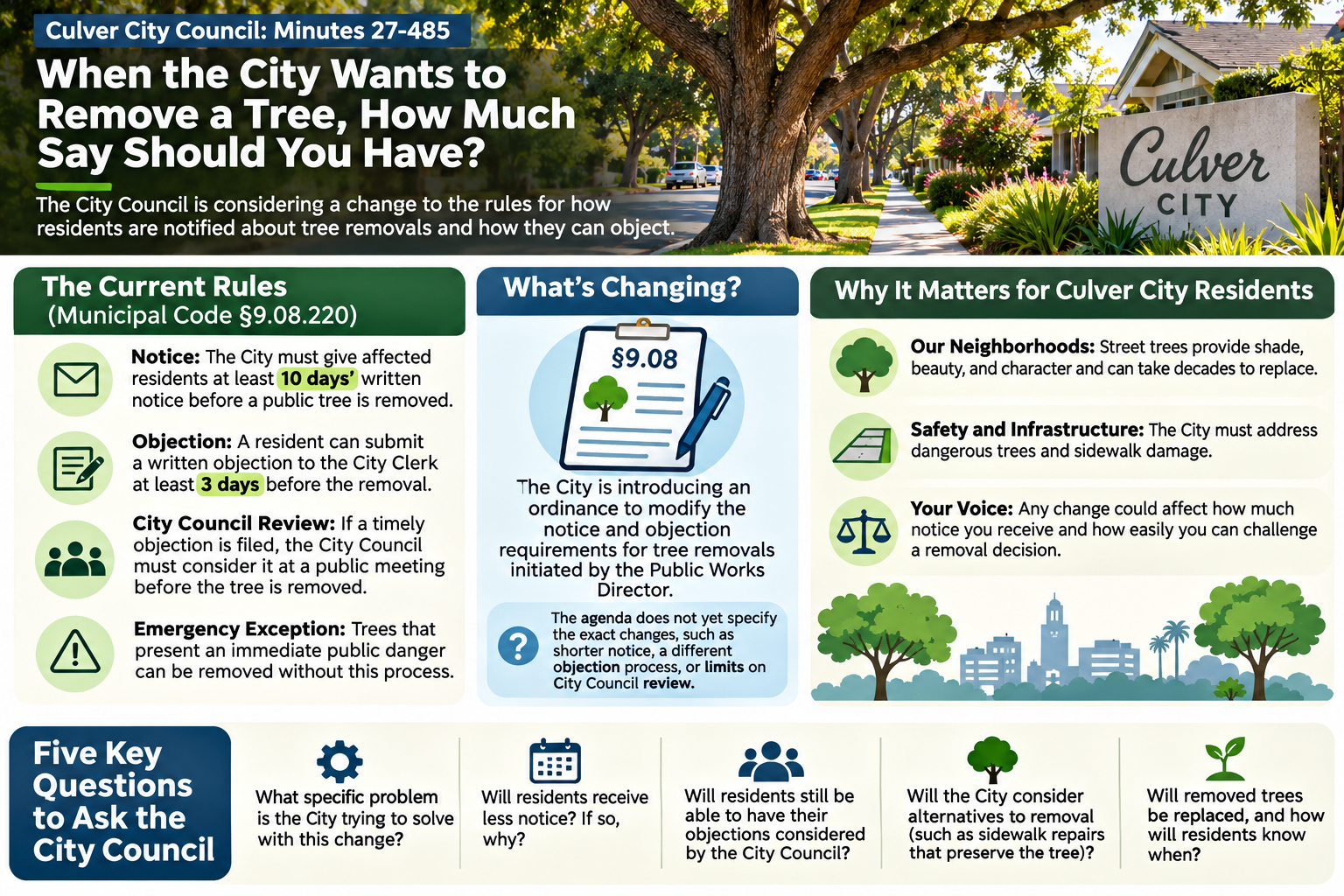
Culver City Council — Minutes 27-485
Imagine waking up one morning and discovering that the City wants to remove a beautiful tree in front of your home.
Perhaps the tree has been there for 30 or 40 years. It provides shade, makes your street attractive, and is part of the neighborhood's character.
The City decides that the tree needs to go.
Naturally, you want to know why. Is it dangerous? Is it diseased? Are its roots damaging the sidewalk? Could the sidewalk be repaired without removing the tree?
Most importantly, do you have the right to object before the City cuts it down?
That is why Culver City Council Item 27-485 deserves attention.
What Is the City Council Considering?
The City Council considered introducing an ordinance amending Culver City Municipal Code Section 9.08 to modify the notice and objection requirements when the Public Works Director initiates the removal of street trees in medians and parkways.
In plain English, the City is considering changing the rules governing how residents are informed about proposed tree removals and how they can challenge those decisions.
A parkway is the strip of land between the sidewalk and the street. A median is the landscaped area separating traffic lanes.
These trees may belong to the City, but they are also part of the neighborhoods where residents live.
What Are the Existing Rules?
Under the existing municipal code, residents ordinarily receive at least 10 days' written notice before a public tree is removed.
Residents who disagree can submit a written objection to the City Clerk at least three days before the scheduled removal.
A timely objection requires City Council consideration before the removal decision is finalized.
There is already an exception for trees that present an immediate danger.
In other words, the existing system recognizes two things: the City has a responsibility to maintain public safety, and residents deserve an opportunity to question decisions affecting their neighborhoods.
Why Does the City Want to Change the Rules?
That is the first question I would ask.
Perhaps the City believes the existing procedures are too slow. Perhaps staff members spend too much time processing objections. Perhaps the City wants greater flexibility to address damaged sidewalks, infrastructure problems, or dangerous trees.
Those could be legitimate administrative concerns.
However, the agenda title alone does not explain the specific changes or demonstrate why they are necessary.
Before residents can evaluate this proposal, the City should clearly explain what is changing, why it is changing, and how the changes will affect their ability to object.
Efficiency is important, but efficiency should not automatically come at the expense of public participation.
A Tree Versus a Sidewalk: Why Not Consider Both?
This issue also raises a broader question about how Culver City maintains its infrastructure.
Many residents are familiar with sidewalks damaged by tree roots.
A raised sidewalk can create a tripping hazard, particularly for older residents, children, and people with disabilities.
The City has a responsibility to address these hazards.
But does fixing a sidewalk necessarily require removing the tree?
Not always.
Depending on the circumstances, alternatives might include redesigning a section of sidewalk, adjusting its alignment, or using other engineering solutions that preserve the tree.
Of course, some trees genuinely need to be removed. A severely diseased tree or one presenting a serious safety risk cannot always be saved.
The point is that residents should understand whether reasonable alternatives were evaluated before a mature tree is removed.
The Bigger Issue: Who Gets to Make the Decision?
This is where the matter becomes particularly interesting.
The Public Works Director is an appointed administrative official, not an elected representative.
That official has technical responsibilities and expertise. It is entirely appropriate for the Director to evaluate public trees and recommend necessary maintenance or removal.
However, when residents disagree with a nonemergency removal decision, should they continue to have access to their elected City Council?
Or should the City make the administrative process easier by limiting opportunities for objections?
We need the precise language of the proposed ordinance to know whether that is what the City intends.
Nevertheless, it is an important question.
Public participation is not merely an administrative inconvenience. It is part of local government accountability.
Five Questions I Would Ask the City Council
Before supporting any changes, I would want clear answers to five questions:
What specific problem exists with the current ordinance? How many tree removals have been delayed by resident objections, and what have those delays cost the City?
Will residents receive less notice? If so, why is the existing 10-day requirement inadequate?
Will residents retain the right to have their objections considered by the City Council? If that right changes, what alternative appeal process will exist?
Must the City consider alternatives before removing a healthy tree? Particularly when the problem involves sidewalk damage rather than an immediate safety threat.
What happens after a tree is removed? Will the City replace it, and how will residents know when replacement planting will occur?
These are reasonable questions. They are not arguments against removing dangerous trees.
They are questions about transparency, accountability, and responsible administration.
My Perspective as a Culver City Resident
I have lived in Culver City for approximately 10 years, and one of the things I appreciate about our community is its neighborhoods.
Trees are part of what makes those neighborhoods attractive and livable.
At the same time, I have repeatedly raised concerns about sidewalk maintenance.
We should not have to choose between safe sidewalks and healthy trees whenever an engineering solution could reasonably preserve both.
And we should not assume that giving City administrators greater flexibility is automatically good or bad.
The real question is whether a proposed change solves a demonstrated problem without unnecessarily reducing residents' rights.
That requires evidence, not simply assurances.
The Strange World of Politics
Here is what I find interesting about this seemingly small agenda item.
Local governments frequently discuss transparency, community engagement, and the importance of listening to residents.
Yet the details of municipal ordinances determine whether those principles actually mean anything.
A change to a notice requirement may sound like a minor administrative adjustment.
But for the resident who wants to save a 40-year-old tree, the difference between having a meaningful opportunity to object and learning about a decision too late can be enormous.
This does not mean the proposed ordinance necessarily reduces residents' rights. The actual amendment must be examined before reaching that conclusion.
It means we should pay attention to the details.
My position is simple: Remove dangerous trees when necessary. Repair unsafe sidewalks. Preserve healthy trees whenever reasonably possible. And give residents a meaningful voice before irreversible decisions are made.
That should not be controversial.
It should be ordinary good government.
The Strange World of Politics is a series examining Culver City government decisions, public spending, transparency, and accountability from the perspective of a resident who believes local government should be understandable to everyone.
Dr. Franklin Carvajal
Clinical Forensic Psychologist | Culver City Resident
Editorial note: This discussion is based on the agenda description for Minutes 27-485 and the previously identified provisions of Municipal Code §9.08.220. The precise proposed amendment and final Council action have not been independently verified. Accordingly, potential reductions in notice or objection rights are presented as questions, not established facts.
0 Comments
Comments are reviewed before they appear.