
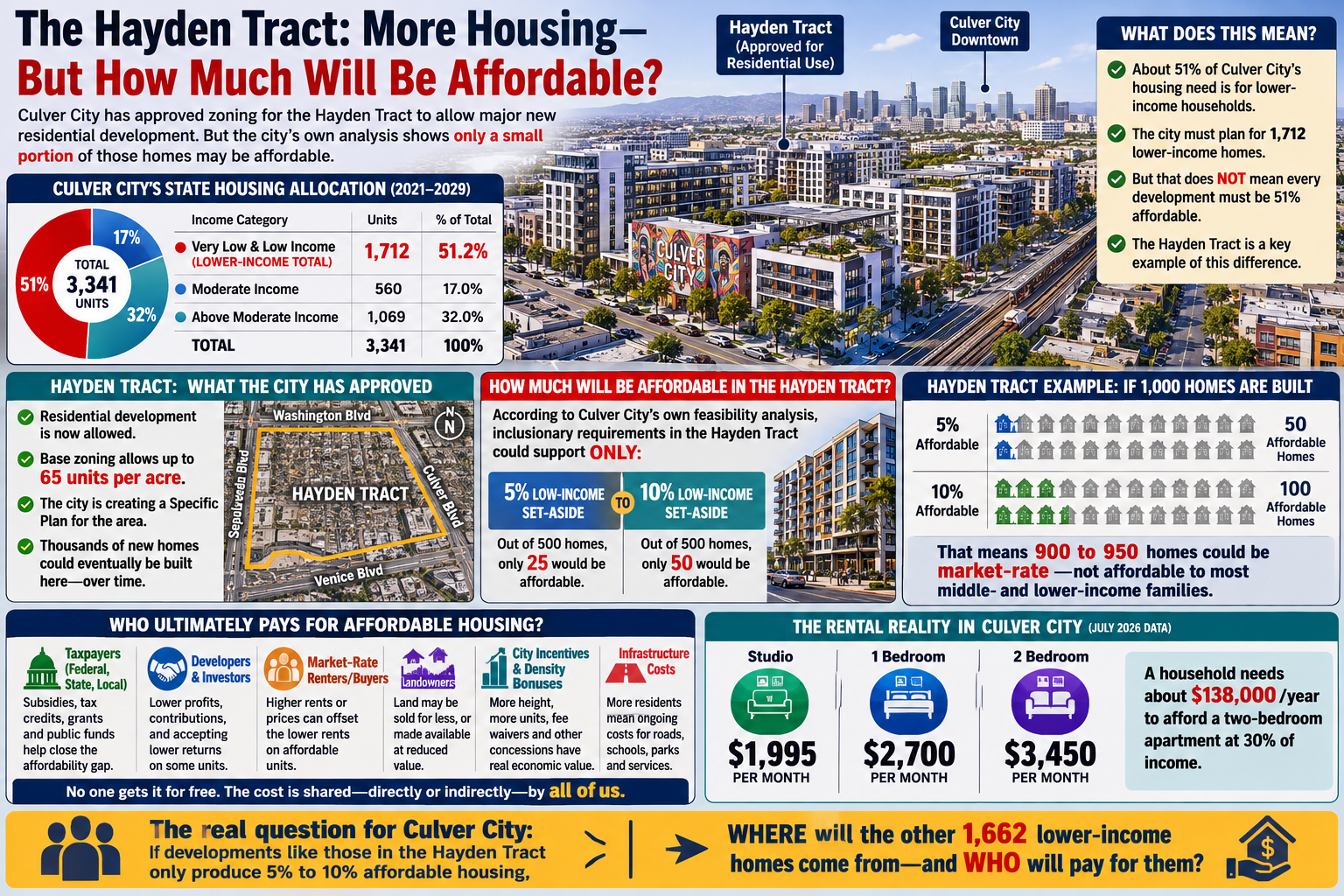
The Hayden Tract provides a particularly useful example of the difference between building more housing and building affordable housing.
Culver City's new General Plan and Zoning Code opened the Hayden Tract—a historically industrial and creative-office district—to residential development. The base zoning allows residential development of up to 65 dwelling units per acre, and the City is developing a Hayden Tract Specific Plan that could permit greater density and taller buildings in portions of the area.
That potentially creates room for a substantial amount of housing where virtually none existed before.
But residents should pay attention to another number.
How much of that housing will actually be affordable?
The City's own inclusionary-housing feasibility study examined whether greater height and density in the Hayden Tract could support an affordable-housing requirement.
According to Culver City staff, the analysis found that the increased densities and heights could likely support a requirement of approximately:
5% to 10% low-income housing.
Think about what that means.
If a hypothetical Hayden Tract development contained 500 apartments, a 5% requirement would produce:
25 affordable apartments.
At 10%:
50 affordable apartments.
The remaining 450 to 475 apartments could generally be market-rate, subject to the particular project's requirements and any additional state or local affordability provisions.
Now compare that with Culver City's overall RHNA allocation.
Approximately 51% of Culver City's state-assigned housing need is allocated to lower-income households.
That does not mean 51% of Hayden Tract housing must be affordable.
In fact, the City's feasibility work suggests something very different: a potential inclusionary requirement in the neighborhood could be closer to 5% or 10%.
That leaves residents with an important question:
If major new housing areas such as the Hayden Tract produce only 5% to 10% lower-income housing, where will the rest of Culver City's lower-income housing come from?
Presumably, other projects will have to contribute substantially more affordable housing if actual production is ever going to approach the City's lower-income RHNA allocation.
Some developments may be 100% affordable.
Others may receive government subsidies.
Some may rely on tax credits.
Others may receive additional density or development concessions in exchange for affordable units.
And some of those costs will ultimately be borne by taxpayers, developers, landowners, market-rate housing economics, or some combination of them.
This is precisely why Culver City's housing debate should not focus exclusively on how many apartments can be built.
Residents should ask:
How many will actually be affordable?
And then:
Who will pay to make them affordable?
The Hayden Tract could eventually produce hundreds—or potentially far more—new homes.
But until actual projects are proposed and approved, we should not claim that a specific number of apartments will be constructed there.
What we can say today is much more revealing:
Culver City is creating substantially greater capacity for housing in the Hayden Tract, while its own analysis indicates that a 5% to 10% low-income set-aside may be financially supportable under the contemplated increased densities and heights.
That is a long way from 51%.
And understanding how Culver City closes that gap—both in housing units and in dollars—may ultimately be one of the most important questions residents should be asking.
0 Comments
Comments are reviewed before they appear.