
This may be one of the most misunderstood parts of Culver City's housing debate.
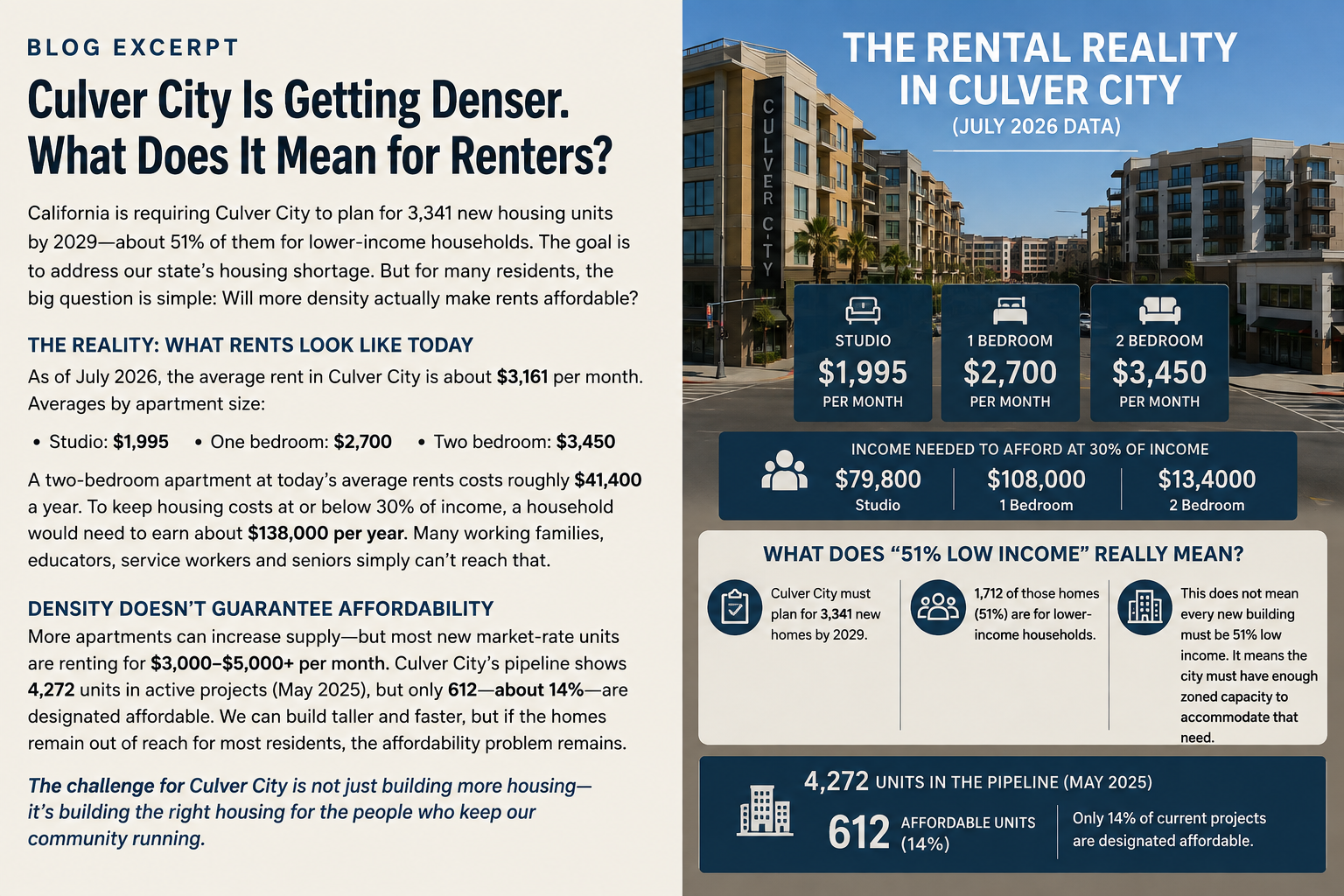
California's housing planning process has assigned Culver City a Regional Housing Needs Allocation, or RHNA, of 3,341 housing units for the 2021–2029 planning period.
But those 3,341 units aren't all treated the same.
The allocation is divided according to household income:
554 extremely-low-income units
554 very-low-income units
604 low-income units
560 moderate-income units
1,069 above-moderate-income units
Put the first three categories together and Culver City has 1,712 units allocated to lower-income households.
That's approximately 51% of the entire 3,341-unit RHNA allocation.
But we need to be precise about what that means.
California Is NOT Saying Every New Apartment Building Must Be 51% Low Income
This distinction is extremely important.
The state is not simply telling a developer who wants to build 100 apartments in Culver City:
"You must make 51 of those apartments low-income."
Instead, RHNA establishes the amount of housing need Culver City must plan for at different income levels.
Culver City must demonstrate through its Housing Element, zoning and inventory of available sites that sufficient realistic capacity exists to accommodate its assigned housing need.
That is considerably different from guaranteeing that 1,712 affordable apartments will actually be constructed.
In fact, Culver City's own Housing Element explains that state law generally considers sites allowing at least 30 dwelling units per acre appropriate for accommodating lower-income housing under the state's methodology, subject to other requirements.
In other words, zoning land densely enough to theoretically accommodate affordable housing can help satisfy the city's planning obligation.
But zoning capacity isn't the same thing as somebody actually financing, constructing and operating an affordable apartment building.
That distinction matters enormously.
What Does "Low Income" Actually Mean?
The phrase "low income" can be misleading because many people hear it and imagine poverty.
That's not necessarily what California's housing terminology means.
California housing programs generally classify households relative to Area Median Income (AMI), with categories that broadly include extremely low, very low, low and moderate income.
And because Culver City is located in Los Angeles County—one of the country's most expensive housing markets—the dollar amounts can surprise people.
For example, under California HCD's 2026 HOME income limits for Los Angeles County, the low-income ceiling at 80% is approximately:
1 person: $93,300
2 people: $106,600
3 people: $119,950
4 people: $133,250
So a family of four earning more than $130,000 per year can fall within a "low-income" threshold under certain affordable-housing programs.
That sounds extraordinary until we compare those incomes with the cost of living in Los Angeles.
It also illustrates why residents should not interpret the phrase "low income" as meaning only unemployed or impoverished households.
Depending on the applicable program and household size, affordable housing can serve working people earning substantial salaries who nevertheless struggle with Southern California housing costs.
Teachers.
Government employees.
Young professionals.
Healthcare workers.
Retail employees.
Restaurant workers.
Single parents.
Seniors living on fixed incomes.
And many other people who work in or around Culver City.
The exact income and rent limits depend on the particular housing program, financing source, household size and applicable rules, so there isn't one universal dollar amount defining every "low-income apartment."
Affordable Doesn't Mean Free Housing
This is another misconception worth addressing.
Affordable housing generally isn't free housing.
Residents still pay rent.
The difference is that eligibility and maximum housing costs are tied to income standards rather than simply whatever rent the private market will bear.
California HCD explains that affordable housing costs for lower-income households are generally structured around approximately 30% of gross household income, with important adjustments and program-specific rules.
Compare that concept with today's Culver City rental market.
If a market-rate two-bedroom apartment rents for around $3,450 per month, that's approximately:
$41,400 per year in rent.
Using the traditional 30% affordability benchmark, a household would need roughly:
$138,000 in gross annual income
to comfortably afford that apartment without becoming housing-cost burdened.
That's where the affordable-housing debate becomes much more understandable.
A household can earn what sounds like a reasonably good salary and still struggle to rent a family-sized apartment in Culver City.
But Here Is the Difficult Question: Who Pays for the Difference?
This is where the conversation about 51% lower-income housing becomes much more complicated.
If an apartment that would rent for $3,500 on the open market must instead rent for substantially less, somebody absorbs that economic difference.
Potential sources can include:
Federal housing programs
California housing programs
County or local subsidies
Tax credits
Public land
Affordable-housing funds
Developer contributions
Inclusionary housing requirements
Density bonuses and other development incentives
Cross-subsidization from market-rate units
Affordable housing therefore doesn't appear simply because a city changes its zoning map.
It has to be financed.
And constructing housing in Culver City is expensive.
Land is expensive.
Labor is expensive.
Materials are expensive.
Financing is expensive.
Insurance is expensive.
Government fees and regulatory compliance add costs.
That creates a legitimate economic question residents should ask:
If roughly half of our state-assigned housing need is for lower-income households, what financial mechanism will actually produce those homes?
The Difference Between Planning for Affordable Housing and Building It
This distinction becomes especially important when looking at Culver City's current development pipeline.
In May 2025, Culver City reported 36 active residential projects totaling 4,272 units.
That sounds impressive.
It exceeds the city's total 3,341-unit RHNA allocation.
But only 612 of those 4,272 pipeline units were designated affordable at that point.
That's roughly 14% of the pipeline.
So Culver City can simultaneously have thousands of housing units in development and still face a substantial challenge meeting the lower-income portion of its housing needs.
That is one of the central contradictions residents need to understand.
We can dramatically increase density without necessarily producing the amount of affordable housing envisioned by the RHNA allocation.
And Culver City Has Been Here Before
There is a reason California has become more aggressive about these requirements.
Culver City's own General Plan materials acknowledge that during the previous Housing Element cycle, the city exceeded its allocation for above-moderate-income housing but produced only about 13% of the housing allocated across the moderate-, low- and very-low-income categories.
That's an important piece of history.
The market was capable of producing expensive housing.
It was considerably less successful at producing housing for households earning less.
That helps explain the state's approach.
But it also raises questions about whether simply allowing much greater density will solve the affordability problem.
There Are Two Very Different Arguments Here
Supporters of greater density make an important economic argument.
Even market-rate housing can help.
If a high-income household moves into a newly constructed $4,500 apartment, that household isn't competing for an older $3,000 apartment somewhere else.
Increasing the total housing supply can therefore reduce competition throughout the housing market.
Under this argument, today's expensive new apartments can eventually contribute to a healthier overall housing market.
There is legitimate economic reasoning behind that position.
But critics raise an equally important practical concern.
If Culver City accepts dramatically taller buildings and substantially greater density while most newly constructed apartments remain unaffordable to middle- and lower-income residents, residents may reasonably ask whether the policy is accomplishing its stated social objective quickly enough.
Both questions deserve consideration.
Perhaps Culver City Should Measure Results, Not Just Density
Instead of debating whether someone is "pro-housing" or "anti-development," Culver City could establish a much simpler test:
Show us the results.
Every year, residents should be able to see:
1. How many new housing units were completed?
2. How many were market-rate?
3. How many were extremely-low-income?
4. How many were very-low-income?
5. How many were low-income?
6. How many were moderate-income?
7. What are the actual rents being charged in the market-rate apartments?
8. What are the rents in the income-restricted apartments?
9. How much public subsidy was required to create the affordable units?
10. How many older, relatively inexpensive apartments were demolished to build the new housing?
Then residents could judge the policy based on evidence rather than ideology.
The Bigger Question for Culver City
California has essentially told communities throughout the state that housing scarcity can no longer be treated solely as a local matter.
For Culver City, the state's allocation says something particularly significant:
Approximately 51% of our assigned housing need is for households in the lower-income categories.
That's not a trivial number.
But residents should understand exactly what it means.
It doesn't mean Sacramento is simply delivering 1,712 affordable apartments to Culver City.
It doesn't mean every new apartment development will contain 51% affordable units.
And it doesn't mean rezoning Culver City for greater density automatically creates affordable housing.
It means the state has determined that a very substantial portion of the city's housing need exists among households earning below the area's higher income levels—and Culver City must plan accordingly.
The harder question is how those homes actually get built.
And that's where the debate should become much more sophisticated.
If we are going to substantially increase Culver City's density in the name of solving a housing crisis, residents deserve to know not merely how many apartments are being approved, but who will actually be able to afford to live in them.
That is the difference between measuring density and measuring housing success.
0 Comments
Comments are reviewed before they appear.