
If you own property in Culver City, you receive a property-tax bill every year.
You probably look at the amount due.
But what exactly are you paying for?
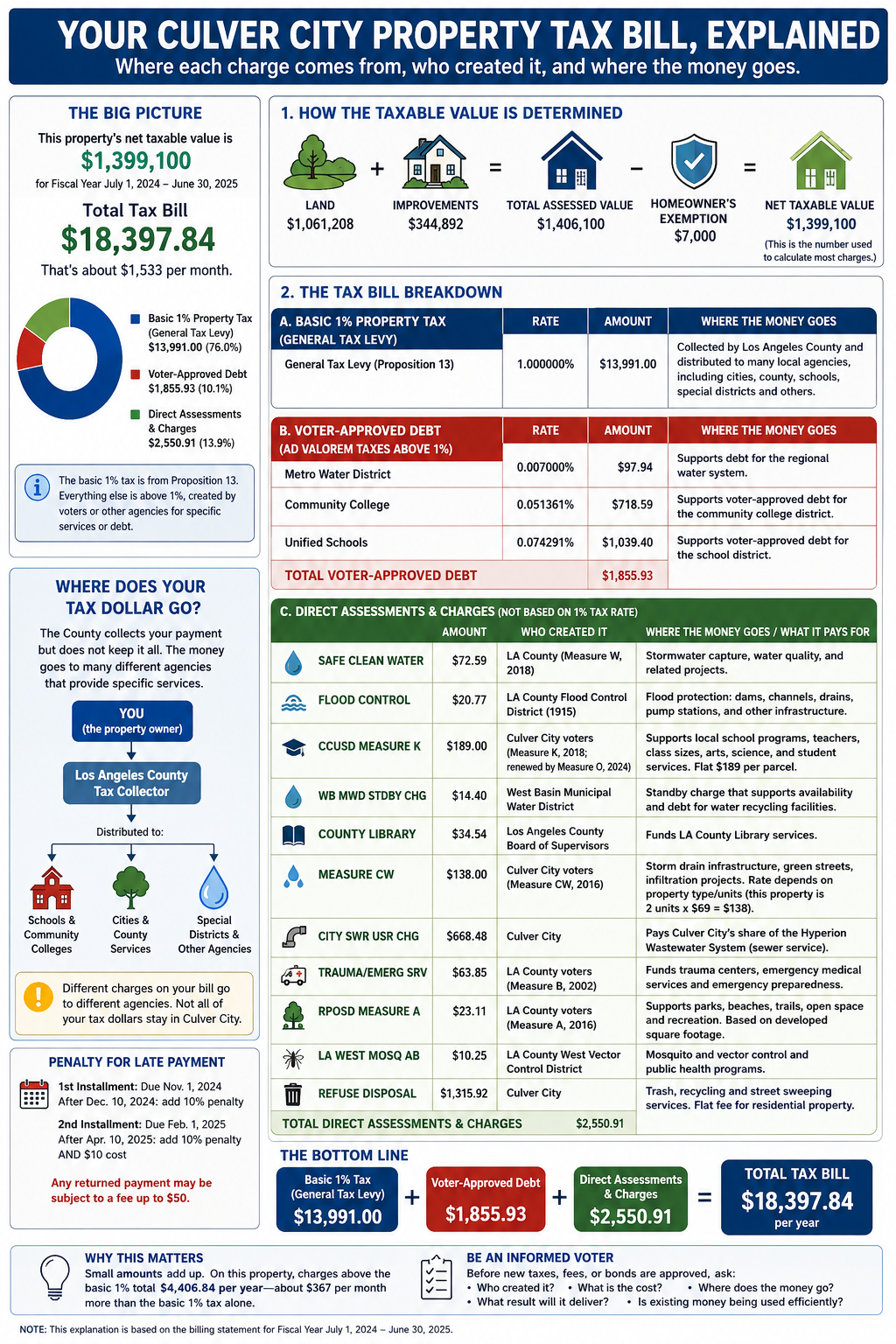
A real Culver City property-tax statement for fiscal year July 1, 2024 through June 30, 2025 shows:
Assessed value of land: $1,061,208
Assessed value of improvements: $344,892
Total assessed value: $1,406,100
Homeowner's exemption: $7,000
Net taxable value: $1,399,100
And the final bill was:
$18,397.84
That works out to about $1,533 per month.
But the bill is not one single tax going to one government.
It is really a collection of taxes, assessments, service charges and voter-approved obligations from numerous government agencies, all collected on the same bill.
To understand where the $18,397.84 goes, we first have to learn a little government vocabulary.
First: What Does "Rate" Mean?
The word rate appears repeatedly on the bill.
A rate tells you how the government calculates the tax.
For example, the basic property-tax rate on this bill is:
1.000000%
That means $1 for every $100 of taxable assessed value.
So if the taxable value were $100,000:
$100,000 × 1% = $1,000
If it were $500,000:
$500,000 × 1% = $5,000
On this property, the taxable value was $1,399,100.
Therefore:
$1,399,100 × 1% = $13,991
But notice something interesting.
Some lines on the bill have a percentage rate.
Others don't.
That's because not every charge is based on the value of your property.
One might be based on the number of housing units.
Another might be based on the square footage of your building.
Another might depend on how much of your property is covered by roofs and pavement.
And another may simply be a flat dollar amount.
We'll explain each one.
What Does "Levy" Mean?
The first line says:
GENERAL TAX LEVY
"Levy" sounds complicated.
It isn't.
To levy a tax simply means to impose or charge a tax.
So a $1,000 tax levy means the government is charging $1,000 in taxes.
What Is a Bond?
This is important because bonds are one reason a property owner can pay more than the basic 1% property tax.
A bond is a way for government to borrow money.
Imagine a school district needs $100 million to renovate schools.
It could wait years and try to save $100 million.
Or it can borrow the money now.
One way it does that is by selling bonds to investors.
The investor essentially says:
"I'll give you money today."
The government says:
"We'll pay you back over time, with interest."
That's basically a bond.
If voters authorize bonds supported by property taxes, property owners can subsequently see additional taxes on their bills to provide money for that debt.
And here's an important distinction:
The amount voters authorize is not necessarily the amount taxpayers ultimately repay.
If a government sells $100 million of bonds, it generally must repay the $100 million principal plus interest and financing costs over time.
Think of a mortgage.
If you borrow $500,000 to buy a house, you don't necessarily pay the bank only $500,000 over the life of the loan.
You repay the money you borrowed plus interest.
Government bonds work on a similar basic principle.
What Is "Voted Indebtedness"?
Now the phrase on the property-tax bill makes more sense.
VOTED INDEBTEDNESS
means voter-authorized governmental debt or obligations for which an additional property-tax levy is being collected.
"Indebtedness" simply means debt.
So now we can read the bill.
1. GENERAL TAX LEVY
Rate: 1.000000%
You paid: $13,991.00
This is the basic Proposition 13 property-tax levy.
The calculation is:
$1,399,100 × 1% = $13,991
Who gets the $13,991?
This is where people sometimes misunderstand their property-tax bills.
Culver City does not simply receive $13,991.
Los Angeles County collects the money and distributes the basic property-tax revenue among eligible local taxing agencies under California's property-tax allocation system.
That includes governmental entities such as the County, cities, schools and special districts.
Think of the County Tax Collector as the cashier.
You make one payment to the cashier.
The money is then divided among different governments.
Now We Get to "Voted Indebtedness"
There are three additional percentage rates on this bill.
Together they add another $1,855.93.
2. METRO WATER DISTRICT
Rate: 0.007000%
You paid: $97.94
Here's how the math works:
$1,399,100 × 0.007% = approximately $97.94
Notice that this rate is much smaller than 1%.
A rate of 0.007% means approximately $7 for every $100,000 of taxable assessed value.
What is this?
This is the Metropolitan Water District of Southern California's ad valorem property tax.
"Ad valorem" is Latin terminology that basically means:
according to value.
In other words, the tax depends on the assessed value of your property.
Where does the money go?
Metropolitan Water District is the regional water wholesaler that helps provide imported water to Southern California.
Its financial documents explain that property-tax authority has historically supported major water-system investments, including the Colorado River Aqueduct, other system improvements and Metropolitan's participation in the State Water Project.
Its budget also explains the relationship between this property tax and debt. State law specifically addresses property taxes needed for Metropolitan's general-obligation bonded indebtedness and its share of bonds financing State Water Project facilities, although Metropolitan's current tax authority and State Water Project obligations make this more complicated than simply calling the entire tax a bond repayment.
In plain English:
Southern California built extremely expensive systems to bring water here.
Those systems were financed in part through long-term obligations.
This property-tax levy helps Metropolitan meet those financial obligations.
3. COMMUNITY COLLEGE
Rate: 0.051361%
You paid: $718.59
Here's what that rate means.
For every $100,000 of taxable assessed value, this property pays approximately:
$51.36
At $1,399,100:
$1,399,100 × 0.051361% ≈ $718.59
Why is this under voter-approved debt?
This is an additional property-tax levy associated with voter-authorized indebtedness of the applicable community college district.
Where does the money go?
Rather than being ordinary operating money for things such as this year's everyday expenses, bond-related revenue and repayment are associated with long-term capital investments authorized under the applicable bond measures.
That can include facilities work such as constructing, modernizing or repairing college buildings and infrastructure, depending on the particular bonds involved.
The tax bill itself does not identify the individual bond issues being serviced, so we should not claim from this document alone exactly which projects this particular $718.59 ultimately supports.
That's an important transparency distinction.
4. UNIFIED SCHOOLS
Rate: 0.074291%
You paid: $1,039.40
This is another percentage applied to taxable assessed value.
For every $100,000 of taxable value, that's approximately:
$74.29
For this property:
$1,399,100 × 0.074291% ≈ $1,039.40
What does the money do?
This line represents voter-approved school indebtedness.
School districts commonly issue bonds to finance long-lived capital improvements—things such as school buildings, classrooms, major renovations, infrastructure and equipment permitted by the applicable bond authorization.
The government gets money upfront from investors.
Then the debt is repaid over time.
Important: This is NOT the same as CCUSD Measure K.
You'll see another school charge farther down:
CCUSD Measure K — $189
These are fundamentally different types of charges.
One relates to voter-approved indebtedness.
The other is a parcel tax supporting school programs and operations.
That difference matters.
What Are "Direct Assessments"?
We now reach the next major section:
DIRECT ASSESSMENTS
The easiest way to understand this section is:
These are additional charges that government agencies place directly on your property-tax bill.
Some are taxes.
Some are assessments.
Some are fees for services.
And unlike the percentage taxes above, many are not based on the assessed value of your house.
5. SAFE CLEAN WATER
You paid: $72.59
This comes from Los Angeles County's Measure W, approved by County voters in 2018.
The rate is:
2.5 cents per square foot of impermeable area.
"Impermeable" simply means water doesn't easily pass through it.
Examples include:
roofs, driveways, concrete, asphalt, sidewalks and pools.
So this tax isn't asking:
"How much is your house worth?"
It's asking something closer to:
"How much surface on this parcel prevents rain from soaking naturally into the ground?"
Where does the money go?
This is particularly interesting because the revenue is divided among programs.
The Safe Clean Water structure directs funding toward regional watershed projects, municipal programs and administration, with major portions going to regional projects and cities for local stormwater programs. The program finances projects designed to capture stormwater, improve water quality, reduce pollution entering waterways and increase local water supplies.
So your $72.59 isn't simply deposited into an unrestricted County account.
It is dedicated to the Safe Clean Water Program.
6. FLOOD CONTROL
You paid: $20.77
This is associated with the Los Angeles County Flood Control District.
How is it calculated?
The Flood Control District has described its benefit assessment as being based on estimated stormwater runoff from individual parcels.
Where is the money spent?
The District says assessment revenue helps pay for:
operating and maintaining the flood-control system, responding to storms and flooding emergencies, rehabilitating dams and other infrastructure, removing sediment from debris basins and reservoirs, and complying with regulatory requirements.
So this $20.77 helps maintain the regional infrastructure intended to keep stormwater moving and reduce flood risk.
7. CCUSD MEASURE K
You paid: $189.00
This is a parcel tax.
Unlike the percentage taxes above, the value of the house does not determine this particular charge.
Measure K established a flat:
$189 per parcel per year.
Culver City voters approved it in 2018. Measure O, approved in 2024, continued the $189 annual parcel tax for another eight years.
Where is this money spent?
CCUSD has identified uses including:
attracting and retaining teachers, maintaining smaller class sizes, math, science, engineering and technology programs, art and music, services for students with special needs, and college and career preparation.
Is this a bond?
No.
That's a crucial distinction.
A bond gives the government borrowed money upfront and creates debt that must be repaid.
A parcel tax raises tax revenue each year.
So:
Bond = borrow now and repay later.
Parcel tax = collect tax revenue as it comes in.
8. WEST BASIN MWD STANDBY CHARGE
You paid: $14.40
This goes to the West Basin Municipal Water District.
A "standby charge" helps support water infrastructure being available to serve properties.
Where is it spent?
West Basin's financial reporting has specifically explained that standby-charge revenue, together with certain other revenues, has been used to pay debt incurred to construct and improve its recycled-water facilities. West Basin also reported that much of its bond issuance historically financed recycled-water projects.
So here we have another connection to bonds.
Infrastructure gets built.
Money is borrowed.
The debt must subsequently be serviced.
This charge is one revenue source connected to that financing structure.
9. COUNTY LIBRARY
You paid: $34.54
This is associated with the Los Angeles County Library system.
In practical terms, library funding supports the operation of the County library system—libraries, collections, programs and related services.
The tax bill itself, however, doesn't tell us how this specific $34.54 is allocated among individual library expenditures.
That's another distinction worth making: knowing which agency receives a charge doesn't necessarily tell us which specific employee, book, building or program your individual dollars paid for.
10. MEASURE CW
You paid: $138.00
This is a Culver City tax.
Voters approved Measure CW in 2016.
For multi-family residential property, the original rate was:
$69 per dwelling unit.
The bill shows $138.
That's consistent with:
2 units × $69 = $138.
Measure CW also established other rates, including $99 for a single-family residential parcel and $1,096 per acre or portion thereof for nonresidential property.
Where does it go?
Measure CW is dedicated to Culver City's safe and clean water purposes.
The measure authorizes spending related to stormwater and urban runoff, including water-quality improvements and infrastructure.
Is it a bond?
No.
This is a special parcel tax, not the same thing as government borrowing through bonds.
11. CITY SEWER USER CHARGE
You paid: $668.48
This is easier once we translate the abbreviation:
CITY SWR USR CHG = City Sewer User Charge.
This isn't a general property tax.
It is a charge associated with providing sewer/wastewater service.
Wastewater from Culver City ultimately has to be transported and treated.
So this revenue supports the wastewater system rather than being ordinary unrestricted tax revenue.
In plain English:
You're helping pay for the system that takes wastewater away and gets it treated.
The property-tax statement itself establishes the $668.48 charge but doesn't provide a detailed expenditure breakdown for that money.
12. TRAUMA/EMERGENCY SERVICES
You paid: $63.85
This comes from Los Angeles County Measure B, approved by voters in 2002.
It funds the County's trauma and emergency medical system.
And we can actually see where this money goes.
For fiscal year 2024–25, County financial reporting shows Measure B expenditures supporting County hospitals, non-County trauma hospitals, physician services for indigent patients, air ambulance and search-and-rescue services, public-health preparedness and trauma-prevention activities.
For example, County reporting shows Measure B funding going to facilities including LA General Medical Center, Harbor-UCLA Medical Center and Olive View-UCLA Medical Center, as well as other trauma-system expenditures.
So this line is a good example where we can trace the tax beyond simply saying "emergency services."
13. RPOSD MEASURE A
You paid: $23.11
RPOSD means:
Regional Park and Open Space District.
Los Angeles County voters approved Measure A in 2016.
For fiscal year 2024–25, the applicable rate was 1.81 cents per square foot of structural improvements.
Notice again:
This isn't based on the assessed dollar value of your house.
It is based on developed/structural square footage.
Where is the money spent?
Measure A funds can support:
parks, beaches, trails, recreation facilities, open space, water conservation, park improvements and related programs.
The Regional Park and Open Space District distributes significant amounts through grants to cities and other eligible organizations for park development and improvements.
So some of the money collected countywide eventually returns to local communities through grants and allocations.
14. LA WEST MOSQUITO ABATEMENT
You paid: $10.25
This is a vector-control charge.
A vector is an organism capable of transmitting disease.
Mosquitoes are the obvious example.
The money supports mosquito and vector-control activities such as surveillance, treatment and public-health work.
The bill identifies the amount and responsible agency, but it doesn't provide a detailed breakdown of how this individual $10.25 was spent.
15. REFUSE DISPOSAL
You paid: $1,315.92
"Refuse" means:
Garbage or trash.
This is a Culver City service charge associated with refuse collection and disposal.
In practical terms, this supports the system for handling trash and related sanitation services rather than simply going into the same pot as ordinary property-tax revenue.
And notice the size of it:
$1,315.92
That's actually larger than several of the taxes and assessments above combined.
Now Let's Put the Entire Bill Together
The basic 1% property tax was:
$13,991.00
The three voter-approved indebtedness rates added:
$1,855.93
The direct assessments and service charges added:
$2,550.91
Therefore:
$13,991.00 + $1,855.93 + $2,550.91 = $18,397.84
That is the total shown on the actual bill.
Another useful way of looking at it is this:
The amount above the basic 1% levy was:
$4,406.84
or approximately:
$367 per month.
Taxes, Assessments, Fees and Bonds Are Not the Same Thing
This may be the most useful takeaway from the entire bill.
When people say:
"My property taxes are $18,398,"
they are really describing several different financial mechanisms collected together.
Property tax
A tax based on the assessed value of property.
Parcel tax
A special tax imposed on parcels according to the formula approved for that tax. It doesn't necessarily depend on the property's dollar value.
Assessment
A charge associated with a particular governmental purpose or benefit, calculated according to the rules governing that assessment.
User fee or service charge
Money charged for providing a particular service, such as sewer or refuse service.
Bond
Borrowed money.
The government receives money from investors and promises to repay the principal plus interest.
Bond tax or debt levy
A tax collected to help make payments associated with voter-authorized governmental debt.
These differences matter because the money can legally be used in very different ways.
One Property-Tax Bill, Many Governments
So when you write a check to the Los Angeles County Tax Collector, don't picture all $18,397.84 going into one giant County bank account.
A better picture is:
PROPERTY OWNER
↓
LOS ANGELES COUNTY COLLECTS THE BILL
↓
Money is distributed according to law to different agencies and purposes:
Schools
Culver City
Los Angeles County
Community colleges
Metropolitan Water District
West Basin Municipal Water District
Flood Control District
Regional Park and Open Space District
Vector-control services
and other agencies
And within those agencies, some money pays for current services, while other money supports long-term infrastructure or debt obligations created when government borrowed money.
That is why a one-page property-tax statement can contain the financial history of decisions made by different governments and different groups of voters over many years.
The $18,397.84 at the bottom is simply where all of those decisions finally meet.
0 Comments
Comments are reviewed before they appear.